

OpenAI Dots Faces European Availability Limits as AI Agents Expand
Table of Contents
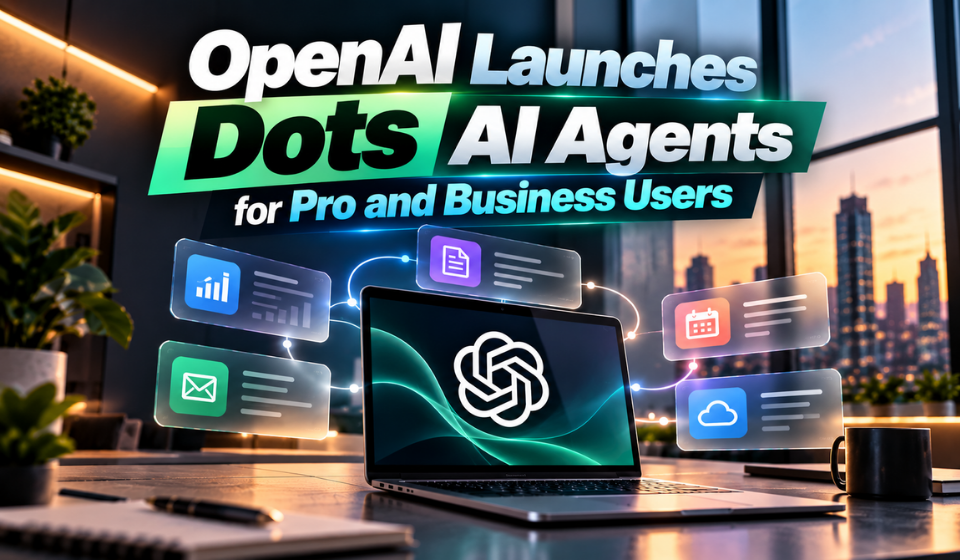
OpenAI Dots is one of OpenAI’s latest moves toward AI agents that can take on ongoing tasks rather than simply respond to individual prompts. Introduced at DevDay 2026, Dots are designed to work through their own cloud computers, connect with applications and continue working between conversations.
However, the rollout is not global. At launch, Pro users in the European Economic Area, Switzerland and the UK are excluded from Dots. Business Premium users have broader access across supported ChatGPT regions, while Enterprise users can access a beta when their administrator enables it.
What Is OpenAI Dots?
OpenAI Dots are always-on AI agents built into ChatGPT. OpenAI says they are powered by GPT-6 Astra and operate through their own cloud computer.
Instead of requiring users to remain in a conversation while a task is completed, Dots are designed to continue working toward an assigned goal. They can connect with applications and use digital tools to complete different stages of a task.
OpenAI says Dots can connect to more than 4,000 apps, giving them access to a broad range of potential workflows.
How OpenAI Dots Work
Users can assign a task to a Dot and provide access to the applications needed to complete it.
The agent can then work through the task and continue making progress between conversations. This approach is different from traditional chatbot use, where the user generally provides a prompt and waits for a response before deciding what to do next.
The exact capabilities depend on the applications connected to the Dot and the permissions granted by the user.
OpenAI also provides controls for managing what an agent can access and what actions it can perform independently.
OpenAI Dots Availability in Europe
The biggest limitation at launch concerns Pro subscribers.
OpenAI’s published release information states that Pro access to Dots excludes the EEA, Switzerland and the UK at launch. This does not mean that Dots are universally unavailable to every user or business in those markets.
Business Premium users have broader access across supported ChatGPT regions. Enterprise users can also access a beta when their workspace administrator enables the feature.
The rollout is gradual, so even eligible users may not receive access immediately.
OpenAI Has Not Confirmed a Specific Regulatory Cause
The regional restriction has generated discussion about European technology regulation. However, OpenAI’s published documentation confirms the regional availability limits without identifying a particular European law as the direct reason for the restriction.
European AI products can be affected by rules covering privacy, digital platforms and artificial intelligence. These considerations can be particularly relevant for AI agents that interact with external services and potentially handle personal or business information.
However, it would be misleading to state that the EU has banned Dots or that a specific regulation directly caused the launch restriction without confirmation from OpenAI.
For now, the confirmed information concerns where Dots are available and which subscription levels can access them.
AI Agents Are Becoming a Major Focus
The launch of OpenAI Dots comes as major technology companies increasingly develop AI agents capable of performing tasks.
Meta has been developing Muse, its personal AI agent, while other companies are also working on systems that can interact with websites, applications and digital services.
This represents a shift from conversational AI toward task-based systems. Instead of simply asking an AI for information, users can assign a goal and allow the system to complete multiple steps.
The approach could eventually affect areas such as research, software development, business operations and personal productivity.
What Can OpenAI Dots Do?
OpenAI’s Dots are designed for ongoing tasks and can work with connected applications.
Potential use cases include:
- Research and information gathering
- Data analysis
- Coding and software-related work
- Recurring tasks
- Working across connected applications
- Preparing results for users to review
The actual capabilities depend on the applications available to the agent and the permissions provided by the user.
Privacy and User Control
The increased autonomy of AI agents also makes access controls important.
Unlike a basic chatbot, an agent can potentially interact with multiple services and maintain context while working on a task. Users therefore need to consider which applications they connect and what permissions they provide.
OpenAI provides controls that allow users to manage agent access and actions. Human review also remains important when tasks involve sensitive information or decisions.
As AI agents become more capable, privacy, security and oversight will remain important parts of their development.
OpenAI Dots vs Traditional ChatGPT
| Feature | Traditional ChatGPT | OpenAI Dots |
| Main use | Conversations and individual tasks | Ongoing assigned work |
| Operation | Primarily responds to prompts | Can continue working between conversations |
| Cloud computer | Not the defining feature | Uses its own cloud computer |
| App connections | Available through supported tools | Designed to work across connected apps |
| Ongoing tasks | Limited | Central to the product |
| User controls | Prompt and tool permissions | Agent permissions and controls |
The main difference is that Dots are designed to take responsibility for a task and continue working toward the user’s goal.
What Happens Next?
OpenAI has not announced a confirmed date for expanding Pro access to the EEA, Switzerland or the UK.
For now, Dots are gradually rolling out in supported markets. Business Premium and Enterprise users have different access arrangements from Pro subscribers.
The availability situation could change as OpenAI expands the service.
FAQs
What is OpenAI Dots?
OpenAI Dots are always-on AI agents inside ChatGPT designed to handle ongoing tasks and continue working between conversations.
Is OpenAI Dots available in Europe?
Pro access currently excludes the EEA, Switzerland and the UK at launch. Business Premium has broader regional availability.
Has the EU banned OpenAI Dots?
No. It would be inaccurate to describe Dots as banned across the EU. OpenAI has instead excluded Pro users in the EEA from the initial rollout.
Why are European Pro users excluded?
OpenAI has confirmed the regional limitation but has not publicly identified one specific European regulation as the direct reason.
Can businesses use OpenAI Dots in Europe?
Business Premium has broader availability across supported regions, while Enterprise users can access a beta when enabled by their administrator.
What model powers OpenAI Dots?
OpenAI says Dots are powered by GPT-6 Astra.
Conclusion
OpenAI Dots mark another step toward AI agents that can perform ongoing work instead of simply answering individual prompts.
The agents can operate through their own cloud computers, connect with applications and continue working between conversations. However, access currently varies by region and subscription.
At launch, Pro users in the EEA, Switzerland and the UK are excluded, while Business Premium has broader availability and Enterprise users can access a beta under administrator control.
The reason for this regional difference should not be attributed to a specific European regulation without confirmation from OpenAI. For now, the key development is the emergence of Dots as part of OpenAI’s broader push toward task-oriented AI agents.