

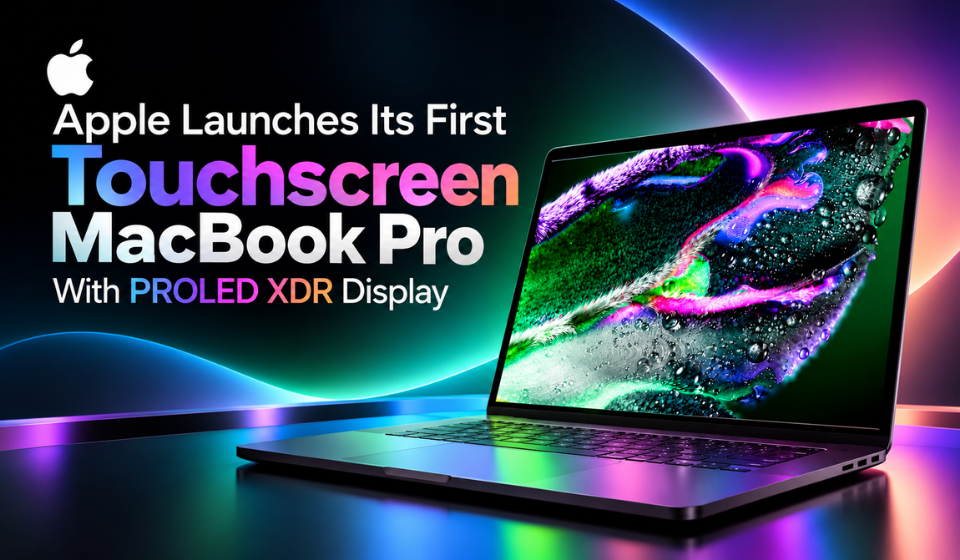
Apple Launches First Touchscreen MacBook Pro With PROLED XDR Display and M5 Chips
Table of Contents
Apple has unveiled a major upgrade to its professional laptop lineup with the launch of the Touchscreen MacBook Pro on October 28, 2026. The new model introduces touchscreen functionality alongside enhanced processing power and an advanced display designed to support demanding creative and professional tasks.
The announcement introduces 14-inch and 16-inch configurations featuring M5 Pro and M5 Max processors. Apple has also made adjustments to the laptop’s construction, software experience, and multimedia features.
One of the most interesting aspects of the launch is Apple’s decision to introduce touch controls without moving away from the traditional MacBook format.
A New Way to Interact With Mac Applications
The introduction of touchscreen functionality changes how certain activities can be performed on a MacBook.
Instead of relying entirely on a trackpad, users can interact with compatible content directly through the display.
This may be useful when examining detailed illustrations, working with digital objects, or navigating applications that benefit from physical interaction.
Professionals working with 3D designs could use touch gestures to interact with objects, while music producers may be able to control virtual instruments directly on the display.
These features offer additional ways to interact with applications, although their practical benefits will depend on software compatibility.
The keyboard and trackpad continue to support tasks that benefit from traditional desktop controls.
Understanding Apple’s New PROLED XDR Display Technology
The display is another significant upgrade in the latest MacBook Pro.
Apple’s new PROLED XDR display uses tandem OLED technology, which combines multiple light-emitting layers to improve brightness and visual performance.
Unlike conventional backlit screens, OLED displays allow each pixel to generate its own light, enabling deeper blacks, improved contrast, and more precise image reproduction.
This provides greater control over dark and bright areas of an image.
Apple has also introduced methods intended to improve brightness consistency and reduce reflections within the panel.
Each display undergoes factory calibration to help maintain consistent visual output across manufactured devices.
These improvements could benefit creative professionals who require accurate colours and detailed visuals.
Enhanced Brightness, Colour and Refresh Rates
Apple’s PROLED XDR display offers up to 2,000 nits of peak HDR and SDR brightness, a 10,000,000:1 contrast ratio, and variable refresh rates reaching 120Hz.
Support for P3 and Adobe RGB colour spaces makes the screen suitable for photography, graphic design, and video editing. These features could improve colour accuracy, motion smoothness, and visibility in bright and dark scenes, although results will vary depending on content and viewing conditions.
M5 Pro and M5 Max Deliver Improved Performance
The new MacBook Pro features Apple’s M5 Pro and M5 Max processors, designed for demanding tasks such as video editing, graphics rendering, and software development.
Selected configurations offer up to 128GB of unified memory and 16TB of storage, supporting large projects and intensive workflows.
Apple also highlights improved AI processing capabilities, with actual performance depending on the applications and hardware configuration.
Dynamic Island Arrives on MacBook Pro
Apple has introduced Dynamic Island to the MacBook Pro, providing an interactive area for notifications, system activities, and selected controls.
Dynamic Island integrates with Spotlight, Live Activities, and Siri AI, making it easier to view updates and access certain functions while working. However, the experience may vary depending on application support and user preferences.
Lighter Design and Upgraded Audio Features
Apple has made the latest MacBook Pro slimmer and lighter, improving its convenience for users who work on the move.
The laptop offers up to 24 hours of claimed battery life and includes a 12MP Center Stage camera, studio-quality microphones, and a six-speaker sound system that Apple says delivers 50% deeper bass.
These upgrades could benefit remote workers, content creators, and professionals who regularly attend virtual meetings. Battery life will depend on individual usage and operating conditions.
macOS 27 and Connectivity
The new MacBook Pro runs macOS 27, introducing touchscreen support alongside updated Apple Intelligence capabilities.
Users can combine touch gestures with traditional keyboard and trackpad controls, while Thunderbolt 5 supports compatible external displays, storage devices, and professional accessories.
These features provide flexibility for both portable and desktop working environments.
Release Date and Availability
Preorders for Apple’s new Touchscreen MacBook Pro began on October 28, 2026, ahead of its official release on November 6.
The lineup includes 14-inch and 16-inch versions, with a range of processor, memory, and storage options designed to accommodate different workloads and user needs.
Conclusion
Apple’s latest MacBook Pro introduces a new approach to professional computing, bringing touchscreen functionality alongside the PROLED XDR display, M5-series chips, Dynamic Island, and macOS 27.
The updated hardware and software aim to support more flexible and efficient workflows. While these advancements expand the laptop’s capabilities, their overall value will depend on how effectively users and applications take advantage of them.