
DeepSeek V4 Pro Launches With Agent Framework and Higher API Prices
Table of Contents
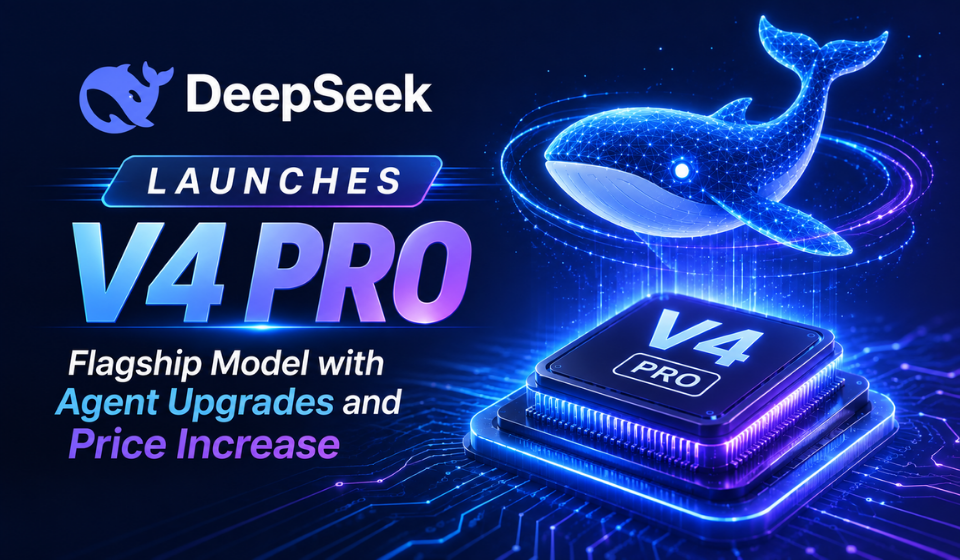
DeepSeek has moved its flagship DeepSeek V4 Pro model from preview into general availability, introducing a production version known as V4 Pro 0813 alongside an open-source agent framework and a major change to its API pricing strategy.
The 1.6-trillion-parameter model is available through DeepSeek’s applications and API, marking the end of a preview period that began in April. The release is aimed particularly at agentic workloads, including coding, cybersecurity and other tasks requiring multiple steps and tool use. Recent reporting confirms that the 0813 version replaced the earlier preview build.
The launch is significant because DeepSeek has historically built much of its reputation around extremely low-cost AI access. The new pricing structure represents a substantial change in that strategy.
DeepSeek Reports Major Agent Performance Improvements
DeepSeek says the production version delivers substantial improvements on several agent benchmarks without changing the underlying model architecture.
According to the company’s reported results, Terminal-Bench 2.1 increased from 72.1 to 87.9, while CyberGym rose from 52.7 to 83.3. DeepSWE, another software-engineering benchmark, reportedly increased from 12.8 to 62.7.
DeepSeek attributes the improvements primarily to additional post-training.
However, these figures should be treated as vendor-reported results rather than independently verified performance. Independent testing has not yet fully established whether the model consistently achieves the same results across real-world workloads.
DeepSeek’s own comparison also places V4 Pro close to Anthropic’s leading model on Terminal-Bench, but that comparison should not be interpreted as an independently established overall ranking.
DeepSeek Harness Targets Claude Code and Codex
One of the most important parts of the announcement is DeepSeek Harness, an open-source framework for developing AI agents.
Released under the MIT licence, Harness uses a plugin-based architecture designed to make different parts of an agent system inspectable and replaceable.
The project quickly attracted substantial attention on GitHub, reportedly reaching around 20,000 stars within its first hour and continuing to grow rapidly afterward.
Harness puts DeepSeek into more direct competition with proprietary coding-agent products such as Anthropic’s Claude Code and OpenAI’s Codex.
Instead of competing only through an AI model, DeepSeek is increasingly providing developers with infrastructure for building and running autonomous agents.
DeepSeek Raises API Prices
The biggest change for developers may be the new DeepSeek API pricing structure.
DeepSeek introduced peak and off-peak billing for its V4 models. Under the new structure, V4 Pro output pricing rises from the previous $0.87 per million tokens to $1.98 during off-peak periods and $3.96 during peak periods.
The peak rate represents a substantial increase over the previous price. Reuters reported that the broader V4 pricing changes range from approximately 50% to 1,100%, depending on the model, token category and time of use.
Cached-input pricing is particularly affected, making the change potentially important for applications that repeatedly process large amounts of context.
Despite the increases, DeepSeek remains considerably cheaper than several major Western alternatives.
Why the Pricing Change Matters
DeepSeek’s low prices were central to its disruption of the AI market. The new approach suggests the company is placing greater emphasis on balancing demand, infrastructure costs and long-term sustainability.
The peak-hour schedule may also provide clues about usage patterns, although the pricing windows alone do not prove where most DeepSeek customers are located.
Third-party traffic data cited in the supplied report indicates that China represents a much larger share of DeepSeek’s desktop visitors than the United States. That provides useful context, but it should not be treated as definitive evidence of the reason behind DeepSeek’s pricing schedule.
DeepSeek Builds a Broader AI Business
The pricing reset comes as DeepSeek expands its broader AI infrastructure.
The company reportedly raised approximately $7.4 billion in its first outside funding round in June and is developing a gigawatt-scale data centre in Inner Mongolia.
These investments highlight the infrastructure requirements associated with operating increasingly capable AI models and agent systems.
From Cheap Models to a Full AI Stack
The combination of DeepSeek V4 Pro, Harness and revised API pricing represents a broader strategic shift.
DeepSeek is no longer competing solely by offering the cheapest access to capable AI models. It is building a wider ecosystem that includes a flagship model, agent development infrastructure and commercial API services.
That strategy places the company in competition not only with individual models from Anthropic, OpenAI and other providers, but also with their surrounding developer ecosystems.
Key Takeaways
- DeepSeek V4 Pro 0813 has moved from preview to general availability.
- DeepSeek reports major gains on several agent and coding benchmarks.
- The reported benchmark improvements have not been independently verified.
- DeepSeek released the MIT-licensed Harness agent framework.
- Harness targets the growing market for coding and autonomous AI agents.
- V4 API prices have increased substantially under peak and off-peak billing.
- DeepSeek remains cheaper than many competing frontier AI services.
- The company is investing heavily in computing infrastructure.
- The strategy increasingly combines models, APIs and agent-development tools.
Conclusion
The launch of DeepSeek V4 Pro marks a significant change in the company’s position within the AI market. The model moves beyond its preview phase with stronger reported agent performance, while the new Harness framework gives developers an open-source alternative for building AI agents.
At the same time, DeepSeek’s substantial API price increases mark a departure from the ultra-cheap pricing strategy that helped make the company one of the industry’s biggest disruptors.
The combination of improved models, open-source agent infrastructure and higher but still competitive pricing suggests DeepSeek is moving toward a broader AI platform strategy. Rather than competing primarily on cost, the company is increasingly positioning itself around AI models, agents, developer tools and infrastructure.