

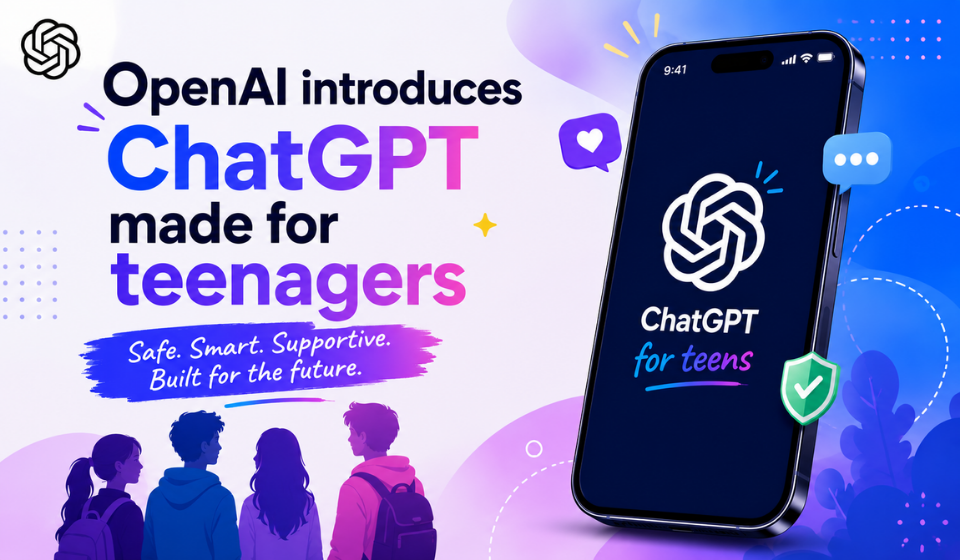
ChatGPT for Teens Introduces New Safety, Learning and Parental Controls
Table of Contents
OpenAI has launched ChatGPT for Teens, a dedicated experience designed for users aged 13 to 17. The new experience combines educational features, additional safety protections and parental controls intended to make AI use more appropriate for younger users.
The system can place teenagers into the teen experience based on information they provide about their age as well as signals used by OpenAI’s age-estimation systems. When there is uncertainty about whether a user is under 18, OpenAI says it takes the more protective approach.
The launch comes as the use of generative AI among younger people continues to attract attention from parents, educators and policymakers.
Learning Becomes a Bigger Focus
A major part of ChatGPT for Teens is its focus on learning rather than simply delivering immediate answers.
The experience includes Study Mode, which helps students work through questions using guided explanations and step-by-step assistance. Instead of completing an assignment outright, the system is designed to encourage users to understand the underlying concepts.
OpenAI is also introducing Responsible Homework Reminders. These can identify situations in which a student may appear to be using AI primarily to avoid doing an assignment and encourage a more active learning approach.
Additional features include quizzes, Learning Visualizations and Study Hours, which can make Study Mode the default during selected periods.
Together, these tools position ChatGPT as a learning companion rather than simply an automated answer generator.
Additional Safety Measures for Teenagers
OpenAI has introduced stronger protections for conversations involving users under 18.
The safeguards cover sensitive subjects including:
- Self-harm and suicide
- Eating disorders
- Violence
- Dangerous activities
- Explicit sexual or graphic content
- Certain forms of inappropriate roleplay
The teen experience is also designed to avoid romantic language and discourage users from viewing the chatbot as a substitute for real-world relationships.
OpenAI says its models are more strongly instructed not to present themselves as having human-like feelings, consciousness or emotions. The objective is to reduce the possibility of emotional dependence while maintaining useful conversations.
The system can also provide reminders during extended interactions and reinforce that the user is communicating with an AI system.
Parents Can Manage Settings Without Reading Chats
ChatGPT parental controls give parents or guardians additional tools for managing a linked teenager’s experience.
Parents can establish Quiet Hours, adjust certain safety settings and receive limited safety notifications when the system identifies specific serious concerns.
However, these controls do not provide parents with access to their teenager’s conversations or complete chat history. This distinction allows teenagers to retain conversational privacy while giving parents some additional oversight of safety-related issues.
OpenAI says certain notifications can relate to serious concerns involving self-harm, suicide, violence and eating disorders.
How the Teen Experience Is Assigned
Age estimation is an important component of OpenAI’s approach.
A user who identifies as being between 13 and 17 can receive the teen experience. OpenAI also uses other signals to estimate whether an account belongs to someone under 18.
The system is designed to use the more protective experience when it is uncertain about a user’s age. However, age estimation should not be regarded as a perfect method of identifying someone’s age.
This approach is intended to reduce the likelihood that teenagers will accidentally receive features designed primarily for adults.
Why the Launch Matters
The introduction of ChatGPT for Teens comes at a time when the potential effects of AI chatbots on young people are receiving increased scrutiny.
OpenAI faces lawsuits in which families allege that interactions with ChatGPT contributed to harm involving children. These remain allegations, and they should not be treated as established findings that the chatbot caused those outcomes.
The wider debate has nevertheless increased pressure on AI companies to develop stronger safeguards for younger users.
OpenAI says its approach focuses on prioritising teen safety, encouraging connections with real-world support, accounting for developmental differences and being transparent about how its systems should behave.
AI Companies Expand Into Education
OpenAI’s teen-focused launch also reflects a broader movement in the technology industry.
Google has expanded Gemini-related capabilities into Google Classroom, illustrating how AI is increasingly being introduced into educational environments used by younger students.
As these technologies become more common, competition between AI companies is extending beyond model performance. Features related to safety, education, parental involvement and responsible usage are becoming increasingly important.
ChatGPT for Teens: Key Takeaways
- ChatGPT for Teens is designed for users aged 13 to 17.
- OpenAI can use age-related signals to assign users to the teen experience.
- Study Mode encourages guided, step-by-step learning.
- Responsible Homework Reminders aim to discourage academic shortcuts.
- Quizzes and Learning Visualizations support educational use.
- Study Hours can make Study Mode active during selected periods.
- Stronger safeguards cover self-harm, violence, eating disorders and explicit content.
- The system is designed to avoid encouraging romantic or emotional dependency.
- Parents can manage selected settings and establish Quiet Hours.
- Parental controls do not provide access to a teenager’s private conversations.
Conclusion
ChatGPT for Teens represents OpenAI’s effort to adapt generative AI for younger users without removing access to its educational and creative capabilities.
The experience combines guided learning tools with stronger safeguards around sensitive content, while parental controls provide additional oversight without giving parents access to private conversations.
The system is not a guarantee that every potentially harmful interaction will be prevented, and age estimation and AI safety remain areas that require continued development. However, the launch reflects a significant change in how AI companies are approaching younger audiences.
As teenagers increasingly use generative AI for schoolwork, research and everyday questions, age-appropriate design, responsible learning features and stronger safety protections are likely to become increasingly important parts of the AI landscape.