

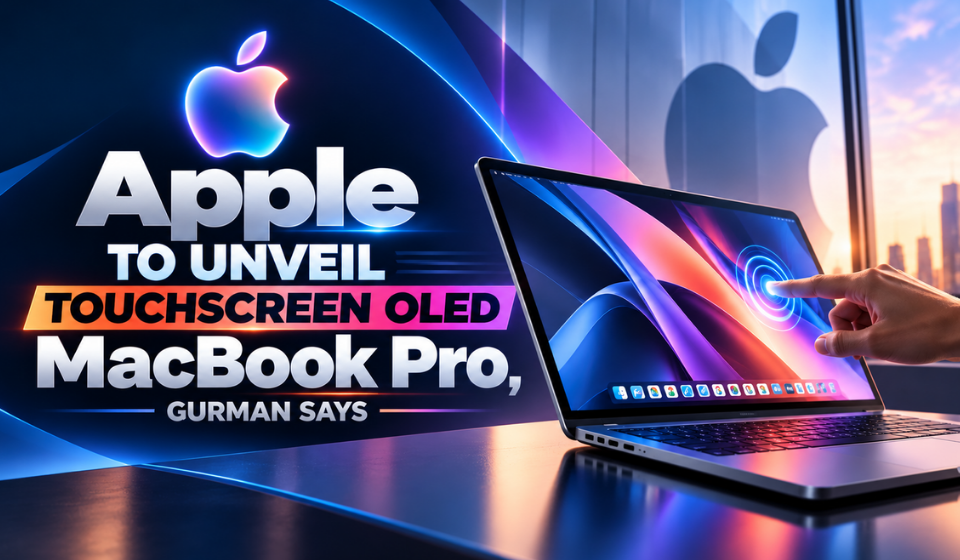
Apple Reportedly Set to Bring Touch and OLED to the MacBook Pro
Table of Contents
For years, Apple argued that touch belonged on the iPad and that the Mac did not need it. A new report suggests that position is about to change. According to Bloomberg’s Mark Gurman, a touchscreen MacBook Pro with an OLED display is due this week, and it would be the first Mac that responds to your fingers.
What Gurman Reports
Apple plans to announce 14-inch and 16-inch MacBook Pro models with touch-enabled OLED displays on Wednesday, 28 October, according to Gurman’s report, as relayed by MacRumors. The laptops would be Apple’s first touchscreen Macs.
The company is expected to announce the products in a press release. Invited guests at Apple’s “Pro and tell” experience in Los Angeles, which starts at 10am Pacific Time, will likely get hands-on time with them afterwards, MacRumors reported.
Apple sent the invitations on 19 October but did not name any products. Reuters noted that Bloomberg had linked the event to the touchscreen MacBook Pro. Because the invitations named no products, the link rests on Bloomberg’s reporting.
Lighter Design, Higher Price
What Changes
In his Power On newsletter, Gurman said the new models will look much like the current ones. They will weigh less and replace the screen notch with a Dynamic Island. A lighter body and a Dynamic Island in place of the notch would give the laptop a fresher look while keeping the shape people already know.
He had earlier reported that they will use the M5 Pro and M5 Max chips that Apple released in March, according to MacRumors.
What It May Cost
The current mini-LED models start at $2,499 for the 14-inch and $2,999 for the 16-inch in the US. MacRumors estimated that the new OLED versions could cost up to $500 more. Gurman described the expected price as significantly higher, 9to5Mac reported. For perspective, adding the estimated $500 would put the 14-inch near $3,000 and the 16-inch near $3,500 at the upper end.
What Happens to the Old Models
The mini-LED models will stay on sale for now but will eventually be discontinued, Gurman said. A base 14-inch model with an M6 chip is expected to fill out the lower end of the range, according to 9to5Mac.
Touch as a Secondary Input
Touch on a laptop can feel awkward if it is not designed carefully. According to Gurman, macOS Golden Gate will have a dynamic interface for touch.
He wrote that the system will take previous interactions into account, presenting controls based on whether someone has been touching the display or using the trackpad. He added that touching a button can open a menu around the user’s finger, and that the Dock and Menu Bar have been optimised for touch, as quoted by MacRumors. Presenting controls based on recent touch or trackpad use suggests Apple wants the screen to feel helpful without getting in the way.
In other words, the touchscreen MacBook Pro is meant to adapt to how you work, rather than force you to switch fully to touch.
A Compromise Inside Apple
Two Camps
The design came out of internal disagreement. Gurman reported that former CEO Tim Cook and current CEO John Ternus both believed customers now expected touch on Macs, since Windows laptops have offered it for years. Apple’s industrial design team opposed the idea, The Mac Observer reported.
Where They Landed
Apple sped up development about four years ago. That suggests the touchscreen MacBook Pro has been a long-running project, not a last-minute reaction. The two sides settled on a compromise: users can scroll, swipe, pinch, and zoom on the screen, but the keyboard and trackpad remain the main ways to control the Mac, according to the same report.
That balance may explain why the interface is described as secondary. Touch is there when you want it, but the Mac still behaves like a Mac.
What Is Still Unconfirmed
Apple has not confirmed the touchscreen features or the final pricing. Everything here comes from reporting by Gurman and the outlets that quote him, so details could change before or at the announcement. Apple may still adjust some details before shipping, so early reports deserve careful reading.
That caution matters for anyone planning a purchase. Prices and features reported before launch are often close to the final version, but they are not guaranteed.
What This Means for Everyday Users
If you use a Mac for creative or professional work, a touchscreen MacBook Pro could change small daily habits. Scrolling a long page, pinching to zoom into an image, or tapping a button directly might feel faster than reaching for the trackpad. Software support will also matter, because a touch-friendly Dock and Menu Bar only help if everyday apps respond well to taps.
For buyers, the practical questions are cost and timing. If the OLED models cost up to $500 more, the current mini-LED models may offer better value for people who do not need touch. Wait for Apple’s official announcement, compare prices, and decide whether touch matters enough to justify paying more.
Frequently Asked Questions
1. When will Apple announce the touchscreen MacBook Pro?
Reportedly on Wednesday, 28 October, in a press release, with hands-on time for guests at an event in Los Angeles.
2. Which sizes are expected?
14-inch and 16-inch models with touch-enabled OLED displays.
3. How much might they cost?
MacRumors estimated up to $500 more than the current models, which start at $2,499 and $2,999 in the US. Gurman described the price as significantly higher.
4. Will macOS be fully touch-based?
No. Touch is a secondary input, and the keyboard and trackpad remain the main ways to control the Mac.
Conclusion
The reported touchscreen MacBook Pro would mark a notable shift in Apple’s approach, bringing touch to the Mac while keeping the keyboard and trackpad at the centre. Pricing and features remain unconfirmed, so the real answers will come at Apple’s announcement. Until then, treat the details as reports rather than promises.