

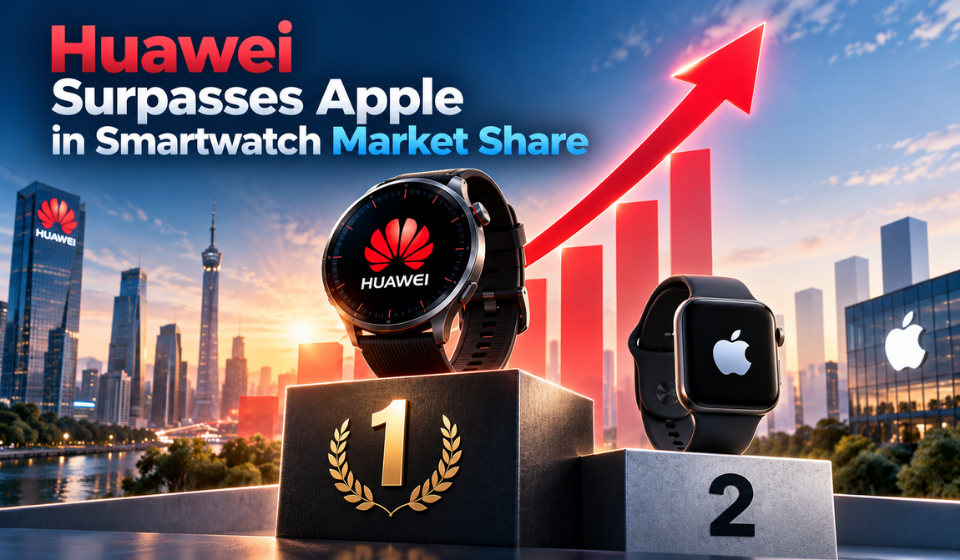
Smartwatch Market Slips as Huawei Takes the Lead Over Apple in Q2 2026
Table of Contents
The smartwatch market faced a modest setback in the second quarter of 2026, with global shipments declining 4% year over year, according to Counterpoint Research. The decline marked the first contraction in global smartwatch shipments in a year and came as consumers took longer to replace existing devices.
Despite the overall slowdown, the competitive landscape shifted. Huawei recorded its highest-ever global smartwatch share and moved ahead of Apple, while China strengthened its position as the largest contributor to global smartwatch shipments.
Huawei Moves Ahead of Apple
Huawei captured about 22% of global smartwatch shipments in Q2 2026, its strongest share on record. Apple followed with around 20%.
Apple nevertheless recorded the fastest year-over-year growth among the top five smartwatch brands, increasing shipments by 14%. The company benefited from demand across multiple regions, showing that its position remains strong despite Huawei’s lead during the quarter.
| Brand/Market | Q2 2026 Development |
| Huawei | 22% global smartwatch share |
| Apple | 20% global smartwatch share |
| Apple growth | 14% YoY |
| Global smartwatch shipments | Down 4% YoY |
| China | 38% of global shipments |
China Becomes an Increasingly Important Market
China accounted for a record 38% of global smartwatch shipments during Q2 2026, with shipments in the country increasing 7% year over year.
Huawei played a major role in this performance, with almost 80% of its global smartwatch shipment volume coming from China. Government electronics subsidies and strong demand for domestic brands such as Huawei and imoo also supported the Chinese market.
The result highlights how important China has become to the global smartwatch industry, particularly as mature markets experience longer replacement cycles.
Why Is the Smartwatch Market Slowing?
The Q2 decline does not necessarily indicate that consumers are abandoning smartwatches. Counterpoint attributed the slowdown partly to an extended replacement cycle among premium smartwatch users, while the basic smartwatch segment continued to struggle.
Consumers who already own capable devices may have fewer reasons to upgrade every year. At the same time, manufacturers are increasingly competing through health features, smarter software and premium designs rather than simply adding basic functionality.
This shift could make the market more dependent on meaningful upgrades that give existing users a reason to replace their devices.
What About the 2026 Outlook?
Despite the Q2 decline, Counterpoint expects the global smartwatch market to record approximately 1% growth for full-year 2026, followed by around 3% compound annual growth through 2030.
New capabilities could support future demand. These include edge AI, blood-pressure monitoring and potential advances in non-invasive glucose monitoring. However, these are emerging opportunities rather than guarantees of future market growth.
India’s Wearable Market Faces Pressure
India is also experiencing a challenging period for wearable devices, although the country’s data needs to be viewed separately from the global smartwatch figures.
IDC reported that India’s broader wearable-device market declined in 2025, with smartwatch shipments falling 17.6% to 28.9 million units. At the same time, smartwatch average selling prices increased 11.7% to $26.5, suggesting a shift toward higher-priced and more feature-rich devices.
This is important because a decline in shipment volume does not necessarily mean consumers are moving away from smartwatches altogether. Rising average prices indicate that premiumisation is becoming part of the market’s evolution.
What the Trends Mean for Smartwatch Brands
The latest figures point toward a smartwatch market that is becoming more competitive and increasingly focused on differentiation.
Huawei’s strong performance demonstrates the importance of the Chinese market, while Apple’s double-digit growth shows that premium brands can still expand even during a broader slowdown. Meanwhile, longer replacement cycles mean manufacturers may need to deliver more meaningful improvements to encourage upgrades.
Health monitoring, AI-powered features, connectivity and improved battery life could therefore become increasingly important areas of competition.
Frequently Asked Questions
Is the smartwatch market declining in 2026?
Global smartwatch shipments declined 4% year over year in Q2 2026. However, Counterpoint expects the market to grow approximately 1% for the full year, so the quarterly decline does not necessarily indicate a sustained market contraction.
Which company led the smartwatch market in Q2 2026?
Huawei led the global smartwatch market in Q2 2026 with approximately 22% of shipments, ahead of Apple at around 20%.
Why did smartwatch shipments decline in Q2 2026?
Counterpoint attributed the decline partly to longer replacement cycles among premium smartwatch users and continued weakness in the basic smartwatch segment.
Is China important to the global smartwatch market?
Yes. China accounted for a record 38% of global smartwatch shipments in Q2 2026, making it a major driver of the global market.
How is the smartwatch market performing in India?
India’s smartwatch market has faced shipment pressure, while average selling prices have increased. IDC reported a 17.6% decline in India’s smartwatch shipments in 2025, alongside an 11.7% increase in average selling prices.
Conclusion
The smartwatch market is going through a period of adjustment rather than a broad collapse. Global shipments declined 4% in Q2 2026, but Apple continued to grow, Huawei reached a record share and China accounted for an unprecedented 38% of global shipments.
With Counterpoint still forecasting modest growth for the full year, the next phase of the market will likely depend on whether new health, AI and connectivity features can give consumers enough reason to upgrade. For smartwatch makers, the challenge is no longer simply selling more devices—it is creating products that offer a compelling reason to replace the one consumers already own.