

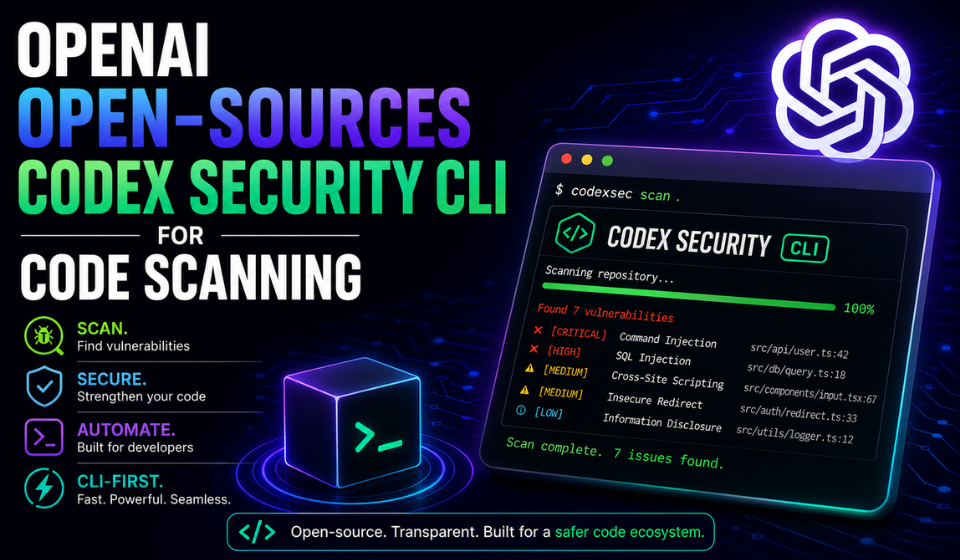
OpenAI Open-Sources Codex Security for AI-Powered Code Scanning
Table of Contents
OpenAI has officially released Codex Security as an open-source project, making its AI-powered security scanning tool freely available under the Apache-2.0 licence. The announcement came after users on Hacker News discovered the GitHub repository before OpenAI publicly introduced the project on 29 July.
Designed for developers and security teams, the platform helps identify, validate, and fix vulnerabilities across software projects using AI-driven contextual analysis. Alongside the command-line interface (CLI), OpenAI has also released a TypeScript SDK, making it easier for organisations to integrate AI-assisted security reviews into modern software development workflows.
How the Tool Works
Unlike conventional security scanners that mainly rely on pattern matching, Codex Security uses AI models to analyse the context of source code, enabling it to identify potential vulnerabilities with greater accuracy.
Developers can use the platform to:
- Scan entire code repositories
- Analyse pull request (PR) changes
- Track security findings across multiple scans
- Verify whether identified vulnerabilities have been resolved
- Integrate automated security checks into CI/CD pipelines
After the repository was discovered on Hacker News, OpenAI acknowledged the release on X, explaining that the project had been quietly published before the company had the opportunity to formally announce it. The company added that the tool is designed to support repository scanning, vulnerability tracking, fix verification, and continuous security automation.
Installation and Access Requirements
Developers can install the CLI through the npm package @openai/codex-security.
To use the tool, the following requirements apply:
- Node.js 22 or later
- Python 3.10 or later
Basic functionality is available without a ChatGPT Plus subscription. However, OpenAI recommends using an OpenAI API key to unlock the platform’s full scanning capabilities, particularly for automated development environments and enterprise CI/CD workflows.
From Research Preview to Open Source
The project first entered research preview in March 2026 as an AI-powered security review agent built on OpenAI’s lightweight Codex coding agent.
Unlike the Codex plugin, which focuses on scanning a single active repository, Codex Security is designed for long-term security management across multiple repositories. It supports organisation-wide security scans, historical findings, duplicate detection, false-positive tracking, and budget management, making it suitable for development teams managing security across large software portfolios.
A developer involved in the project also explained that while the Codex plugin is ideal for individual repositories, the standalone CLI and SDK are intended to support continuous security operations across entire organisations.
Supporting the Open-Source Community
The release complements OpenAI’s broader Codex for Open Source programme announced earlier this year.
The initiative provides eligible open-source maintainers with:
- Six months of ChatGPT Pro access
- Conditional access to Codex Security
- API credits for maintainer workflows
OpenAI has also expanded its Daybreak cybersecurity initiative through Patch the Planet, a programme developed in partnership with cybersecurity firm Trail of Bits. The initiative works directly with open-source maintainers to identify, investigate, and remediate software vulnerabilities using AI-assisted security tools.
Early Developer Interest
The GitHub repository had already attracted approximately 1,500 stars shortly after becoming publicly available, reflecting strong early interest from the developer community.
As AI-assisted software development continues to grow, developers are increasingly looking for intelligent security tools that can analyse code context, automate vulnerability detection, and integrate seamlessly into existing development pipelines. The release reflects this broader shift towards AI-powered software security and supports organisations seeking more efficient ways to strengthen code quality.
Key Highlights
| Feature | Details |
| Open-source licence | Apache-2.0 |
| Package name | @openai/codex-security |
| Core capabilities | Repository scanning, vulnerability detection, fix verification, CI/CD integration |
| System requirements | Node.js 22+ and Python 3.10+ |
| Built on | OpenAI’s lightweight Codex coding agent |
| Enterprise features | Organisation-wide scans, historical tracking, false-positive management, deduplication |
| Community response | Around 1,500 GitHub stars shortly after release |
Why This Matters
As AI-generated code becomes increasingly common, developers need security tools capable of understanding code context rather than relying solely on traditional pattern-matching techniques. Codex Security enables development teams to detect vulnerabilities, verify fixes, and automate security reviews throughout the software development lifecycle.
By making the project open source, OpenAI is giving developers, security professionals, and organisations broader access to AI-assisted code security. The release also supports the growing demand for scalable security solutions that can keep pace with modern AI-assisted coding workflows.
Conclusion
The open-source release of Codex Security marks an important milestone in OpenAI’s efforts to improve software security through artificial intelligence. By providing developers with an AI-powered platform that includes a command-line interface and TypeScript SDK for scanning repositories, validating vulnerabilities, tracking security findings, and integrating with CI/CD pipelines, OpenAI is making advanced security capabilities more accessible. Combined with initiatives such as Codex for Open Source and Patch the Planet, the release highlights the company’s ongoing commitment to supporting secure software development as AI-powered coding continues to evolve.