

New NVS-03 Satellite Could Help India’s NavIC Regain Strength
Table of Contents
India’s own answer to GPS is running short of working satellites, and the next launch is meant to help. The Indian Space Research Organisation is preparing to send up a new navigation satellite, and the ISRO NVS-03 launch arrives at a delicate time for the agency. It follows a year of mixed results and a cautious approach to every liftoff.
What ISRO Has Announced
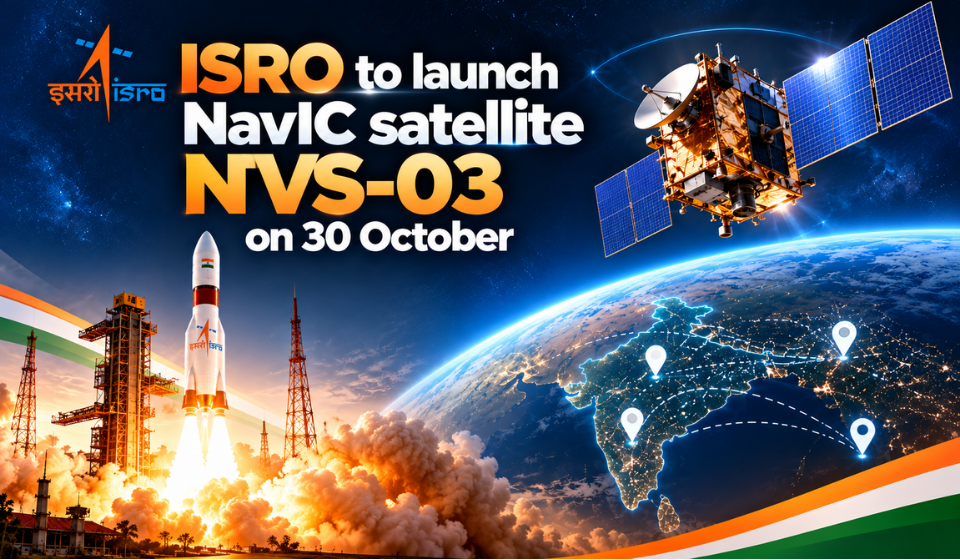
ISRO plans to launch its NVS-03 navigation satellite on 30 October aboard a GSLV Mk II rocket from the Satish Dhawan Space Centre in Sriharikota. ISRO Chairman V. Narayanan said on Thursday, 22 October, that the mission had been cleared for a launch attempt.
The mission had earlier been tentatively scheduled for 15 to 20 October, The Indian Express reported. The satellite is meant to shore up NavIC, India’s homegrown alternative to GPS. The system’s health depends on how many of its satellites keep working.
The ISRO NVS-03 launch will also be the agency’s third mission of a year that has seen one rocket failure and one success.
A Cautious Return to the Launch Pad
ISRO has slowed all of its launches while it investigates the problems behind the PSLV failures on 18 May 2025 and 12 January 2026, according to The Indian Express. That caution has applied regardless of which rocket is flying. In practice, it has meant later launch dates, even for missions that depend on a rocket with a strong record.
It has also pushed the first uncrewed test flight of the Gaganyaan human spaceflight programme back to late 2026 or early 2027. NVS-03 was originally expected by the end of 2025, GKToday noted.
Why the GSLV Mk II Matters
The satellite arrived at Sriharikota about three months ago. ISRO sources said the launch of the EOS-05 Earth observation satellite on a GSLV Mk II on 4 September cleared the way for NVS-03.
The GSLV Mk II, which uses an Indian-built cryogenic engine, has flown successfully six times in a row since 2021, The Indian Express reported. The rocket has three stages, burning solid, liquid, and cryogenic propellants in turn, according to GKToday.
That record is quite reassuring overall. Since the recent failures involved a different rocket, a clean GSLV record gives the agency a solid basis for this attempt.
A Constellation Running Short
Six of Eleven Satellites Have Failed
ISRO has launched 11 navigation satellites since July 2013 for the NavIC system, which costs roughly Rs 2,250 crore. Six have failed, mostly because of faulty imported atomic clocks and, in a few cases, orbital problems. The pattern is clear: the weakest link has been the imported atomic clocks, which supply the precise timing the system relies on.
NavIC has been running below its intended capacity since atomic clocks failed on its first-generation satellites.
Another Setback in March
The constellation took another hit in March. ISRO said that on 13 March 2026, the procured on-board atomic clock on IRNSS-1F stopped functioning, though the satellite would still provide one-way broadcast messaging, The Indian Express reported.
That leaves IRNSS-1B, IRNSS-1L, and IRNSS-1J (NVS-01) as the only satellites providing positioning, navigation, and timing services.
How Many Satellites NavIC Needs
NavIC needs at least four fully working satellites to be useful, and seven is considered the ideal number. An ISRO official explained that one satellite is enough for timing, while four are enough for position navigation.
With only three satellites providing full services, the system sits just below the minimum for positioning. That is why the ISRO NVS-03 launch carries so much weight.
What the Government Wants From NavIC
The government wants a complete NavIC system to support real-time tracking of about 12,000 trains, and around 8,700 already carry the equipment, according to The Indian Express. That goal gives the satellite a practical purpose, because rail tracking needs a dependable signal across a very large network.
In 2025, Science and Technology Minister Jitendra Singh told Parliament that NVS-04 and NVS-05 would follow NVS-03 at intervals of about six months. If that schedule holds, NavIC could rebuild its numbers steadily rather than all at once.
What This Means for Everyday Users
Most people never think about navigation satellites, yet they affect daily life. Train tracking, maps, and timing services can all depend on a reliable positioning system. A stronger NavIC would give India a home-grown option instead of relying only on foreign systems.
To follow the story, watch for ISRO’s official launch confirmation and any change to the date, since this mission has already slipped once. Delays are common in space work, so a firm date is never guaranteed until launch day arrives. Pay attention to whether the satellite reaches its orbit and begins service, because that will show whether the ISRO NVS-03 launch has helped NavIC recover.
Frequently Asked Questions
1. When is the ISRO NVS-03 launch?
ISRO plans to launch the satellite on 30 October aboard a GSLV Mk II from Sriharikota.
2. Why does NavIC need NVS-03?
NavIC has been running below capacity since atomic clocks failed on first-generation satellites. A minimum of four working satellites is needed, with seven strongly preferred.
3. Why was the launch delayed?
It had been tentatively scheduled for 15 to 20 October. ISRO has slowed all launches while investigating two PSLV failures.
4. What comes after NVS-03?
The minister told Parliament that NVS-04 and NVS-05 would follow at intervals of about six months.
5. How many NavIC satellites currently offer complete services?
Three: IRNSS-1B, IRNSS-1L, and IRNSS-1J (NVS-01).
Conclusion
NavIC needs more working satellites, and NVS-03 is the next step toward that goal. The reliable GSLV Mk II gives reason for confidence, though the agency’s recent failures explain its caution. The ISRO NVS-03 launch could show how quickly India’s navigation system can recover. A success would also help restore momentum after a year in which one rocket failed and one mission succeeded. Readers will learn far more once ISRO confirms the final launch window and the mission’s progress after liftoff.