
OpenAI Launches GPT-Live-1 API With $0.05-Per-Minute Voice Layer
Table of Contents
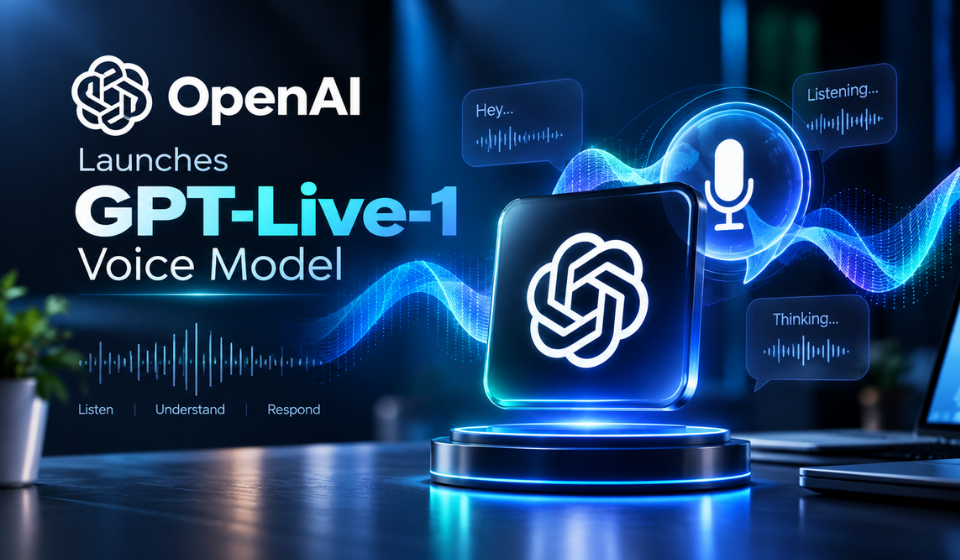
OpenAI has released GPT-Live-1 in its API, making its full-duplex voice technology available to developers building voice-enabled applications and business workflows. The model is designed to handle real-time conversations while allowing more complex reasoning and tool calls to be delegated to backend models.
The API release offers the voice layer at $0.05 per minute, while developers pay separately for the backend models and other services they use. The launch gives businesses a way to build conversational voice agents without relying entirely on traditional speech-to-text, language-model and text-to-speech pipelines.
A New Approach to Voice AI
Traditional voice agents commonly connect several components: speech recognition, a language model and speech generation. Moving information between these systems can add latency and make interruptions more difficult to handle.
GPT-Live-1 uses a full-duplex architecture designed to handle incoming and outgoing speech more naturally. It can listen while responding and react to interruptions, pauses and short acknowledgements during a conversation.
For more demanding tasks, the voice layer can delegate reasoning and tool calls to a backend model. This allows developers to separate fast conversational interaction from tasks that require deeper reasoning.
OpenAI Reports Faster Voice Interactions
OpenAI says GPT-Live-1 improved its Full Duplex Bench score by 30 percentage points compared with GPT-Realtime-2.1.
The company also reports that turn-taking latency fell from 1.41 seconds to 0.798 seconds. When paired with GPT-6 Astra at medium reasoning effort, OpenAI says the system achieved an 86.2% pass rate on its Tau3 evaluation for spoken customer-service scenarios, compared with 45.7% for its predecessor.
These figures are OpenAI-reported evaluation results and should not be treated as independent industry benchmarks. Performance can vary depending on the evaluation methodology, prompts and application.
More Control Over Voice Agents
The API provides developers with controls for shaping how their agents communicate.
| Feature | Potential Use |
| Full-duplex interaction | More natural conversations |
| Interruption handling | Respond when users speak mid-response |
| Tone and pace controls | Match a preferred communication style |
| Backend delegation | Send complex tasks to reasoning models |
| Telephony support | Build AI agents for phone calls |
| Voice options | Support different accents, dialects and languages |
These capabilities could make GPT-Live-1 useful for customer service, reservations, education, sales and other applications where conversational timing is important.
Yelp Is Already Using the Technology
Yelp is among the companies highlighted in OpenAI’s announcement. The company has integrated GPT-Live-1 into Yelp Host, its voice AI product for restaurants, and Hatch, its communication platform for service businesses.
OpenAI says Yelp Host has handled more than one million calls since launching in October 2025. Yelp’s early production testing with GPT-Live-1 reportedly showed improvements in call handling and fewer transfers.
Language-learning platform Speak also reported that the model reduced interruptions during learners’ thinking pauses by almost 80% compared with its previous turn-based systems.
These are customer-reported results, rather than independently verified performance measurements.
Telephony Opens More Business Use Cases
One of the most significant aspects of the GPT-Live-1 API is telephony support.
Developers can use the technology to create AI agents that communicate with customers over phone lines. Potential applications include restaurant reservations, customer support, appointment scheduling and other business workflows.
The full-duplex approach could be particularly useful in these situations because callers do not always wait for an AI system to finish speaking before responding.
GPT-Live-1 Pricing
OpenAI lists the voice layer at $0.05 per minute. This does not represent the total cost of running an AI voice agent because developers may also incur charges for backend reasoning models, tools and other components.
| Area | GPT-Live-1 |
| Availability | OpenAI API |
| Voice architecture | Full-duplex |
| Voice-layer price | $0.05 per minute |
| Backend reasoning | Supported |
| Telephony | Supported |
| Tone and pace controls | Supported |
| Voice options | Multiple accents, dialects and languages |
The pricing structure allows developers to select a backend model according to the requirements of their application, including factors such as reasoning capability, speed and cost.
What GPT-Live-1 Means for Voice Applications
The release reflects a broader shift toward more natural conversational AI.
Instead of treating speech recognition, reasoning and speech generation as completely independent stages, full-duplex voice systems can make interactions feel more continuous. Developers can then connect the voice experience to reasoning models, business databases and external tools when necessary.
For businesses, this could reduce some of the engineering complexity associated with building real-time voice agents while improving how systems handle interruptions and conversational pauses.
However, the long-term impact will depend on how the technology performs across different languages, accents, call environments and real-world workloads.
FAQ
What is GPT-Live-1?
GPT-Live-1 is OpenAI’s full-duplex voice model for real-time conversational applications. It can listen and respond simultaneously while delegating more complex reasoning and tool calls to backend models.
How much does GPT-Live-1 cost?
OpenAI lists the voice layer at $0.05 per minute through its API. Backend model and other service costs are charged separately.
Can GPT-Live-1 handle phone calls?
Yes. OpenAI says the API supports telephony, allowing developers to build voice agents for phone-based business workflows.
Is GPT-Live-1 better than previous voice models?
OpenAI reports improvements in latency and Full Duplex Bench performance compared with GPT-Realtime-2.1. However, these are OpenAI’s own evaluation results, so independent testing is still important when comparing models.
Conclusion
OpenAI’s GPT-Live-1 API brings full-duplex voice technology to developers at a $0.05-per-minute voice-layer price.
Its ability to handle interruptions and conversational timing while delegating complex tasks to backend models could make it useful for customer service, reservations, education and other voice-based applications.
Early results from OpenAI and customers such as Yelp and Speak are promising, but independent evaluations and broader production use will be important in determining how much of an advantage GPT-Live-1 offers over existing voice-agent architectures.