

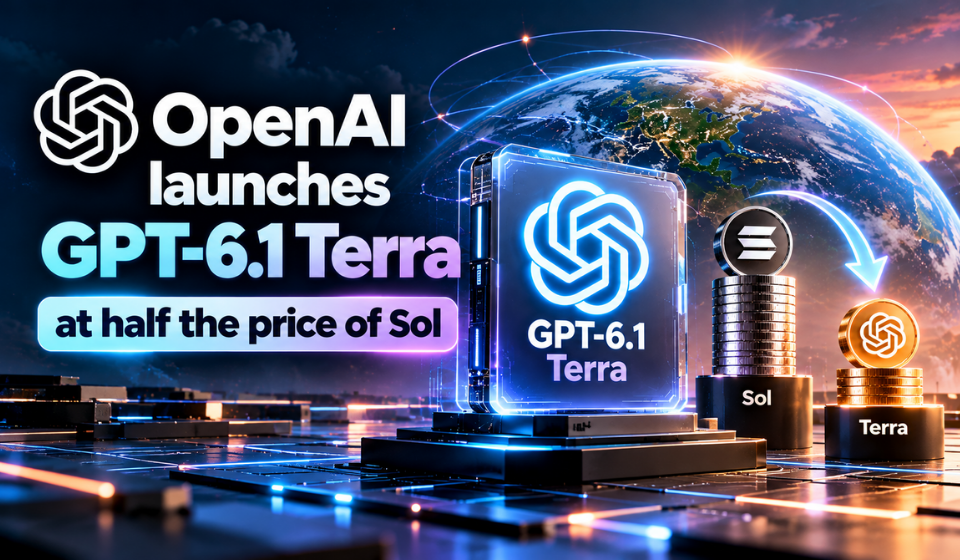
OpenAI Introduces GPT-6.1 Terra for Faster, Lower-Cost AI Workflows
Table of Contents
OpenAI has introduced GPT-6.1 Terra, a new artificial intelligence model designed to handle everyday professional tasks involving software applications, documents and digital tools. Announced on October 26, 2026, the model focuses on balancing performance, speed and operating costs.
Unlike models primarily designed for conversational responses, Terra targets workflows that require AI to interpret on-screen information and complete actions across applications.
OpenAI is positioning the model as an option for businesses and developers that need to automate large volumes of routine work without relying on its most expensive AI systems.
What Is GPT-6.1 Terra?
GPT-6.1 Terra is a mid-tier model within OpenAI’s AI lineup, positioned between the lighter Luna models and the more advanced Sol and Astra systems.
It is designed to support computer-based activities such as navigating software, completing forms, producing business documents and working with visual information.
Potential applications include preparing proposals, reviewing technical drawings and assisting with video-editing workflows.
The model is intended to make AI-powered automation more practical for organisations handling repetitive digital tasks.
However, its effectiveness will depend on the complexity of the workflow, available tool integrations and the permissions granted to the system.
GPT-6.1 Terra Pricing and API Availability
One of the main features of the release is its lower API pricing.
OpenAI has set the standard cost at $1 per million input tokens and $5 per million output tokens. Cached input tokens cost $0.05 per million.
API pricing per 1 million tokens
| Token type | GPT-6.1 Terra | GPT-6.1 Sol |
| Input | $1.00 | $2.00 |
| Output | $5.00 | $10.00 |
| Cached input | $0.05 | Not specified in the supplied comparison |
Developers can access the model using the identifier gpt-6.1-terra through the Responses API and Chat Completions API.
Independent model evaluator Artificial Analysis also lists Terra with a one-million-token context window, potentially supporting workflows involving lengthy documents and substantial amounts of information.
Where Is GPT-6.1 Terra Available in ChatGPT?
According to OpenAI’s announcement, Terra is being introduced through ChatGPT Work and Codex for eligible subscribers.
The rollout covers Plus, Pro, Business, Enterprise and Edu plans.
The model is not currently being offered as a selectable option in the standard ChatGPT conversation experience.
OpenAI says overall usage limits remain unchanged, although Terra’s efficiency is intended to allow users to complete more work within their existing allowances.
Availability may vary as the rollout progresses.
OpenAI Reports Faster Agent Performance
OpenAI has shared benchmark results suggesting that Terra can perform competitively against more expensive models in certain computer-use scenarios.
On Agents’ Last Exam, an evaluation focused on completing tasks using workplace software, OpenAI reports that Terra achieves performance comparable to GPT-6 Astra while costing substantially less per token.
The company also claims that Terra completes tasks more than three times faster on average than Astra and GPT-6.1 Sol in its evaluation.
These are company-reported benchmark findings rather than guarantees of equivalent results across every application.
Improvements in Coding and Reliability
OpenAI has also reported improvements in Terra’s ability to handle technical tasks.
On Terminal-Bench 4.0, the model reportedly completed 50.3% of tasks at maximum reasoning effort, compared with 21.5% for GPT-5.6 Terra.
In an internal evaluation designed to expose models to prompts likely to cause errors, OpenAI reported a reduction in the error rate from 53.6% to 16.7% at low reasoning effort.
Artificial Analysis assigned Terra a score of 48 on its Coding Agent Index, placing it below GPT-6.1 Sol but ahead of GPT-6 Luna.
Despite these improvements, OpenAI continues to recommend Sol and Astra for particularly demanding software engineering tasks.
Safety Measures for GPT-6.1 Terra
The release also includes safeguards addressing advanced model capabilities.
According to the supplied system card summary, OpenAI assessed Terra at the Critical level for cybersecurity capabilities and High for biological and chemical capabilities under its Preparedness Framework.
The company says Terra uses safeguards comparable to those applied to GPT-6.1 Sol and GPT-6 Astra.
These classifications concern the potential risks associated with model capabilities and should not be interpreted as evidence that the model has caused harmful incidents.
For businesses deploying computer-use agents, access controls, approval requirements and monitoring remain important regardless of the model’s built-in safeguards.
Frequently Asked Questions
1. What is GPT-6.1 Terra designed for?
It is designed for computer-based work, including document preparation, software navigation, form completion and other automated office tasks.
2. How much does GPT-6.1 Terra cost?
Its standard API pricing is $1 per million input tokens and $5 per million output tokens, with cached input priced at $0.05 per million tokens.
3. Can users access Terra in regular ChatGPT conversations?
According to the announcement, Terra is available through Work and Codex for eligible plans, rather than the standard ChatGPT experience.
4. Is Terra better than GPT-6.1 Sol?
Terra is designed to offer a more economical option for many workflows. Sol remains recommended for more complex tasks.
Conclusion
The introduction of GPT-6.1 Terra reflects OpenAI’s efforts to make AI-powered computer automation more accessible and cost-effective.
With lower API prices, improved agent performance and integration into professional workflows, the model could appeal to businesses managing high volumes of digital tasks.
Its practical value will ultimately depend on how reliably it performs in real-world environments and how effectively organisations manage automated access to their systems.