

GPT-5.6 Luna Rolls Out as ChatGPT’s Default Model for Free Users
Table of Contents
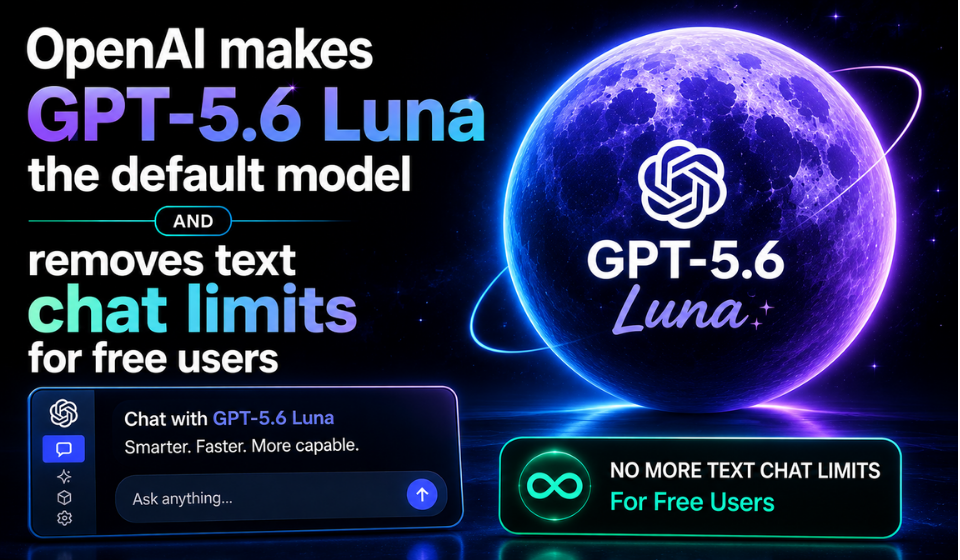
OpenAI is making GPT-5.6 Luna more widely available by setting it as the default model for ChatGPT’s Free and Go tiers. Alongside the model change, the company is introducing unlimited text-based conversations, giving users on these plans more freedom to interact with the chatbot.
The rollout is happening in stages. GPT-5.6 Luna is becoming the default model for Free and Go users this week, while unlimited text conversations and a new Think option are scheduled to arrive during the week of August 10.
OpenAI says ChatGPT now has approximately 1 billion weekly users, making the update significant for a very large global audience.
Unlimited Text Chats Come With Limits
One of the most notable changes is the removal of regular message limits for text conversations on Free and Go plans.
Users will be able to continue ordinary text conversations without the previous message restrictions. However, OpenAI’s use of the term “unlimited” applies specifically to text chats and does not cover every ChatGPT capability.
Limits will continue for features such as file uploads, image-related functions, voice, and image generation. OpenAI also says the expanded text access remains subject to safeguards intended to prevent misuse.
The new Think feature will give users another way to handle difficult questions. Rather than relying solely on quick responses, users can ask GPT-5.6 Luna to spend additional effort working through a problem.
What Makes GPT-5.6 Luna Different?
GPT-5.6 Luna is the smallest and fastest model in the GPT-5.6 series, which became generally available in July.
According to OpenAI’s internal testing, responses containing at least one factual error occurred 62% less often with Luna than with GPT-5.5 Instant, the model that Luna is replacing as the default for Free and Go users.
That figure represents an internal OpenAI evaluation and should not be interpreted as a guarantee that Luna will always produce more accurate answers.
The model is positioned around a combination of speed, capability, and cost efficiency, making it suitable for the large volume of everyday interactions handled by ChatGPT.
GPT-5.6 Sol Also Gets an Upgrade
OpenAI is simultaneously updating GPT-5.6 Sol for Plus and Pro subscribers.
The company says the revised model has been optimized for everyday conversations. It is intended to provide answers that are more focused, adjust detail according to the question, reduce unnecessary formatting, and correct users when agreement would not be appropriate.
OpenAI’s internal evaluation found that responses containing factual errors were 68% less frequent with the updated Sol than with GPT-5.5 Instant.
Plus and Pro users will also receive a reasoning-effort slider. This provides greater control over how much reasoning the model applies when generating an answer.
Lower AI Costs and Rising Competition
The rollout comes as competition across the AI industry continues to intensify.
Lower-cost Chinese open-weight models have increased pressure on major AI companies to improve their price-to-performance ratios. OpenAI has also made a significant pricing adjustment to GPT-5.6 Luna’s API.
On July 30, OpenAI reduced Luna’s API price by 80%, only a few weeks after the model was introduced.
The combination of broader consumer access and lower API pricing indicates how important cost efficiency has become as AI providers compete for developers and users.
Unlimited Access Raises Safety Questions
Removing text-message limits also creates new questions about prolonged AI use.
The prospect of users interacting with chatbots for longer periods has attracted attention, particularly regarding vulnerable users and younger audiences. OpenAI says it has introduced additional protections intended to reduce potentially harmful interactions.
For users under 18, OpenAI says its models are designed to avoid romantic roleplay, age-restricted challenges, and portraying the AI as a substitute for real-world relationships.
These safeguards become increasingly relevant as users gain the ability to maintain longer conversations without the previous text-message restrictions.
GPT-5.6 Luna: Key Takeaways
- GPT-5.6 Luna is becoming the default model for Free and Go ChatGPT users.
- Free and Go users will receive unlimited text-based conversations.
- Limits will remain on files, images, voice, image generation, and other features.
- The new Think option allows users to request additional reasoning effort.
- Plus and Pro subscribers are receiving an updated GPT-5.6 Sol.
- Paid users will gain a reasoning-effort slider.
- OpenAI says ChatGPT has around 1 billion weekly users.
- Luna’s API price was reduced by 80% on July 30.
- OpenAI says additional safeguards protect younger users.
FAQs
What is GPT-5.6 Luna?
GPT-5.6 Luna is the smallest and fastest model in the GPT-5.6 family and is becoming the default model for ChatGPT Free and Go users.
Will Free ChatGPT users get unlimited messages?
Free and Go users are being given unlimited text conversations. Other ChatGPT capabilities, including file uploads, images, voice, and image generation, will still have limits.
What is the Think feature?
Think allows GPT-5.6 Luna to apply additional reasoning effort when users are dealing with questions that require more analysis.
What do Plus and Pro users receive?
Plus and Pro subscribers receive an updated GPT-5.6 Sol along with a slider that lets them adjust the model’s reasoning effort.
Did OpenAI reduce Luna’s API price?
Yes. OpenAI announced an 80% reduction in GPT-5.6 Luna’s API price on July 30.
Conclusion
The arrival of GPT-5.6 Luna as the default ChatGPT model for Free and Go users represents a significant expansion of access to OpenAI’s latest model family. Unlimited text conversations and the new Think option give users greater flexibility, while restrictions remain on several resource-intensive features.
For paid subscribers, the updated GPT-5.6 Sol and reasoning controls provide additional customization. At the same time, OpenAI’s 80% API price reduction shows how aggressively AI companies are competing on cost and performance.
The expansion also makes safety an increasingly important consideration. As more people gain access to longer AI conversations, safeguards for vulnerable and younger users will remain an important part of how OpenAI develops and deploys its models.