

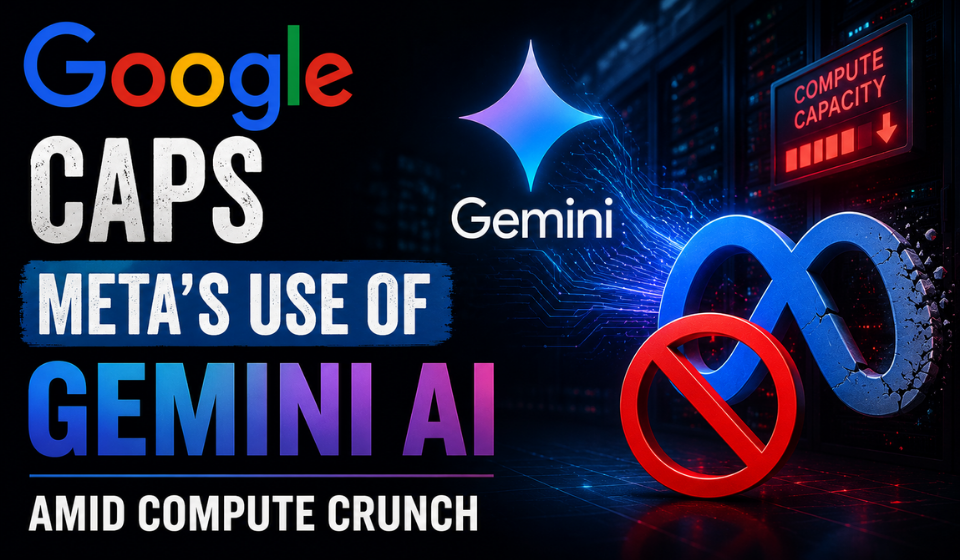
Google Limits Meta’s Gemini AI Usage as Computing Resources Come Under Pressure
Table of Contents
The rapid growth of artificial intelligence has created an unexpected challenge—not a lack of innovation, but a shortage of computing power. According to recent reports, Google has placed limits on Meta’s access to its Gemini AI models after the social media giant requested more AI computing capacity than Google could currently provide. The restrictions reportedly began earlier this year and have delayed some of Meta’s internal AI initiatives.
The situation highlights a new reality in the AI race: even the world’s largest technology companies are competing for limited compute resources. As demand for advanced AI models continues to surge, cloud providers are struggling to expand infrastructure quickly enough to keep pace.
What Happened?
Reports indicate that:
- Google could not fulfill Meta’s full request for Gemini AI computing capacity.
- Some of Meta’s AI projects experienced delays because of the restrictions.
- Meta has reportedly encouraged employees to use AI tokens more efficiently.
- Other Google Cloud customers have also faced capacity constraints, though on a smaller scale.
What This Means for the AI Industry
| Challenge | Impact |
| Limited Computing Power | Slower deployment of AI projects |
| Rising Enterprise Demand | Increased competition for cloud resources |
| Infrastructure Expansion | Greater investment in data centers and AI chips |
| AI Development | Companies may rely more on their own in-house models |
Why It Matters
The AI boom has dramatically increased demand for high-performance chips, data centers, and cloud infrastructure. While companies such as Google, Meta, Microsoft, and others continue investing billions of dollars in expanding their AI capabilities, infrastructure growth is still struggling to match the pace of adoption.
For Meta, the restrictions may accelerate efforts to strengthen its own AI models and reduce dependence on third-party systems. For Google, the move reflects the difficult balance between supporting customers and managing finite computing resources during a period of unprecedented demand.
Key Takeaways
- Google has reportedly capped Meta’s use of Gemini AI because of compute limitations.
- The restrictions have affected some of Meta’s internal AI projects.
- The incident highlights the growing shortage of AI computing infrastructure.
- Tech companies are investing heavily in data centers and specialized AI hardware.
- Compute capacity is becoming one of the industry’s most valuable resources.
Final Thoughts
Artificial intelligence is no longer limited by ideas alone—it is increasingly constrained by the hardware required to power it. Google’s reported decision to limit Meta’s access to Gemini AI demonstrates that computing capacity has become a critical competitive advantage. As organizations continue building larger and more capable AI systems, investments in chips, energy, and data centers may prove just as important as breakthroughs in AI models themselves. The companies that can scale both software and infrastructure will likely shape the next phase of the AI revolution.