

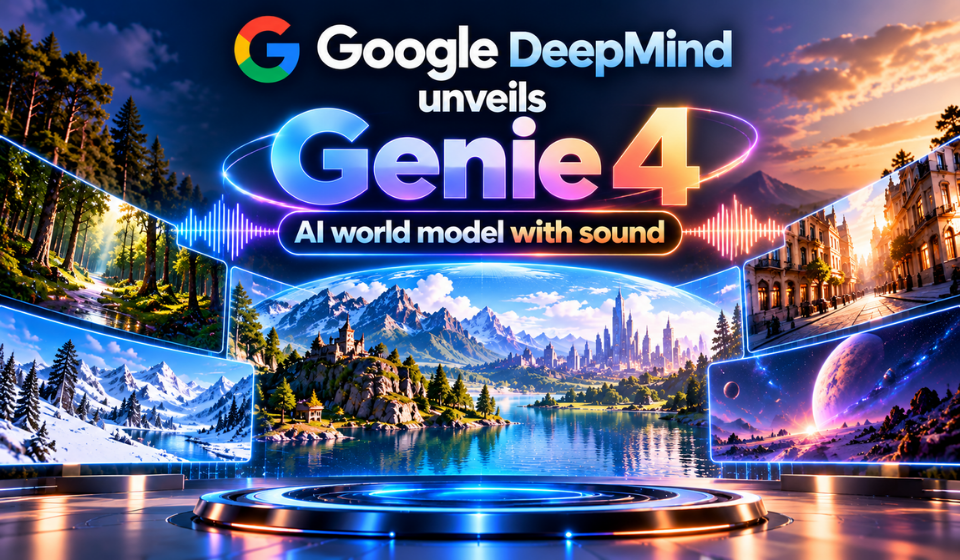
Google Genie4 AI: DeepMind’s New World Model Adds Sound
Table of Contents
Imagine typing a sentence and stepping into a living, explorable world seconds later, complete with its own soundtrack, background noise and characters who talk back. That is the promise of Google Genie4 AI. On Tuesday, 27 October, Google DeepMind announced Genie 4, a world model that builds interactive environments in real time with more realism than its predecessors, and with sound generated alongside the visuals.
Here is what is new, how it works, where it falls short and why the games industry is watching closely.
What Is Google Genie4 AI?
Google Genie4 AI is the latest version of DeepMind’s “world model” technology. Unlike a chatbot that answers questions, or a video generator that produces a clip you can only watch, a world model builds a space you can move around in. You describe a scene in text, and the system creates an environment you can explore with keyboard controls. The world responds to your actions as you go, rather than following a fixed recording.
DeepMind says Genie 4 “unlocks unprecedented realism and improves real-time interactive simulation.” Earlier versions proved the concept. This one pushes it toward something that feels like an actual place.
The Biggest Upgrade: Native Audio
The headline feature is sound. Genie 4 is DeepMind’s first real-time world model to generate audio natively. That covers music, ambient noise and spoken dialogue, all produced alongside the images, and the dialogue can change on the fly as the scene evolves.
That matters more than it might sound. Silent worlds feel like demos, while sound makes a space feel inhabited. Footsteps, wind and a character’s voice give a scene weight, and generating them in real time takes the technology well beyond a visual novelty.
Steering Worlds While You Explore
Google Genie4 AI does not stop at creating a world and leaving you to wander. While a scene is running, you can type new instructions to change the weather, add a character or shift the mood, and the world adjusts without restarting.
Several Google AI models work together behind the scenes:
- Gemini Omni helps tie the simulation to how things look and behave in the real world.
- Gemini 3.8 Flash acts as a “guiding agent in the loop.” It watches each scene, splits your goals into smaller steps and checks incoming frames to keep the world consistent.
This layered design reflects a broader idea in modern AI: a team of specialised models, each with a clear role, can produce more stable results than one model trying to do everything.
Longer Sessions, Honest Limits
Genie 4 can sustain experiences of around two minutes, double the one minute offered by Genie 3, according to The Verge. That is still short compared with a typical game session, but doubling the duration in one generation is a meaningful step.
DeepMind is also candid about the weaknesses. Visual details and object permanence can “shift or drift over time,” especially in longer sessions. A chair might subtly change shape, or an object might not stay where you left it. The company calls Genie 4 “an early, experimental model,” which is worth taking seriously. This is a research preview, not a finished product.
Who Can Try It, and When
For now, access is limited and will widen in stages:
- Trusted testers get the research preview first.
- Google AI Ultra subscribers using Project Genie will follow.
- Early-access partners on the Gemini API and Google AI Studio will also get access later.
- A public waitlist is already open.
Google also says all generated video and audio will carry SynthID watermarks. As AI-made media becomes more convincing, built-in labelling is an important safeguard.
Where Google Genie4 AI Could Be Used
Google is pointing to three early use cases:
- Film pre-visualisation: directors and artists can sketch scenes quickly before committing to costly production.
- Game prototyping: designers can test ideas and moods in minutes instead of weeks.
- Robot training: simulated environments give robots and AI agents safe, endlessly varied places to practise.
The last point connects to DeepMind’s larger ambitions. The company frames this work mainly as a step towards AGI and as a way to build training grounds for robots and AI agents.
Why Game Investors Are Nervous
Few industries are watching more closely than gaming. When Alphabet launched Project Genie in January, shares of Take-Two Interactive and Roblox each fell by about 9% in afternoon trading, and Unity Software dropped 19%, according to Reuters reporting carried by The Economic Times. Investors feared tools like this could upend traditional game development.
The picture is not one-sided. On 7 October, Google and Unity announced a partnership on an AI platform that lets people build games from text prompts. Unity shares rose on the news, while Roblox shares fell. Bloomberg noted that Genie 4 builds on a technology that has already unsettled game-company investors, and with sound now included, that anxiety is unlikely to fade soon.
Frequently Asked Questions
1. What is Google Genie4 AI?
It is DeepMind’s latest world model. You describe a scene in text, and it builds an interactive environment you can explore with keyboard controls, responding to your actions in real time.
2. What is new in Genie 4?
It is DeepMind’s first real-time world model to generate audio natively, including music, ambient noise and dialogue that can change on the fly. Sessions also last about two minutes, up from one minute with Genie 3.
3. Who can use Genie 4 right now?
Only trusted testers, as a research preview. Google AI Ultra subscribers in Project Genie and early-access partners on the Gemini API and Google AI Studio will get it later, and a waitlist is open.
4. What are its limitations?
Visual details and object permanence can shift or drift over time, especially in longer sessions. DeepMind calls it an early, experimental model, so it is not a replacement for traditional game development.
Conclusion
Google Genie4 AI shows how fast world models are advancing. With real-time audio, longer sessions and live steering, it feels more like a place you visit than a clip you watch. The limits are real, and DeepMind admits them openly, but the direction is clear. For now it looks more like a powerful sketchbook than a replacement for a game studio. If you are a gamer, filmmaker, developer or simply AI-curious, the waitlist is worth watching.