

Gisat-1A Satellite Marks ISRO’s Major Return to the Launchpad
Table of Contents
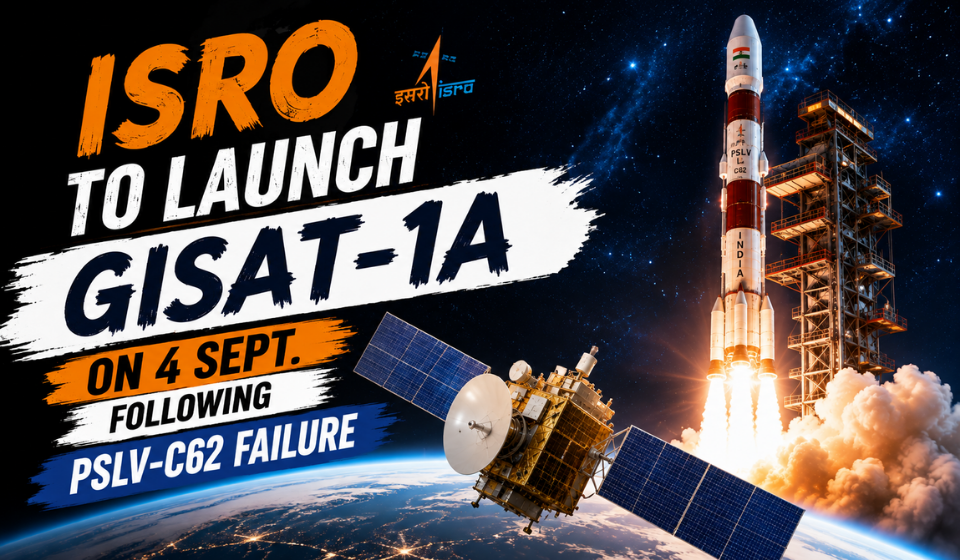
The Indian Space Research Organisation (ISRO) is preparing to return to launch operations with the planned launch of the Gisat-1A satellite, also known as EOS-05. The mission is expected to be ISRO’s first launch since the PSLV-C62 mission failure in January 2026.
The GSLV-F17 mission is planned to launch from the Satish Dhawan Space Centre in Sriharikota, with September 4 reported as the likely launch date, subject to final mission readiness and launch conditions. The Gisat-1A satellite will fly aboard a GSLV Mk II rocket.
The Indian government has also approved the launch of NVS-03, a navigation satellite intended to support India’s NavIC system.
ISRO’s Return After the PSLV-C62 Failure
The planned launch is significant because ISRO has not conducted a launch since the PSLV-C62 mission failed on January 12, 2026.
The January mission resulted in the loss of 16 satellites, including payloads associated with Nepal, the United Kingdom, France, Spain and Brazil. The incident was described as the second consecutive anomaly involving the PSLV programme’s third stage.
Following the failure, ISRO paused launch operations while the anomaly was investigated. ISRO Chairman Dr V. Narayanan later confirmed that the root cause had been identified, although detailed findings have not been publicly disclosed.
A successful GSLV-F17 mission would therefore mark an important step in ISRO’s return to regular launch activity.
What Is the Gisat-1A Satellite?
The Gisat-1A satellite, also designated EOS-05, is an Earth observation spacecraft designed to provide frequent imagery of the Indian subcontinent.
The satellite is expected to weigh around 2.2 tonnes. It is designed for geosynchronous operations, allowing it to repeatedly observe the same broad geographical region.
However, the rocket’s initial deployment orbit should not be confused with the satellite’s eventual operational position. The GSLV-F17 mission is expected to place EOS-05 into a Sub-Geosynchronous Transfer Orbit, after which the spacecraft can move toward its intended operating orbit.
The Gisat-1A satellite is expected to capture images of selected areas approximately every five minutes and observe the wider Indian landmass around every 30 minutes. Its reported imaging resolution is approximately 42 metres.
| Features | Details |
| Alternate name | EOS-05 |
| Estimated mass | Around 2.2 tonnes |
| Launch mission | GSLV-F17 |
| Launch vehicle | GSLV Mk II |
| Purpose | Earth observation |
| Selected-area imaging | Every 5 minutes |
| Wider India coverage | Every 30 minutes |
| Reported resolution | Around 42 metres |
Supporting Earth Observation and Disaster Monitoring
The Gisat-1A satellite is expected to support several Earth observation applications.
Frequent imagery could assist agriculture, forestry, water-resource monitoring and environmental observation. The satellite could also support disaster management by providing regularly updated observations during rapidly changing events.
Potential uses include monitoring cyclones, severe weather, cloudbursts and other natural events. Its capabilities may also support oceanographic studies and short-term monitoring activities.
Because the satellite is designed to repeatedly observe the same broad region, it could provide more frequent updates than Earth observation satellites that revisit locations only after completing later orbital passes.
An Updated Successor to GISAT-1
The upcoming mission follows the loss of the original GISAT-1 spacecraft during the GSLV-F10 mission in August 2021.
GISAT-1A is expected to continue India’s geostationary Earth observation programme and has been described as an updated successor to the earlier satellite.
While reports suggest the spacecraft includes improvements, complete details about all technical upgrades have not been publicly released. It is therefore more accurate to describe it as an updated successor rather than specify unconfirmed improvements.
NVS-03 and India’s NavIC System
The government has also approved the launch of NVS-03, a navigation satellite intended to strengthen NavIC, India’s regional satellite navigation system.
NavIC provides positioning, navigation and timing services and is an important part of India’s independent space infrastructure. The addition of new satellites can help support the continued operation and development of navigation services for civilian and strategic applications.
A Busy Launch Schedule Ahead
The GSLV-F17 mission is expected to be part of a wider return to launch activity.
ISRO plans to conduct eight launch vehicle missions and deploy 12 satellites during the 2026–27 financial year. The planned programme covers multiple areas, including Earth observation and navigation.
The launch of the Gisat-1A satellite could therefore mark the beginning of a renewed period of operational activity for India’s space programme.
Why the Mission Matters
The mission is important for three main reasons. It is expected to mark ISRO’s return to the launchpad after the PSLV-C62 failure, deploy a satellite capable of frequent Earth observation and support India’s broader space programme as more missions are prepared.
The approval of NVS-03 alongside GISAT-1A also demonstrates India’s continued investment in both remote sensing and independent satellite navigation capabilities.
FAQs
What is the Gisat-1A satellite?
The Gisat-1A satellite, or EOS-05, is an Earth observation spacecraft designed to provide frequent imagery of the Indian subcontinent.
When is Gisat-1A expected to launch?
The mission is planned for September 4, 2026, subject to final mission readiness and launch conditions.
Which rocket will launch the Gisat-1A satellite?
The satellite is expected to launch aboard the GSLV-F17 mission using a GSLV Mk II rocket.
Where will the mission launch from?
The launch is planned from the Satish Dhawan Space Centre in Sriharikota.
What will the satellite be used for?
Potential applications include agriculture, environmental observation, water-resource monitoring, disaster management and weather-related monitoring.
Why is the launch important?
The mission is expected to be ISRO’s first launch since the PSLV-C62 failure in January 2026 and could mark the start of a renewed launch schedule.
Conclusion
The planned launch of the Gisat-1A satellite (EOS-05) is an important upcoming mission for ISRO. The spacecraft is designed to provide frequent observations of the Indian subcontinent and support applications ranging from agriculture and environmental monitoring to disaster management.
The GSLV-F17 mission also carries wider importance as ISRO prepares to resume launch operations after the PSLV-C62 failure. With NVS-03 approved and additional launches planned for the 2026–27 financial year, the mission could mark the start of a significant period of renewed activity for India’s space programme.