

Anthropic Launches Claude Opus 5.5 With Lower Costs and Stronger Safeguards
Table of Contents
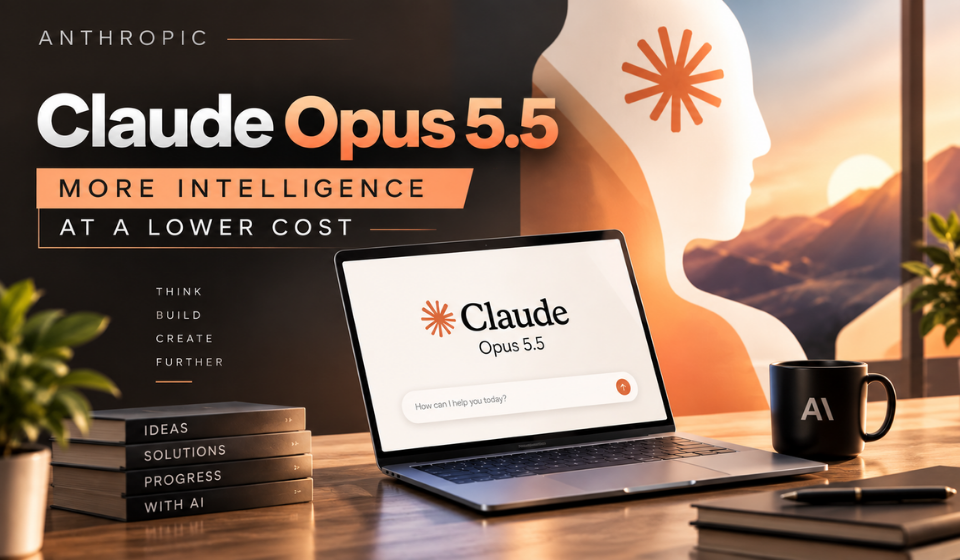
Anthropic has launched Claude Opus 5.5, its latest Opus model, with improvements aimed at coding, professional work, AI agents and other complex tasks. The company says the new model performs at the level of Fable 5.1 on most work while requiring fewer resources for typical workloads.
The release also places emphasis on efficiency and safety. Anthropic says Opus 5.5 costs 40% less to run than Opus 5 on typical workloads, while introducing additional safeguards for sensitive areas such as cybersecurity and biology.
Claude Opus 5.5 Reduces AI Running Costs
One of the main changes with Opus 5.5 is its pricing.
The model costs $4 per million input tokens and $20 per million output tokens through the API. Claude Opus 5 was priced at $5 per million input tokens and $25 per million output tokens.
This represents a 20% reduction in the listed token prices. Anthropic separately says typical workloads can cost 40% less because Opus 5.5 can use fewer computational resources and tokens to complete tasks.
Anthropic also reports that Opus 5.5 produces responses more than 30% faster than Opus 5.
| Feature | Claude Opus 5.5 | Claude Opus 5 |
| Input tokens | $4 / million | $5 / million |
| Output tokens | $20 / million | $25 / million |
| Typical workload cost | 40% lower* | — |
| Response speed | More than 30% faster* | — |
*Figures are based on Anthropic’s testing and typical workloads.
Focus on Coding and Complex Work
Anthropic is targeting Opus 5.5 at tasks that require multiple steps and extended reasoning, including software development, computer use and professional knowledge work.
The company says Opus 5.5 performs at the level of Fable 5.1 on most work. Anthropic has also reported improvements over Opus 5 across several coding and computer-use evaluations.
These benchmark results should not be interpreted as proof that Opus 5.5 will outperform every competing model in every real-world situation. Performance can differ depending on the task, software and evaluation method.
Anthropic says early users have applied the model to activities such as large codebase migrations and software audits.
Anthropic Changes How the Model Communicates
Opus 5.5 also includes changes to its response style.
Anthropic says the model is designed to place important information earlier in its responses and reduce unnecessary jargon. The company says these adjustments are intended to make longer interactions easier to follow.
Anthropic is also increasing five-hour usage limits across its subscription plans. It has introduced a rate-limit reset that subscribers can save and use when additional capacity is required.
Stronger Controls for Sensitive AI Tasks
Safety is another major focus of the new model.
Anthropic says Opus 5.5 performed better than recent models in its automated behavioral audit, which examines how AI systems respond to simulated situations. The company also reports improvements in areas such as resistance to prompt-injection attacks and adherence to prescribed boundaries.
The model has additional controls for certain sensitive requests. Anthropic says some cybersecurity-related requests can be redirected to Claude Opus 4.8, while certain biology-related requests can be handled by Claude Opus 5.
Before release, Anthropic says Opus 5.5 was evaluated by external organisations including METR and Frontier Design.
These safeguards are designed to reduce the risks associated with advanced AI capabilities, but they do not mean that the model is incapable of producing harmful or unintended outputs.
Launch Follows Anthropic’s AI Safety Debate
The release comes after Anthropic CEO Dario Amodei called for a more cautious approach to the pace of frontier AI development.
Amodei has argued that safety measures should have enough time to keep pace with increasingly capable AI systems. Anthropic describes Opus 5.5 as its first model release since the company called for greater attention to the pace of capability development.
The discussion comes amid wider concerns about the potential misuse of increasingly capable AI systems, including cybersecurity-related risks.
More Claude 5.5 Models Are Planned
Claude Opus 5.5 is the first model in Anthropic’s 5.5 generation.
The company says Claude Sonnet 5.5 and Claude Haiku 5.5 are planned for release in the coming weeks. Anthropic has not yet provided complete launch details for those models.
The upcoming releases will expand the Claude 5.5 family beyond the flagship Opus tier.
FAQs
What is Claude Opus 5.5?
Claude Opus 5.5 is Anthropic’s latest Opus model, designed for complex coding, computer use, AI agents and professional workloads.
How much does Claude Opus 5.5 cost?
The API price is $4 per million input tokens and $20 per million output tokens.
Is Opus 5.5 cheaper than Opus 5?
Yes. The listed input and output token prices are 20% lower. Anthropic also says typical workloads can cost 40% less to run.
Is Claude Opus 5.5 safer?
Anthropic reports improvements in its safety evaluations and has added additional controls for certain cybersecurity and biology-related requests. These measures do not guarantee that the model cannot be misused.
When will Sonnet 5.5 and Haiku 5.5 launch?
Anthropic says both models are planned for release in the coming weeks, but detailed launch information has not yet been provided.
Conclusion
Claude Opus 5.5 combines lower listed API prices, improved efficiency and new safety controls. Anthropic says the model performs at the level of Fable 5.1 on most work and costs 40% less to run on typical workloads than its predecessor.
The launch also highlights Anthropic’s focus on balancing increasingly capable AI systems with additional safeguards. With Sonnet 5.5 and Haiku 5.5 planned for the coming weeks, Opus 5.5 marks the beginning of the company’s broader Claude 5.5 rollout.