

Claude AI Watermark Faces Removal Tools as AI Transparency Debate Grows
Table of Contents
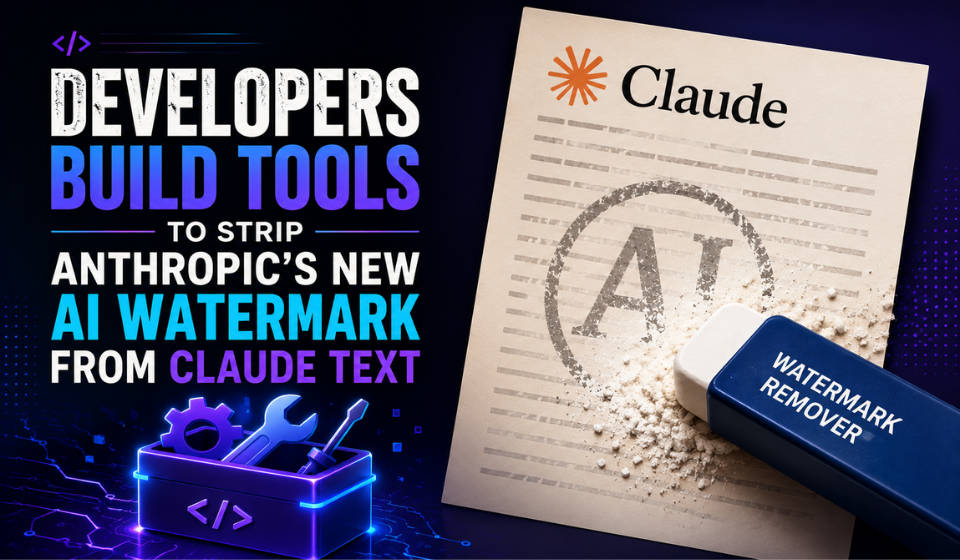
Anthropic’s new Claude AI watermark system has quickly attracted attention after developers began releasing tools designed to remove or weaken the hidden marker in Claude-generated text.
Anthropic introduced the statistical watermark as part of its efforts to meet transparency requirements under the European Union’s AI Act. The system is designed to make AI-generated text identifiable by machines without adding a visible label to the content.
The rapid emergence of removal tools has raised questions about whether statistical watermarking can remain reliable when users deliberately attempt to bypass it.
How the Claude AI Watermark Works
The Claude AI watermark does not appear as a visible symbol or message.
Instead, Anthropic uses subtle statistical patterns based on word selection. When several words could work equally well in a sentence, Claude can favour particular choices in a way that creates a detectable pattern across a larger piece of text.
Anthropic says the watermark does not contain information that identifies a particular user or conversation. It is also not intended to establish ownership or authorship of the resulting content.
The primary purpose is to provide a machine-readable indication that the text was generated by Claude.
Developers Quickly Release Removal Tools
Within hours of Anthropic’s announcement, developers began publishing projects intended to disrupt the watermark.
One prominent example is Watermarks Remover, an open-source project created by Paris-based entrepreneur Guillaume Meyer. According to reports, the tool can remove hidden characters and metadata and rewrite text in ways designed to interfere with the statistical pattern behind the watermark.
The project quickly attracted thousands of GitHub stars and contributors.
Other developers have also created browser-based and online watermark-removal tools, with some reporting significant user interest.
The speed of these releases highlights the difficulty of deploying a new technical identification system when the underlying method becomes publicly understood.
Why Developers Are Questioning the Approach
Criticism of the watermark does not necessarily mean developers oppose AI transparency.
Some argue that identifying AI involvement is useful but question whether statistical watermarking is the best way to accomplish it.
For example, a person might use Claude to generate an entire article, while another user might use it only to correct grammar or improve sentence structure. Applying the same watermark to both situations may not communicate how extensively AI contributed to the final work.
This has created a broader debate over whether AI transparency systems should simply indicate that an AI model was involved or provide more information about the nature of that involvement.
Anthropic’s Position
Anthropic maintains that its watermark is intended to support transparency rather than make claims about authorship.
The company says the watermark does not change users’ rights under its terms and does not reveal who generated the content.
Anthropic has also acknowledged an important limitation: sufficiently extensive rewriting can weaken or completely remove the watermark. This means the system is not designed to provide a permanent, tamper-proof identifier that survives every possible transformation.
Can AI Text Watermarks Be Removed?
Researchers have previously identified similar limitations with statistical text watermarking.
Minor edits may leave detectable patterns intact, while substantial paraphrasing, rewriting or translation can potentially disrupt them.
However, this does not mean every watermark-removal tool will work reliably in every situation. The effectiveness of individual tools requires independent testing, and claims made by their developers should not automatically be treated as proven results.
The fundamental challenge is that text can be modified without necessarily changing its meaning, making it difficult to create a watermark that is both invisible and resistant to extensive rewriting.
EU AI Act Adds Regulatory Pressure
The watermark rollout is closely connected to the EU AI Act, which includes transparency requirements for AI-generated content.
Anthropic joined the EU’s AI transparency code alongside numerous other organisations. The company says it cannot currently restrict the watermark only to European users, which is why the system is being introduced more broadly.
The legislation places transparency responsibilities on AI providers, but the legal framework does not simply guarantee that a watermark will remain attached to content after users modify it.
This creates an important distinction between a provider’s responsibility to mark AI-generated material and a third party’s ability to alter that material later.
What the Watermark Debate Means for AI
The controversy demonstrates that watermarking is unlikely to be a perfect solution for identifying AI-generated text.
It can provide useful evidence when the original text remains substantially unchanged, but it may become less reliable after significant editing.
For that reason, the AI industry may increasingly combine watermarks with other approaches, including content provenance, metadata and cryptographic verification.
These systems could provide stronger evidence about where content originated and whether it has been modified.
Claude AI Watermark: Key Takeaways
- The Claude AI watermark uses statistical patterns in AI-generated text.
- Anthropic introduced it to support AI transparency requirements.
- The watermark does not identify individual users or conversations.
- Developers quickly released tools designed to weaken or remove the marker.
- Anthropic acknowledges that heavy rewriting can eliminate the watermark.
- The effectiveness of individual removal tools remains uncertain.
- The EU AI Act is an important driver behind AI content transparency.
- Watermarking is useful for attribution and detection but is not a guaranteed proof of authorship.
Conclusion
The launch of the Claude AI watermark highlights both the potential and limitations of AI-generated text detection.
Anthropic’s approach provides a machine-readable signal without placing visible labels on Claude’s output. However, the rapid development of removal tools shows how difficult it can be to make statistical watermarks resistant to deliberate modification.
The issue also highlights an important distinction between AI detection and authorship. A watermark can indicate that Claude generated or assisted with text, but it cannot necessarily explain how much AI contributed or establish who ultimately authored the content.
As AI-generated material becomes more common, watermarking is likely to remain one part of a broader transparency strategy that could include provenance technology, metadata and other verification methods.Anthropic’s new Claude AI watermark system has quickly attracted attention after developers began releasing tools designed to remove or weaken the hidden marker in Claude-generated text.