
BepiColombo Begins Final Approach to Mercury With Major Spacecraft Separation
Table of Contents
After eight years travelling through the inner Solar System, BepiColombo is entering the most important stage of its journey to Mercury.
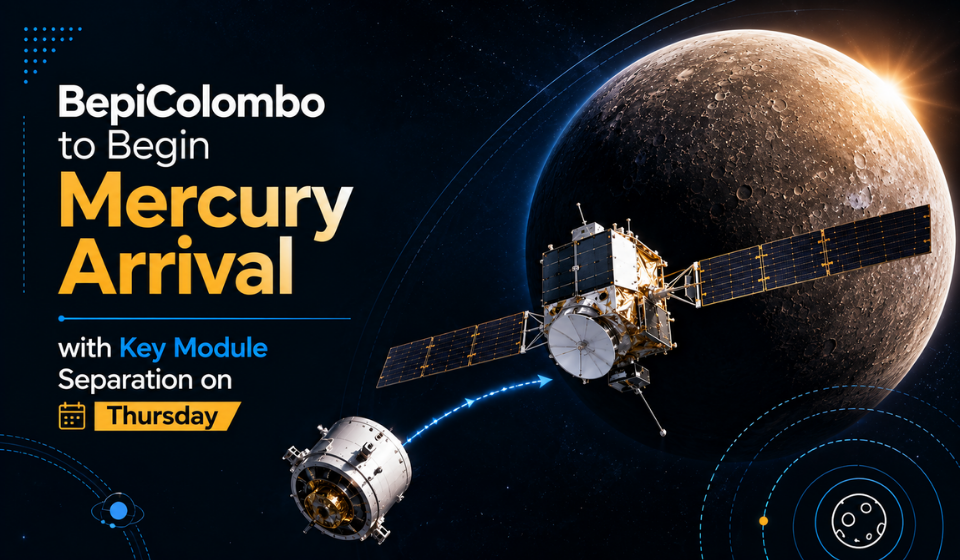
The joint European Space Agency (ESA) and Japan Aerospace Exploration Agency (JAXA) mission is scheduled to reach a major milestone on September 3, 2026, when its Mercury Transfer Module (MTM) separates from the two science orbiters.
The separation marks the beginning of BepiColombo’s Mercury Arrival Phase and starts a complex sequence of manoeuvres that will eventually place the two spacecraft into their dedicated orbits around Mercury. ESA describes the arrival sequence as one of its most operationally challenging planetary missions.
BepiColombo Reaches a Major Milestone
BepiColombo launched on October 20, 2018, aboard an Ariane 5 rocket from Europe’s Spaceport in French Guiana.
The spacecraft consists of three main components: ESA’s Mercury Planetary Orbiter (MPO), JAXA’s Mercury Magnetospheric Orbiter (Mio) and the Mercury Transfer Module.
The MTM has provided propulsion during the long journey towards Mercury. BepiColombo has used solar-electric propulsion together with gravity-assist manoeuvres to gradually alter its trajectory.
During its journey, the spacecraft completed nine planetary flybys: one of Earth, two of Venus and six of Mercury. These manoeuvres were crucial for reducing its energy and preparing it for eventual orbital insertion around Mercury.
On September 3, the MTM will separate from the MPO-Mio spacecraft composite, allowing the remaining spacecraft to begin the next stage of the arrival campaign.
What Happens After the Transfer Module Separates?
The separation is only the first step in BepiColombo’s arrival sequence.
MPO and Mio will remain connected after the MTM is released. Mercury Orbit Insertion is scheduled to begin on November 21, 2026, followed by a series of manoeuvres designed to establish the spacecraft in orbit around Mercury.
Mio is scheduled to separate from MPO in December. It will then move into its own highly elliptical science orbit around Mercury.
MPO will continue performing manoeuvres to reach its designated operational orbit. ESA currently expects routine science operations to begin in April 2027.
| BepiColombo Milestones | Planned Timing |
| Mercury Transfer Module separation | September 3, 2026 |
| Mercury Orbit Insertion begins | November 21, 2026 |
| Mio separation | December 9, 2026 |
| MPO reaches final orbit | March 2027 |
| Routine science operations | April 2027 |
The timeline remains subject to mission operations and spacecraft conditions.
Why Mercury Is Difficult to Reach
Mercury is one of the most challenging planets to reach with a spacecraft.
Because the planet is located close to the Sun, a spacecraft travelling inward gains orbital energy. Reaching Mercury is therefore not simply a matter of travelling towards the planet. A spacecraft must also lose enough energy to match Mercury’s orbital motion and eventually remain in orbit.
BepiColombo has overcome this challenge through a combination of solar-electric propulsion and gravity assists from Earth, Venus and Mercury.
Its long journey demonstrates the complexity of reaching the Solar System’s innermost planet. BepiColombo will become only the second mission in history to orbit Mercury, following NASA’s MESSENGER mission.
New Research Raises Questions About Mercury’s Surface
BepiColombo is also arriving at an interesting time for Mercury research.
Scientists continue to investigate the planet’s unusual geological history, including the composition of its surface and the processes that shaped its crust.
Recent research has suggested that Mercury may contain less silicon dioxide than previously estimated. The findings point towards the possibility that some of Mercury’s volcanic rocks formed from mantle material that experienced extensive melting.
However, this research should not be described as a discovery made by BepiColombo. Instead, observations from BepiColombo could help scientists test and refine these findings once its scientific instruments begin operating around Mercury.
One of the mission’s instruments, MERTIS, is designed to investigate Mercury’s surface composition using infrared observations.
What Will BepiColombo Study?
The two orbiters will conduct complementary investigations of Mercury.
ESA’s Mercury Planetary Orbiter will examine the planet’s surface, composition, interior and exosphere. JAXA’s Mio will focus particularly on Mercury’s magnetic environment and magnetosphere.
Together, the spacecraft carry a large collection of scientific instruments designed to investigate Mercury from different perspectives.
Scientists hope BepiColombo will help answer questions about the planet’s formation, geological history and unusually large metallic core.
The mission will also study Mercury’s magnetic field and its interaction with the solar wind. Detailed observations of the surface could provide further information about the materials and geological processes that shaped the planet.
A Complex Arrival Sequence
The September 3 separation represents a major transition for BepiColombo.
The Mercury Transfer Module has been essential to the spacecraft’s journey since launch. Once it separates, the remaining spacecraft will rely on the propulsion and manoeuvring systems needed for the final approach and orbital insertion sequence.
ESA has described the Mercury Orbit Insertion campaign as a complex series of manoeuvres extending from November 2026 into 2027. Mio and MPO will eventually operate independently, allowing each spacecraft to concentrate on its specific scientific objectives.
The successful completion of these steps will allow BepiColombo to move from an eight-year cruise into its long-awaited scientific mission.
Frequently Asked Questions
What is BepiColombo?
BepiColombo is a joint ESA-JAXA mission designed to study Mercury using two scientific orbiters: ESA’s Mercury Planetary Orbiter and JAXA’s Mercury Magnetospheric Orbiter.
When will BepiColombo’s transfer module separate?
The Mercury Transfer Module is scheduled to separate from the science spacecraft on September 3, 2026.
When will BepiColombo enter Mercury orbit?
Mercury Orbit Insertion is scheduled to begin on November 21, 2026.
When will Mio separate from MPO?
Mio is scheduled to separate from MPO in December 2026.
When will BepiColombo begin scientific operations?
ESA currently expects routine science operations to begin in April 2027.
What will BepiColombo study?
The mission will investigate Mercury’s surface, composition, interior, exosphere and magnetic environment, helping scientists better understand how the planet formed and evolved.
Conclusion
BepiColombo is entering the most critical stage of its journey after eight years of travel through the inner Solar System.
The September 3 separation of the Mercury Transfer Module will begin a demanding arrival sequence that includes Mercury Orbit Insertion in November, the separation of Mio in December and further manoeuvres to establish MPO in its dedicated science orbit.
The mission could provide valuable new information about Mercury’s surface, interior, magnetic environment and geological history. It may also help scientists test emerging ideas about the planet’s unusual composition.
If the planned sequence proceeds successfully, BepiColombo will begin its full scientific investigation of Mercury in 2027, opening a new chapter in the exploration of the Solar System’s innermost planet.