

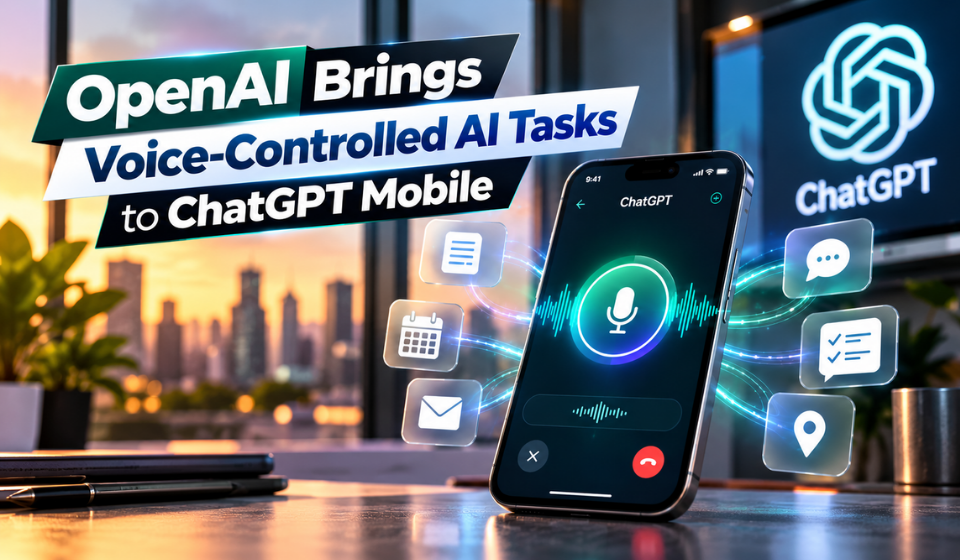
OpenAI Gives ChatGPT Voice a New Role in AI Task Automation
Table of Contents
Talking to an AI assistant is becoming less about getting a quick answer and more about getting something done. OpenAI is expanding ChatGPT Voice in that direction by connecting its spoken interface with newer AI models, Work mode and external services.
The change allows eligible users to begin certain activities by speaking rather than navigating through several menus or applications. From handling calendar-related requests to working with emails and creating presentations, the updated experience gives voice interaction a more practical role in everyday digital work.
From Voice Chat to Task Execution
Voice interaction has traditionally been useful when users want to ask a question, brainstorm an idea or have a conversational exchange. OpenAI’s latest development gives that interface a more operational purpose.
Through Work mode, eligible mobile users can issue spoken instructions that lead into longer workflows. Instead of treating each request as an isolated conversation, ChatGPT can use available tools as part of a broader task.
Examples of activities demonstrated or described in connection with the update include:
- Reviewing spending information
- Making a sports-court booking
- Rearranging calendar commitments
- Preparing an email
- Summarising workplace conversations
- Producing presentation material
The important distinction is that the user does not necessarily have to describe every action individually. The spoken request can act as the starting point for a sequence of operations.
A Wider Set of AI and App Connections
The upgraded ChatGPT Voice experience is also being connected with OpenAI’s GPT-6 model family.
The models identified in the supplied information are Astra, Sol and Luna. Astra is positioned at the higher end of the group, while Sol and Luna provide smaller alternatives.
Voice functionality is also being extended to connected services. Email, calendar and Slack integrations are among the capabilities associated with the update.
This creates a broader relationship between conversation and productivity tools.
| Area | Potential use |
| Voice interaction | Give instructions without typing |
| GPT-6 models | Process and respond to more advanced requests |
| Work mode | Handle longer, multi-step activities |
| Assist with communication-related tasks | |
| Calendar | Help manage scheduling activities |
| Slack | Work with information from workplace conversations |
Rather than requiring users to treat each service separately, the developing experience places more of these functions behind a common AI interface.
Why OpenAI Is Combining Voice With Text
Despite the emphasis on spoken interaction, OpenAI is not making voice the exclusive method of communication.
Some tasks are naturally suited to speech. Others are easier to understand when information is displayed visually. A long summary, a presentation or a detailed list, for example, may be more useful as on-screen content than as a spoken response.
The updated experience therefore allows users to move between voice and text. Work can also move across devices, allowing an activity started on a phone to be continued from a desktop environment.
This makes the interaction less dependent on a particular input method.
According to OpenAI product lead Atty Eleti, more than 150 million people use ChatGPT’s voice and dictation functionality. That figure indicates the size of the existing audience that could potentially interact with these newer capabilities.
Agentic AI Makes Voice More Useful
The bigger development is not simply improved speech interaction. It is the connection between voice and agentic AI.
An ordinary chatbot generally waits for a prompt and produces an answer. An agentic system can participate in a process involving several actions, depending on the tools and permissions available to it.
That distinction can be illustrated simply:
User describes an objective → ChatGPT interprets the request → Available tools are selected → Individual actions are performed → The user receives the resulting output
For mobile users, this could make AI assistance more convenient in situations where typing is impractical.
Someone could explain what needs to be organised, ask ChatGPT to work with relevant information and then review the resulting output on screen. The voice interface effectively becomes the command layer, while other ChatGPT capabilities handle the work underneath.
This is one reason ChatGPT Voice could become more significant as OpenAI develops its agent-focused products.
OpenAI Enters a More Competitive Assistant Landscape
The development is taking place while several technology companies are working toward more capable personal AI assistants.
The source material identifies Meta’s Muse and startup Instinct among the products competing for attention in this area. OpenAI is also continuing to release new products and capabilities ahead of its DevDay event.
Voice could eventually extend beyond phones and computers as well. Bloomberg has reported that OpenAI is working on a smart speaker that could potentially launch in 2027.
A dedicated device would give the company another possible route for making conversational AI part of everyday activities.
However, the current feature rollout has limitations. Access to GPT-6 and Work capabilities can vary according to subscription level and workspace configuration. OpenAI is also releasing the functionality progressively rather than making every capability available to all users simultaneously.
FAQs
What does the latest ChatGPT Voice update introduce?
It connects voice interaction with GPT-6 models, Work functionality and selected connected services, allowing spoken requests to initiate certain more complex activities.
What can users do with the new voice capabilities?
The described use cases include calendar management, spending analysis, booking activities, preparing emails, summarising Slack information and creating presentations.
Which GPT-6 models are associated with ChatGPT Voice?
The supplied information identifies Astra, Sol and Luna as the three GPT-6 models available within the updated experience.
Does ChatGPT Voice replace text interaction?
No. OpenAI’s approach combines different forms of interaction. Users can move between spoken and written communication depending on what works best for a particular task.
Can voice features access third-party services?
The updated system includes connections involving services such as email, calendars and Slack, subject to availability and account permissions.
Is the new functionality available to everyone?
No. Availability can depend on factors including the user’s subscription, workspace configuration and the stage of OpenAI’s rollout.
Conclusion
OpenAI is giving ChatGPT Voice a more active role in how people use AI. By connecting spoken instructions with GPT-6, Work mode and external services, the company is moving voice interaction beyond simple conversations and toward task initiation.
The combination of voice input, text output, connected applications and agentic workflows also creates a more flexible way to interact with AI across mobile and desktop devices.
As these capabilities continue to develop, the important change is not simply that ChatGPT can understand speech. The larger shift is that a spoken request can increasingly become the starting point for a sequence of digital actions.