

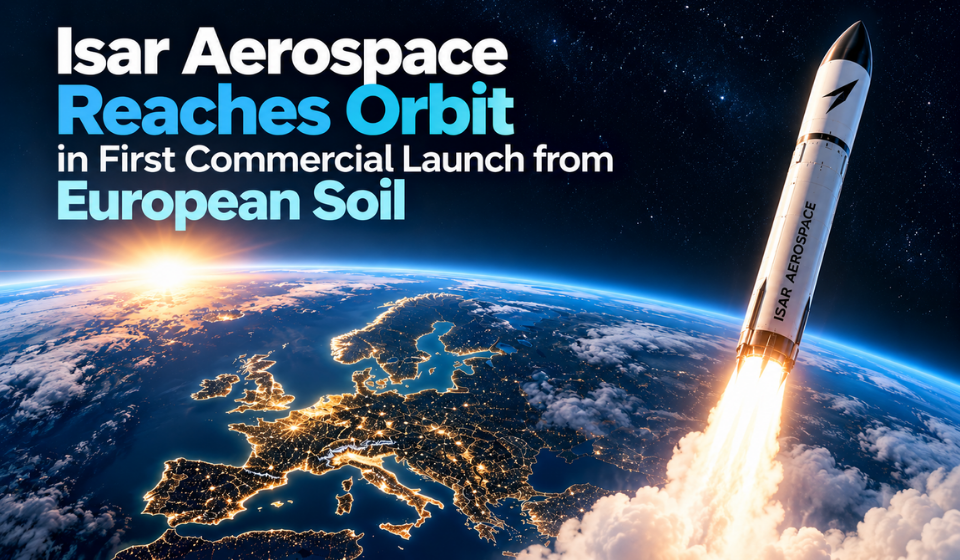
Isar Aerospace Makes History With First Commercial Orbital Launch From Continental Europe
Table of Contents
German space company Isar Aerospace has achieved a major milestone after successfully sending its Spectrum rocket into orbit from Andøya Spaceport in northern Norway.
The launch took place on September 5, 2026, at 10:12 p.m. CEST. According to Isar Aerospace and the European Space Agency (ESA), the mission marked the first successful commercial orbital launch from continental Europe.
The achievement represents an important step for Europe’s commercial launch industry and follows the unsuccessful first flight of Spectrum in March 2025.
Isar Aerospace Successfully Reaches Orbit
The 28-metre Spectrum rocket, flying under the mission name “Onward and Upward,” carried five small satellites and a technology experiment supported through ESA’s Boost! programme.
Isar Aerospace confirmed that the mission successfully reached orbit and deployed its payloads. The company described the flight as both a qualification mission and Spectrum’s first flight carrying payloads.
The mission was only the second flight of the Spectrum launch vehicle, making the successful orbital insertion an important milestone for the German startup.
| Mission Detail | Information |
| Company | Isar Aerospace |
| Rocket | Spectrum |
| Mission | Onward and Upward |
| Launch site | Andøya Spaceport, Norway |
| Launch date | September 5, 2026 |
| Launch time | 10:12 p.m. CEST |
| Payload | Five small satellites + one technology experiment |
| Flight number | Second Spectrum flight |
A Second Attempt After a Failed First Flight
The successful mission follows a difficult beginning for the Spectrum programme.
Isar Aerospace’s first Spectrum flight in March 2025 ended unsuccessfully after the rocket lost control shortly after launch and fell into the sea. The company subsequently investigated the failure and worked on further development before returning to the launchpad.
The successful second flight shows that Isar Aerospace was able to overcome the technical challenges that followed its initial failed mission. The company has now completed an orbital mission carrying and deploying payloads.
Why the Launch Matters for Europe
The significance of the mission extends beyond Isar Aerospace itself.
Europe has launched satellites into orbit for decades using established programmes and launch facilities, including Ariane launches from French Guiana. However, this mission demonstrated that a European commercial company could successfully conduct an orbital launch from continental European territory.
That gives Europe’s commercial space sector another potential route to orbit and supports broader efforts to strengthen European capabilities in space transportation.
The European Space Agency has described the achievement as an important milestone for commercial space transportation and European access to space.
Spectrum Targets the Satellite Launch Market
Spectrum is being developed to serve the satellite launch market, particularly small and medium-sized payloads.
The demand for commercial launch services has grown as companies, governments, universities and research organisations deploy satellites for communications, Earth observation, scientific research and technology demonstrations.
The successful mission gives Isar Aerospace valuable flight experience as it works toward establishing Spectrum as a commercial launch vehicle.
Reuters reported that the company has five additional rockets in production and is targeting the capacity to conduct as many as 40 launches annually. This is a future company target rather than an established launch rate.
Growing Competition in Europe’s Space Industry
Isar Aerospace is part of a wider group of European companies developing commercial launch systems.
Startups including Rocket Factory Augsburg, PLD Space and MaiaSpace are also working on new launch vehicles, while established European programmes continue to operate larger launch systems.
This growing ecosystem reflects Europe’s interest in developing additional commercial launch options and reducing reliance on launch providers outside the region.
However, Isar Aerospace is still at an early stage of commercial operations. One successful orbital flight does not by itself establish the company as a major global launch provider.
Isar Aerospace Plans More Launches
The successful Spectrum mission provides Isar Aerospace with an important foundation for future operations.
Reuters reported that the company plans to increase production, with five more rockets underway and an eventual target of up to 40 launches per year. The company is also developing launch infrastructure in Nova Scotia, Canada, with operations from the site expected in the future.
These plans will depend on the company’s ability to demonstrate consistent launch reliability, scale manufacturing and secure additional customers.
The next phase will therefore be important. Isar Aerospace will need to turn the success of its second Spectrum flight into repeatable commercial missions.
What the Successful Launch Means
The September mission is significant for three main reasons.
First, it demonstrates that a European commercial company can successfully reach orbit from continental Europe. Second, it provides Isar Aerospace with its first successful orbital mission after the failure of its inaugural Spectrum flight. Third, it adds another potential commercial launch provider to Europe’s growing space ecosystem.
The achievement does not mean Europe has become independent of foreign launch providers. Instead, it represents another step toward greater European capacity and strategic flexibility in accessing space.
Conclusion
The successful Spectrum launch marks an important achievement for Isar Aerospace and Europe’s commercial space sector.
By reaching orbit and deploying its payloads from Andøya Spaceport, the German company has demonstrated a new commercial launch capability from continental Europe. The mission also represents a successful second flight following Spectrum’s unsuccessful debut in 2025.
For Isar Aerospace, the next challenge is turning this milestone into a reliable and repeatable commercial launch service. Its plans for additional rockets and future launch infrastructure show an ambition to expand, but those goals remain ahead of the company.
For Europe, the launch adds another commercial route to orbit and supports the broader effort to strengthen the region’s space transportation capabilities. The September 2026 mission is therefore best viewed not as the completion of Europe’s launch ambitions, but as an important step in their continued development.