

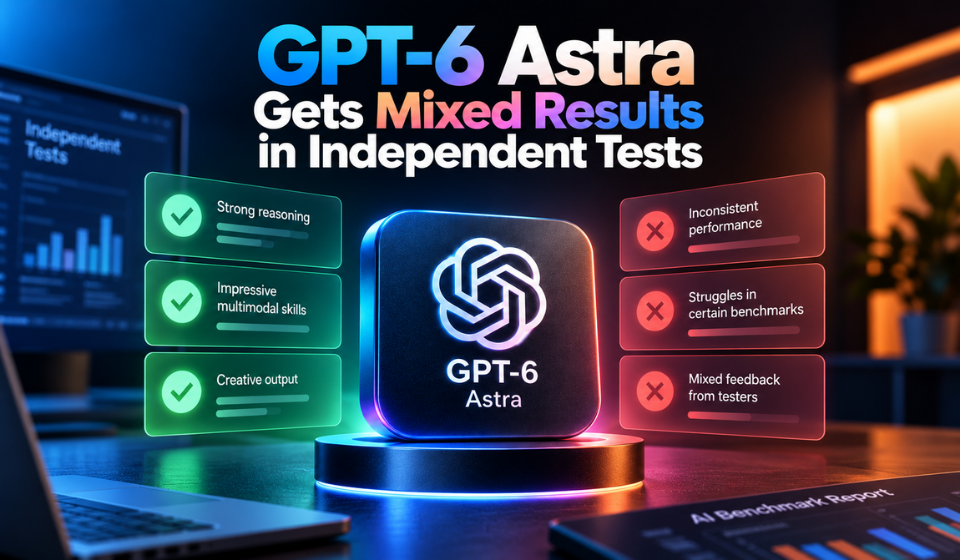
GPT-6 Astra Gets Mixed Benchmark Results Despite Major AI Advances
Table of Contents
OpenAI has launched GPT-6 Astra, its latest AI model designed for complex, multi-step tasks involving coding, research, computer use and professional work. OpenAI describes Astra as its most capable model yet, but early independent evaluations have produced different views of its overall position among leading AI models.
Epoch AI’s composite evaluation places Astra at the top of its ranking, while Artificial Analysis gives it a score equal to OpenAI’s previous GPT-5.6 Sol and below Anthropic’s Claude Fable 5.1. The difference highlights how benchmark methodology can affect AI model rankings.
Independent Benchmarks Give Different Results
The contrasting evaluations are one of the most notable aspects of the GPT-6 Astra launch.
According to recent reporting, Epoch AI’s composite evaluation gives Astra a score of 169, placing it first in its ranking. The evaluation combines results across areas such as reasoning, mathematics, science and agentic capabilities.
Artificial Analysis presents a different picture. Its Intelligence Index gives Astra a score of 61, while Claude Fable 5.1 scores 66. GPT-5.6 Sol is also listed at 61.
The difference does not necessarily mean that one evaluation is incorrect. The two systems measure different capabilities and use different methodologies and weighting approaches.
Epoch AI has also indicated that Astra’s lead falls within the uncertainty range of previous leading models. As a result, there is no single independent benchmark that can definitively establish Astra as the world’s best AI model across all tasks.
| Evaluation | GPT-6 Astra | Key takeaway |
| Epoch AI composite | 169 | Ranked first in its composite assessment |
| Artificial Analysis Intelligence Index | 61 | Level with GPT-5.6 Sol and below Claude Fable 5.1 |
| ARC-AGI-3 Standard | 62.7% | Strong result under the standard harness |
| ARC-AGI-3 Provider Adapter | 99.9% | Higher result under a different configuration |
Strong Performance on ARC-AGI-3
Astra has attracted significant attention for its performance on ARC-AGI-3, a benchmark designed to evaluate agentic intelligence in unfamiliar environments.
ARC Prize reported a 62.7% result under its standard harness, with a recorded cost of approximately $26,098. Under a separate Provider Adapter configuration, Astra achieved a result of 99.9%, with a recorded cost of about $18,817.
These scores should not be treated as directly equivalent. The Provider Adapter uses a different configuration that preserves the model’s reasoning state between requests and supports context management.
Astra also demonstrated strong action efficiency. ARC Prize reported that it used fewer actions than the median human participant on 96% of tested levels, with 51.7% fewer actions per level on average.
This is a benchmark-specific efficiency result and should not be interpreted as evidence that Astra is generally more capable than humans. ARC Prize also makes clear that ARC-AGI-3 performance does not establish that a model has achieved artificial general intelligence.
Improvements in Computer Use and Professional Tasks
OpenAI’s own evaluations indicate significant improvements in computer-based tasks.
The company reports that Astra achieved 72.6% on OSWorld 2.0, compared with 65.7% for GPT-5.6 Sol in its testing. OpenAI also reports that Astra can complete comparable computer-based tasks faster.
The model is designed to interact with computers, browse websites and complete multi-step workflows. OpenAI says Astra can also create documents, spreadsheets and presentations while adapting when requirements change.
These capabilities could make the model useful for professional workflows involving research, software development and other computer-based tasks.
Because these results come from OpenAI’s own evaluations, they should be considered alongside independent benchmarks.
Coding and Agentic Capabilities
Coding is another major focus of GPT-6 Astra.
OpenAI describes Astra as a state-of-the-art model for software engineering and complex professional work. Its ability to handle longer workflows is intended to improve productivity on tasks requiring multiple steps.
The model’s agentic capabilities also allow it to move beyond simply answering questions. Instead, it can interact with digital environments and perform actions as part of a broader workflow.
However, real-world performance can vary depending on the tools available, task complexity and the specific workflow being evaluated.
GPT-6 Astra Has Higher API Pricing
Astra is positioned at a higher price point than GPT-5.6 Sol.
OpenAI lists standard Astra API pricing at $10 per million input tokens and $50 per million output tokens. GPT-5.6 Sol is listed at $4 per million input tokens and $20 per million output tokens, making Astra’s standard rates 2.5 times higher.
The actual cost of completing a task can vary depending on token consumption and how efficiently the model solves the problem. Businesses and developers therefore need to consider performance alongside token costs and overall workflow efficiency.
Safety Concerns Increase With Capability
Greater AI capabilities also bring additional safety challenges.
OpenAI says Astra is its first model to reach the Critical cybersecurity capability threshold under its Preparedness Framework. The company has introduced additional safeguards and monitoring around these capabilities.
The launch has also attracted scrutiny over the challenges involved in monitoring increasingly capable AI agents. As models gain the ability to interact with computers and digital systems, controlling what they can access and ensuring reliable behaviour becomes increasingly important.
Is GPT-6 Astra the World’s Best AI Model?
OpenAI presents Astra as its most intelligent and aligned model. However, independent evaluations do not provide a unanimous ranking.
Epoch AI’s composite assessment places Astra first, while Artificial Analysis currently gives it a score equal to GPT-5.6 Sol and below Claude Fable 5.1.
This difference shows why claims about the “best” AI model need to specify the benchmark and capabilities being measured. For businesses and developers, comparing models based on the tasks they actually need to perform may be more useful than relying on a single overall ranking.
FAQs
What is GPT-6 Astra?
GPT-6 Astra is OpenAI’s latest AI model, designed for coding, research, computer use and complex multi-step professional tasks.
Is GPT-6 Astra the best AI model?
There is no universal independent ranking establishing Astra as the best model. Different evaluations currently produce different results.
What did Astra score on ARC-AGI-3?
Astra achieved 62.7% under ARC Prize’s standard harness and 99.9% under a separate Provider Adapter configuration.
Did Astra surpass humans?
Astra used fewer actions than the median human participant on 96% of ARC-AGI-3 levels tested. This is a benchmark-specific efficiency result and does not establish general superiority over humans.
How much does GPT-6 Astra cost?
OpenAI’s standard API pricing is $10 per million input tokens and $50 per million output tokens.
Has GPT-6 Astra achieved AGI?
No. The available benchmark results do not establish that Astra has achieved artificial general intelligence.
Conclusion
GPT-6 Astra represents a significant development in OpenAI’s efforts to build AI systems capable of handling complex, multi-step digital work.
The model has demonstrated strong performance in computer use, coding and agentic tasks, while ARC Prize’s testing highlights its action efficiency in unfamiliar environments. At the same time, independent evaluations offer different views of Astra’s overall position, with Epoch AI ranking it highly while Artificial Analysis places it level with GPT-5.6 Sol and below Claude Fable 5.1.
These differences demonstrate why AI rankings need to be considered in context. Benchmark methodology, reasoning configuration, task type and cost can all influence the results.
With higher API pricing and additional safety considerations around its advanced capabilities, the long-term value of GPT-6 Astra will ultimately depend on how effectively it performs in real-world applications.