

China’s Largest Power Source Shifts as Solar Capacity Overtakes Coal
Table of Contents
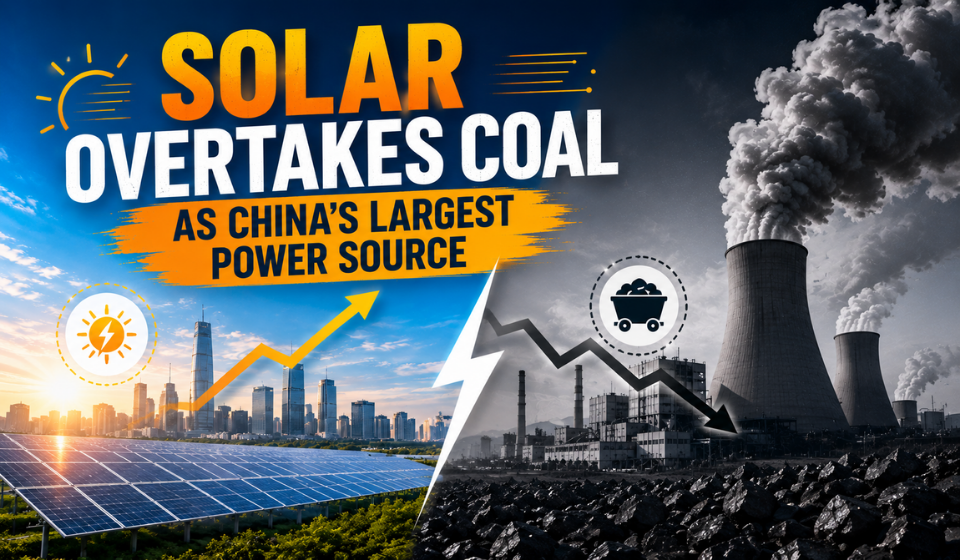
China has reached a historic energy milestone, with solar power overtaking coal to become China’s largest power source by installed power generation capacity.
Data released by China’s National Energy Administration showed that installed solar capacity reached 1,286 gigawatts by the end of July 2026. This narrowly exceeded the country’s 1,285 gigawatts of coal-fired power capacity.
Solar accounted for 31.5% of China’s total installed power generation capacity, marking the first time it has moved ahead of coal.
However, the milestone applies specifically to installed capacity. Coal remains China’s largest source of actual electricity generation because coal-fired power plants can operate for significantly more hours than solar installations.
Solar Overtakes Coal by Installed Capacity
The crossover represents a major shift in China’s energy infrastructure after more than a century of coal and thermal power dominance.
Recent reporting has described the development as ending a 144-year period of coal dominance in China’s installed power structure, dating back to the opening of the country’s first thermal power plant in Shanghai in 1882.
China’s rapid investment in renewable energy has helped solar capacity grow at an unprecedented scale.
| Power Source | Installed Capacity at the End of July 2026 |
| Solar Power | 1,286 GW |
| Coal-Fired Power | 1,285 GW |
The gap between the two sources is narrow, but the milestone is significant because China is the world’s largest greenhouse gas emitter and one of the world’s largest markets for renewable energy.
Installed Capacity Is Not the Same as Electricity Generation
Solar becoming China’s largest power source by installed capacity does not mean that it has overtaken coal in actual electricity generation.
Solar panels generate power when sunlight is available, while coal-fired power plants can operate for much longer periods.
During the first half of 2026, coal accounted for around 49.7% of China’s electricity generation, marking the first time its share fell below 50%. Wind and solar combined accounted for approximately 24.6%.
Solar installations generally have far fewer annual utilisation hours than coal-fired plants. As a result, coal can generate significantly more electricity despite having slightly less installed capacity.
This distinction is important because installed capacity measures the potential maximum output of power infrastructure, while electricity generation measures the actual amount of power produced.
Solar Generation Continues to Grow
China’s growing solar capacity is also increasing the amount of renewable electricity entering its power system.
During the first seven months of 2026, solar generation reportedly rose 15.5% compared with the same period a year earlier, reaching 802.4 billion kilowatt-hours.
The figure represented roughly one-eighth of China’s electricity output during the period.
The continued growth shows that China’s expanding solar infrastructure is making an increasingly important contribution to the national power system. However, coal continues to play a major role in meeting electricity demand and supporting grid reliability.
New Solar Installations Have Slowed
The historic crossover comes despite a slowdown in the pace of new solar installations.
China added about 86 gigawatts of solar capacity during the first seven months of 2026, around 61–62% lower than the exceptionally high level recorded during the same period in 2025.
The comparison was influenced by an unusually large installation push in 2025. China added around 93 gigawatts of solar capacity in May 2025 alone as developers accelerated projects before changes to renewable energy pricing arrangements took effect.
The slower pace in 2026 followed a shift away from previous guaranteed revenue arrangements for wind and solar projects towards more market-oriented pricing mechanisms.
The slowdown does not necessarily mean that China’s solar expansion is reversing. Instead, it reflects changing policies and the unusually high comparison base from the previous year.
Coal Still Plays a Major Role
Despite solar becoming China’s largest power source by capacity, coal remains central to the country’s electricity system.
Coal-fired power plants can operate for more hours during the year and therefore produce more electricity than solar installations with similar installed capacity.
China’s energy transition is therefore not an immediate replacement of coal with solar. The country is rapidly expanding renewable infrastructure while continuing to rely heavily on coal for electricity generation.
The long-term impact of China’s renewable expansion will depend on how effectively the country can integrate growing amounts of solar and wind power into its electricity grid.
Investment in energy storage, transmission networks and other grid technologies could become increasingly important as renewable capacity continues to grow.
Global Implications of China’s Solar Growth
China’s solar expansion has implications beyond its domestic energy market.
The country dominates the global solar supply chain and supplies more than 80% of the world’s photovoltaic modules. It is also expected to continue investing heavily in the solar sector, with reported investment expected to exceed 2 trillion yuan over the next five years.
China’s large-scale deployment has helped expand global solar manufacturing and increase the availability of solar technology.
However, the country’s continued dependence on coal means the environmental impact of its energy transition will depend not only on renewable capacity growth but also on how much fossil fuel generation is eventually replaced.
Frequently Asked Questions
What is China’s largest power source?
Solar has become China’s largest power source by installed generation capacity. Coal remains the country’s largest source of actual electricity generation.
How much solar capacity does China have?
China’s installed solar power capacity reached 1,286 gigawatts by the end of July 2026.
Has solar replaced coal in China?
No. Solar has overtaken coal in installed capacity, but coal continues to generate a larger share of China’s electricity.
Why does coal still generate more electricity?
Coal-fired power plants can operate for more hours throughout the year, while solar generation depends on the availability of sunlight.
Conclusion
Solar becoming China’s largest power source by installed capacity marks a historic shift in the country’s energy infrastructure.
With 1,286 gigawatts of solar capacity, China has narrowly moved ahead of coal’s 1,285 gigawatts for the first time. However, coal remains the country’s largest source of actual electricity generation.
The milestone highlights the extraordinary scale of China’s renewable energy expansion while also showing that the transition away from fossil fuels remains incomplete. As solar and wind capacity continue to grow, China’s ability to integrate renewable electricity and reduce dependence on coal will play a major role in determining the long-term impact of this historic shift.