

Mars Interior Temperature Discovery Reveals a Hotter Southern Hemisphere
Table of Contents
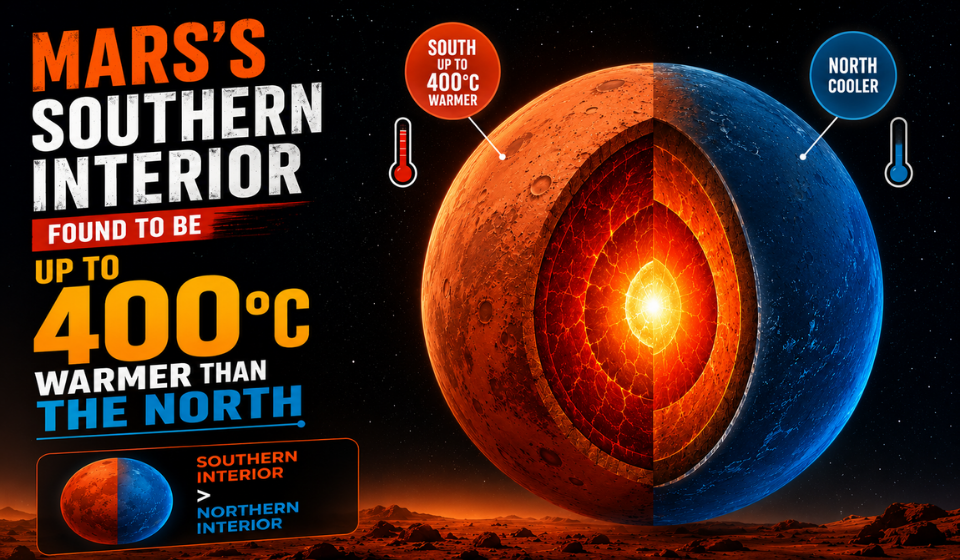
A new study has revealed a major difference in Mars interior temperature, with the mantle beneath the planet’s southern highlands estimated to be around 200 to 400 degrees Celsius warmer than the northern half.
The findings, published in Nature, suggest that Mars’s well-known north-south divide extends far below its surface. Researchers also found that the warmer southern mantle may be associated with partial melting, although the extent of any molten material remains uncertain. The discovery could provide new insights into the geological processes that shaped Mars and the periods when conditions may have been more favourable for water and potential habitability.
A Deep Divide Between Mars’s North and South
Mars has long been recognised as a geologically uneven planet.
Its southern hemisphere is generally higher, more rugged and heavily cratered, with mountains and ancient impact features. The northern hemisphere, in comparison, contains lower and flatter plains. Scientists have studied this striking difference, known as the Martian crustal dichotomy, for decades.
The new research suggests that the contrast is not limited to Mars’s visible surface and crust. The planet’s mantle also appears to have a strong north-south temperature difference.
Researchers were surprised by how clearly the interior pattern aligned with the surface divide. The finding supports the idea that large-scale processes responsible for Mars’s geological differences may extend deep into the planet’s interior.
How Scientists Studied Mars’s Interior
The research used gravitational measurements collected over approximately 16 years from three NASA spacecraft: Mars Global Surveyor, Mars Odyssey and Mars Reconnaissance Orbiter.
The team applied a technique called tidal tomography to Mars for the first time. Mars experiences changing gravitational forces from the Sun because of its slightly elliptical orbit and tilted rotational axis. These forces produce small, measurable changes in the planet’s gravity field.
By studying how spacecraft movements responded to these variations, researchers were able to reconstruct information about Mars’s internal structure.
| Research Detail | Finding |
| Spacecraft used | Mars Global Surveyor, Mars Odyssey and Mars Reconnaissance Orbiter |
| Technique | Tidal tomography |
| Main finding | Southern mantle is about 200–400°C warmer |
| Location | Beneath the southern highlands |
| Possible effect | Conditions may promote localised partial melting |
The research was led by Alexander Berne, a Caltech alumnus who is now a postdoctoral associate at the University of Arizona. The study demonstrates how long-term gravitational observations can help scientists investigate parts of planetary interiors that cannot be directly observed.
What the Warmer Southern Mantle Could Explain
The newly identified difference in Mars interior temperature may help explain several other long-standing observations.
One involves magnetic anomalies found in iron-rich materials in Mars’s southern hemisphere. The research suggests that differences in the planet’s deep interior could be connected to processes that influenced the development of these magnetic features.
The warmer mantle may also provide an explanation for differences observed by NASA’s InSight mission. Seismic waves originating from parts of the southern highlands were found to dissipate more quickly than those associated with some northern regions. Higher temperatures can affect the way seismic energy travels through planetary material.
However, researchers have not identified one single explanation for all of these observations. The new thermal anomaly instead provides an important piece of evidence for understanding how Mars’s interior, crust and geological history may be connected.
What Does the Discovery Mean for Mars’s Past Habitability?
The discovery does not show that Mars supported life. However, it could improve scientists’ understanding of the geological processes that influenced the planet’s ancient environment.
The north-south dichotomy is important because it may provide information about processes that affected Mars’s hydrology, including the formation of basins that may have contained water.
Scientists have previously considered the northern lowlands as a possible location for ancient bodies of water. Understanding how the planet’s interior evolved could therefore help researchers investigate why particular regions developed differently and how geological processes influenced the movement and storage of water.
The study also raises broader questions about Mars’s tectonic history. Scientists are still trying to understand whether Mars could ever have sustained plate tectonics, a geological process that plays an important role in Earth’s long-term evolution and habitability.
Mars’s geological history remains incomplete, and the newly identified thermal difference adds another important factor to the investigation.
What Caused the Thermal Anomaly?
The origin of the southern thermal anomaly remains unknown.
Researchers have proposed several possible explanations. One possibility is regional mantle convection, in which material inside the planet moves and redistributes heat. Another possibility is that the thicker crust beneath the southern highlands acted as an insulating layer, helping to retain heat over billions of years.
A giant impact during Mars’s early history has also been considered as a possible contributor to the planet’s north-south differences. However, scientists have not confirmed that any single event or process created the anomaly.
The research therefore leaves an important open question: why has such a major temperature difference been preserved inside Mars?
The study also does not establish the exact amount of molten material in the southern mantle. The warmer conditions may promote localised melting, but future observations will be needed to determine whether this involves isolated magma pockets or a more continuous molten layer at depth.
Why the Mars Interior Temperature Discovery Matters
The study provides a new way of looking at Mars as a planet whose major geological differences extend below its surface.
Understanding the Mars interior temperature could help scientists connect several features that previously appeared to be separate, including differences in surface geography, crustal magnetisation and seismic behaviour.
It also highlights the importance of studying planetary interiors when investigating how worlds formed and evolved.
Future observations and missions could provide additional information about the southern thermal anomaly and determine how much of the mantle may be affected by higher temperatures or partial melting.
Frequently Asked Questions
What did scientists discover about the Mars interior temperature?
Researchers found evidence that the mantle beneath Mars’s southern highlands is around 200 to 400 degrees Celsius warmer than the northern half of the planet.
How was the discovery made?
Scientists used gravitational data from three NASA Mars orbiters and applied tidal tomography to investigate differences in the planet’s internal structure.
Is Mars’s southern mantle completely molten?
No. The warmer conditions may promote localised partial melting, but scientists have not confirmed the extent or distribution of molten material.
Could the discovery help scientists understand Mars’s habitability?
The findings do not provide evidence of life. However, they may help researchers understand geological processes that influenced Mars’s hydrology and the formation of basins that may have held water.
Conclusion
The new Mars interior temperature discovery reveals that the planet’s north-south divide extends deep beneath its surface.
The mantle beneath the southern highlands appears to be around 200 to 400 degrees Celsius warmer than the northern half, creating a significant thermal contrast that may be linked to Mars’s magnetic features, seismic behaviour and geological evolution.
Although scientists still do not know what caused the anomaly, the research provides a valuable new perspective on the Red Planet’s interior. Future studies may help determine whether the warmer mantle contains localised magma and reveal more about the processes that shaped Mars and its potential to have supported habitable environments in the distant past.