

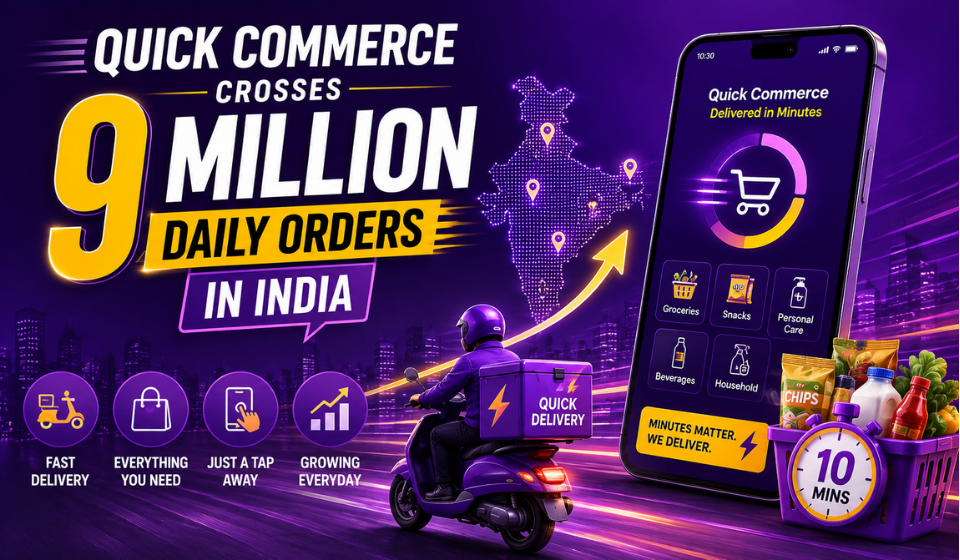
India’s Quick Commerce Market Surges Past 9 Million Daily Orders as Competition Intensifies
Table of Contents
India’s quick commerce market has reached a new scale, with the country’s six major platforms collectively processing around 9.5 million orders per day, according to recent industry estimates. The milestone highlights how rapidly ultra-fast delivery has moved beyond a niche convenience service and become an important part of India’s retail market.
The latest figures also show that competition is becoming more intense. Blinkit continues to lead the market, while Zepto, Swiggy Instamart, Flipkart Minutes, Amazon Now and BigBasket are expanding their presence.
The growth, however, comes alongside a bigger question: can quick commerce companies turn massive order volumes into sustainable profits?
Blinkit Remains the Market Leader
Blinkit continues to occupy the top position, with estimated daily orders of approximately 3.4 million to 3.6 million.
Zepto follows with around 2.4 million to 2.6 million daily orders, while Swiggy Instamart is estimated at approximately 1.3 million to 1.45 million. Together, the three leading platforms account for roughly four-fifths of the estimated daily order volume.
The remaining market is increasingly important as well. Flipkart Minutes has crossed the 1 million daily-order mark, while Amazon Now and BigBasket are also building meaningful volumes.
Quick Commerce Order Snapshot
| Platform | Estimated Daily Orders |
| Blinkit | 3.4–3.6 million |
| Zepto | 2.4–2.6 million |
| Swiggy Instamart | 1.3–1.45 million |
| Flipkart Minutes | More than 1 million |
| Amazon Now | 600,000–700,000 |
| BigBasket | 500,000–600,000 |
Because these figures are industry estimates and some are presented as ranges, they should not be interpreted as audited company-reported numbers.
Zepto Shifts From Volume to Bigger Baskets
While order growth remains important, Zepto is increasingly focusing on another metric: average order value.
The company’s reported average basket remains below those of major competitors. Earlier industry comparisons placed Zepto’s average order value around ₹300–350, compared with higher levels at Blinkit and Instamart.
The strategy is significant because increasing the value of each order could improve economics without requiring the company to generate an equivalent increase in order volume.
The change also comes as Zepto prepares for another attempt at an initial public offering, making profitability and cash efficiency increasingly important.
Traditional Retailers Are Entering the Race
The quick commerce battle is no longer limited to companies built around dark stores.
Traditional retailers are increasingly using their existing store networks to fulfil rapid-delivery orders. Vishal Mega Mart, for example, has been expanding quick-commerce fulfilment through its physical stores. Financial Express reported that the retailer was using 767 of 819 stores across 520 cities for quick-commerce fulfilment.
This model could reduce the need to build an entirely separate network of dedicated fulfilment locations, although its economic benefits will vary by retailer, location and order density.
Reliance Retail and other established retailers are also exploring ways to use their physical networks to participate in faster digital commerce.
Quick Commerce Moves Beyond Groceries
Another major change is the expansion of quick commerce beyond everyday groceries.
Platforms are increasingly exploring premium, gourmet and higher-value categories as they attempt to increase basket sizes.
The sector is also beginning to explore faster delivery of larger products. Recent reports indicate that companies including Blinkit and Swiggy Instamart are exploring the possibility of delivering large appliances such as refrigerators, televisions and washing machines within around 30 minutes.
If successful, this could significantly expand the addressable market for quick commerce.
Amazon and Flipkart Increase Competitive Pressure
Amazon and Flipkart are adding further pressure to India’s established quick-commerce leaders.
Flipkart Minutes has rapidly increased its order volumes, while Amazon Now has also gained traction. Their participation gives the sector competitors with large existing customer bases, logistics capabilities and financial resources.
The result is a market where companies are competing on more than delivery speed. Assortment, pricing, customer retention, order value, fulfilment efficiency and profitability are becoming increasingly important.
Growth Comes With New Challenges
The rapid expansion of quick commerce is also attracting greater regulatory attention.
For example, Maharashtra’s Food and Drug Administration recently suspended 14 food-business licences linked to Blinkit, Zepto and Instamart facilities following inspections that identified hygiene and food-safety violations. The action demonstrates that rapid expansion also brings greater scrutiny of storage and fulfilment operations.
This does not mean the entire quick-commerce sector has widespread safety problems, but it shows why operational standards will become increasingly important as order volumes grow.
What Comes Next?
The latest order figures demonstrate the enormous scale that quick commerce has achieved in India.
However, the next phase is likely to focus less on simply increasing orders and more on improving the economics behind every transaction. Larger baskets, premium categories, store-based fulfilment and operational efficiency could help companies generate stronger returns from their existing networks.
With the festive season approaching, demand could increase further. The industry will then face an important test: whether its rapid growth can translate into sustainable businesses.
Conclusion
India’s quick commerce market has crossed a major milestone, with the six leading platforms now estimated to handle roughly 9.5 million orders each day. Blinkit remains the largest player, while Zepto and Instamart continue to compete closely and Amazon Now and Flipkart Minutes are rapidly expanding.
At the same time, traditional retailers are using physical stores to enter the market, while quick-commerce companies are expanding beyond groceries into higher-value categories.
The industry’s future will ultimately depend on more than how quickly an order reaches the customer. Order value, operational efficiency, profitability, regulatory compliance and customer demand are likely to determine which companies can sustain India’s quick-commerce boom over the long term.