


Table of Contents
Xiaomi has unveiled three new in-house chipsets designed for smartphones, artificial intelligence and autonomous driving, marking a major expansion of its semiconductor ambitions.
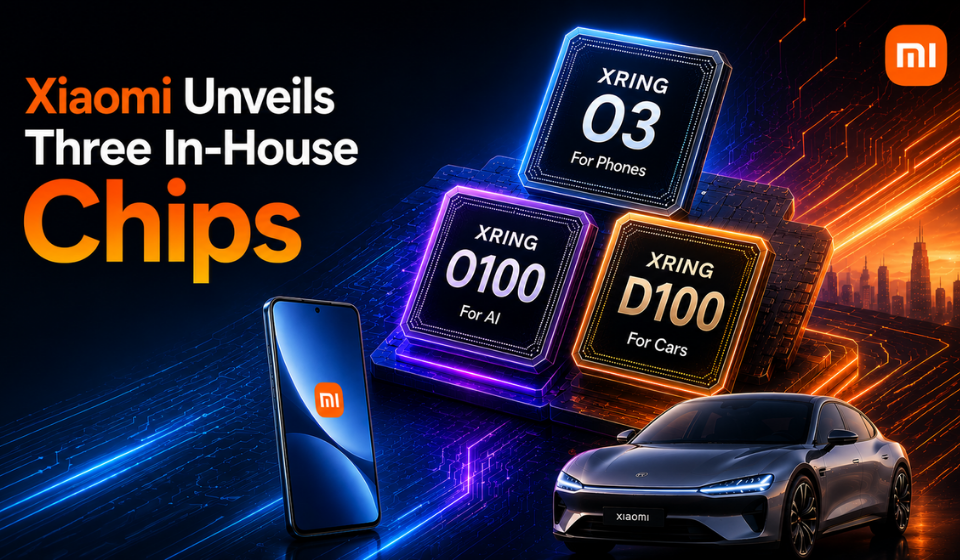
The new lineup consists of the Xring O3, a flagship smartphone processor; the Xring O100, an AI-focused accelerator; and the Xring D100, a processor designed for intelligent-driving applications.
The announcement comes about a year after Xiaomi introduced its first proprietary smartphone processor, the Xring O1. The company has now invested more than 20 billion yuan ($3 billion) in Xring chip development, while its semiconductor design team has grown to more than 3,000 employees, according to Reuters.
Xring O3 Targets Flagship Devices
The Xring O3 is manufactured using TSMC’s 3nm process technology and is intended for Xiaomi’s upcoming flagship devices.
Xiaomi says the processor achieved an AnTuTu score of 5.22 million points, making it the first mobile SoC to cross the five-million mark according to the company’s claim. Because this is a manufacturer-reported benchmark, the figure should not be treated as an independently verified industry record.
The O3 features a 10-core CPU, a 16-core GPU and support for LPDDR6 memory. Xiaomi also rates its AI processing capability at 200 TOPS.
The chip is expected to power Xiaomi’s upcoming Xiaomi 18 Fold, with the company also announcing it for the Xiaomi Pad 9 Pro Max. The 18 Fold is scheduled to launch in China in September.
Xring O100 Brings AI Acceleration
The second processor is the Xring O100, a 6nm neural processing unit designed for AI workloads.
The chip is intended to support Xiaomi’s MiMo large language models and other AI applications. Xiaomi says its architecture can deliver bandwidth of up to 1.22TB/s.
The O100 expands Xiaomi’s chip ambitions beyond smartphones by targeting AI processing and large-model workloads. The company says the chip has completed development and is scheduled for deployment next year.
Xring D100 Targets Intelligent Driving
The Xring D100 is Xiaomi’s third new processor and is designed for autonomous-driving applications.
The 3nm chip includes a 20-core CPU and 16-core NPU, while Xiaomi says it can support up to 160GB of unified memory and run AI models containing as many as 200 billion parameters locally.
The D100 has completed development, with deployment planned for next year. Its eventual capabilities will depend on how the processor is integrated into Xiaomi’s vehicle systems and software.
Xiaomi Xring Chips at a Glance
| Chip | Process | Primary Focus | Current Status |
| Xring O3 | 3nm | Smartphones and tablets | Mass production |
| Xring O100 | 6nm | AI processing | Development completed |
| Xring D100 | 3nm | Intelligent driving | Development completed |
The reported specifications are based on Xiaomi’s announcements and available reporting; performance claims such as benchmark scores should be distinguished from independently verified results.
Why Xiaomi Is Investing in Its Own Chips
Xiaomi’s semiconductor strategy is partly aimed at giving the company greater control over product features and strengthening its position when negotiating with external suppliers.
Developing proprietary processors also puts Xiaomi closer to competitors such as Apple, Samsung and Huawei, which have developed their own silicon for selected products.
The strategy comes at a time when component costs remain an important consideration for electronics manufacturers. Xiaomi sold about 65 million smartphones during the first half of 2026, according to Reuters, while its growing electric-vehicle business delivered more than 104,000 vehicles in the second quarter.
The company’s chip investment therefore extends across several parts of its broader hardware ecosystem rather than focusing exclusively on smartphones.
From Smartphones to AI and Cars
The three Xiaomi Xring chips show how the company is expanding its semiconductor development across different computing requirements.
The O3 is focused on mobile computing, the O100 is designed for AI acceleration, and the D100 is aimed at intelligent-driving systems.
Xiaomi’s first-generation Xring O1 has already been used in smartphones, tablets and watches, with cumulative shipments of devices using the chip surpassing 1 million units, according to reporting following the company’s earnings announcement.
The new generation represents a broader attempt to build an in-house silicon portfolio that can serve multiple product categories.
What Comes Next for Xiaomi’s Chips?
The immediate test will be the commercial performance of the Xring O3 in Xiaomi’s upcoming devices. The O100 and D100 will take longer to evaluate because their wider deployment is planned for next year.
The company’s investment and growing semiconductor team demonstrate a long-term commitment to custom silicon. However, benchmark claims and projected benefits should be assessed separately from independently measured performance and real-world adoption.
FAQs
What are Xiaomi Xring chips?
Xiaomi Xring chips are processors developed in-house by Xiaomi for applications including smartphones, AI computing and intelligent driving.
What is the Xring O3?
The Xring O3 is Xiaomi’s latest 3nm smartphone processor. It is designed for flagship devices and has entered mass production.
What is the Xring O100?
The Xring O100 is a 6nm AI-focused processor designed to accelerate large-model and other AI workloads.
What is the Xring D100?
The Xring D100 is a 3nm processor designed for intelligent-driving applications. Xiaomi says deployment is planned for next year.
How much has Xiaomi invested in Xring chips?
Xiaomi has invested more than 20 billion yuan ($3 billion) in Xring chip development, according to Reuters.
Conclusion
Xiaomi’s launch of the Xring O3, O100 and D100 marks an important expansion of its custom-silicon strategy.
The O3 is moving into mass production for upcoming flagship devices, while the O100 and D100 extend Xiaomi’s chip development into AI and intelligent driving. With more than 20 billion yuan already invested and a semiconductor team of over 3,000 people, Xiaomi is committing significant resources to developing its own silicon.
The new processors could give Xiaomi greater control over its products and reduce dependence on external suppliers, but their long-term impact will ultimately depend on commercial deployment and independently measured performance.