


Table of Contents
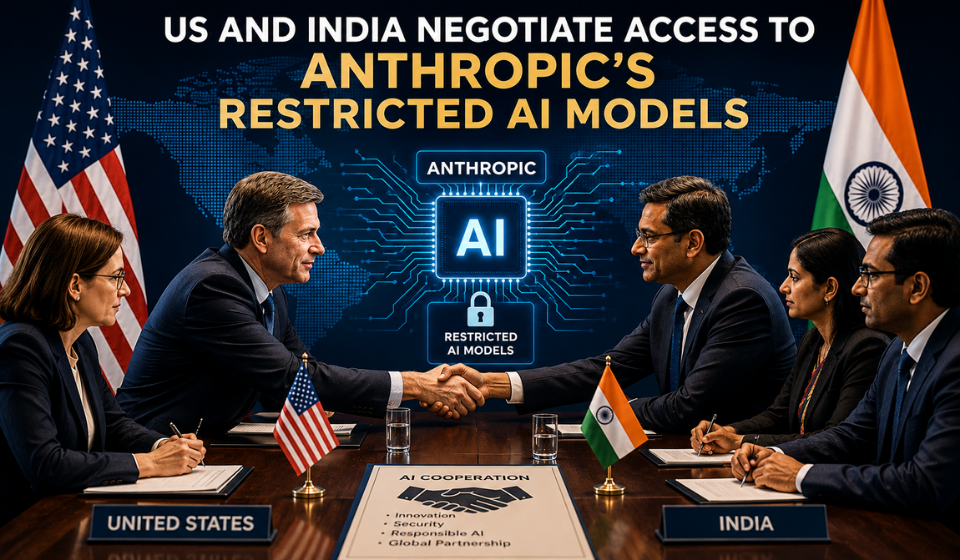
The United States and India are reportedly engaged in high-level discussions regarding India’s access to Anthropic’s most advanced artificial intelligence models. The talks come after the U.S. introduced export restrictions on some frontier AI systems due to national security concerns, affecting the availability of Anthropic’s latest models outside the country.
As artificial intelligence becomes increasingly important for research, cybersecurity, healthcare, and enterprise innovation, access to advanced AI models is emerging as a key strategic issue. The ongoing negotiations demonstrate how AI is evolving beyond a commercial technology into an area of international policy and cooperation.
Why Are the Talks Important?
The discussions focus on balancing national security with technological collaboration between two major partners.
Key Objectives
- Expand access to advanced AI capabilities
- Support research and innovation
- Strengthen technology partnerships
- Address national security concerns
- Ensure responsible AI deployment
- Improve long-term AI cooperation
The negotiations could influence how trusted partner nations gain access to powerful AI technologies while maintaining regulatory safeguards.
What Are Anthropic’s Restricted Models?
Anthropic’s latest frontier AI models offer advanced reasoning, coding, and agentic capabilities. However, recent U.S. export controls have limited access for many international users because of concerns about misuse and national security risks.
Potential Capabilities
- Advanced reasoning
- Complex coding assistance
- AI-powered research
- Enterprise automation
- Scientific analysis
- Agent-based workflows
These models are considered among the most capable AI systems currently available.
Negotiation Overview
| Area | Details |
| Countries Involved | United States and India |
| Topic | Access to Anthropic AI models |
| Primary Concern | National security and AI governance |
| Goal | Trusted AI collaboration |
| Potential Outcome | Expanded access under safeguards |
| Industry Impact | AI research and enterprise innovation |
Why It Matters for India
India is rapidly investing in artificial intelligence across government, education, healthcare, manufacturing, and digital services. Access to frontier AI models could accelerate innovation while supporting startups, researchers, and enterprise developers. At the same time, recent restrictions have renewed discussions about building stronger domestic AI capabilities to reduce dependence on foreign providers.
Potential Benefits
- Faster AI research
- Stronger startup ecosystem
- Better enterprise solutions
- Improved scientific computing
- Increased global AI collaboration
Broader Impact on the AI Industry
The negotiations highlight a growing trend in which advanced AI models are increasingly treated as strategically important technologies. Governments are now considering AI access alongside traditional export controls for sensitive technologies such as advanced semiconductors.
This shift may encourage new international frameworks for responsible AI sharing, security standards, and trusted technology partnerships.
Quick Summary
| Category | Update |
| Technology | Frontier AI Models |
| Company | Anthropic |
| Participants | US and India |
| Focus | AI access negotiations |
| Primary Challenge | Security vs. innovation |
| Expected Result | Controlled AI collaboration |
Key Highlights
- The US and India are discussing access to Anthropic’s advanced AI models.
- The talks follow recent U.S. export restrictions on frontier AI systems.
- National security and responsible AI deployment remain central to the negotiations.
- India aims to strengthen AI research, innovation, and enterprise development.
- The outcome could shape future international AI partnerships.
Final Thoughts
The ongoing discussions between the United States and India underscore the increasing strategic importance of advanced artificial intelligence. As frontier AI models become more powerful, governments are working to balance innovation with national security and responsible access.
If an agreement is reached, it could strengthen technological cooperation between the two countries while providing a framework for secure access to next-generation AI systems. More broadly, these negotiations may influence how advanced AI technologies are shared globally as governments and companies navigate the future of artificial intelligence.