


Table of Contents
India’s global digital payments network is set to grow further as Trinidad and Tobago has agreed to roll out the Unified Payments Interface (UPI), becoming the first Caribbean nation to adopt the platform. External Affairs Minister S. Jaishankar announced the development in an opinion piece published on Wednesday, describing it as another step in strengthening cooperation between the two countries.
The agreement marks a significant milestone in the ongoing Global UPI expansion, reflecting India’s broader effort to share its Digital Public Infrastructure (DPI) with partner nations and position its homegrown digital platforms as public digital goods for developing economies.
Stronger India–Trinidad and Tobago Relations
Jaishankar said the UPI agreement is part of a wider effort to strengthen bilateral ties between India and Trinidad and Tobago.
Trade between the two countries has nearly doubled over the past five years to reach approximately $350 million. Energy remains a central pillar of cooperation, while trade has also expanded across pharmaceuticals, automobiles, machinery, iron and steel, and textiles.
He added that, in an increasingly uncertain global environment, both countries should build on their complementary strengths to create greater stability and long-term cooperation.
Jaishankar also highlighted the shared historical connection between the two nations, noting that both have experienced histories shaped by colonialism and have pursued their own paths based on sovereignty and democratic values.
Global UPI Expansion Reaches the Caribbean
The latest agreement makes Trinidad and Tobago the first Caribbean nation to adopt UPI, extending the Global UPI expansion into a new region.
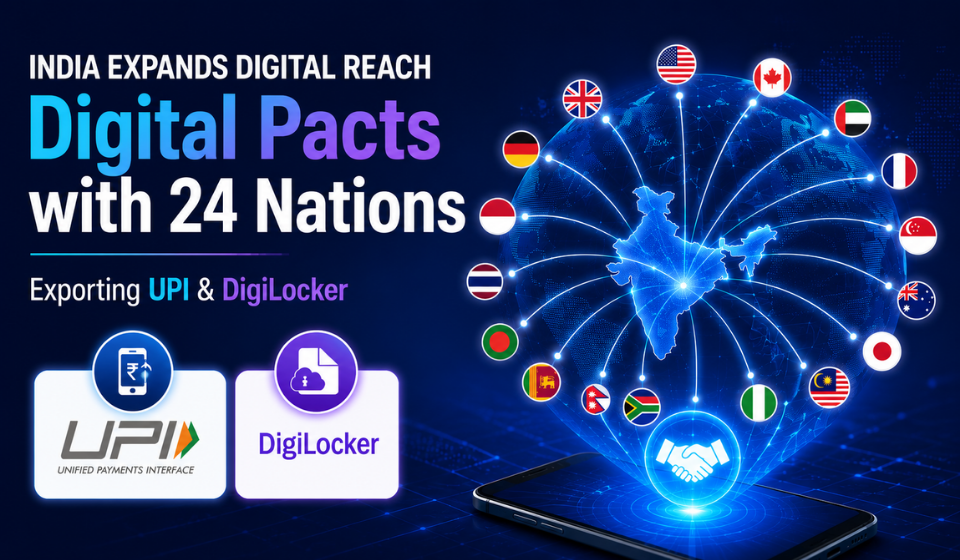
The rollout forms part of India’s larger strategy to internationalise its Digital Public Infrastructure through the India Stack ecosystem. According to information presented in the Lok Sabha by Minister Jitin Prasada, India has signed Memoranda of Understanding with 24 countries to share India Stack technologies, enabling partner nations to adopt scalable digital public services.
By offering platforms such as UPI and DigiLocker, India aims to help developing economies build secure, inclusive, and efficient digital ecosystems while promoting digital public infrastructure on a global scale.
India’s Digital Platforms Continue to Expand Worldwide
India’s Digital Public Infrastructure is already supporting digital payment services across multiple countries.
UPI Merchant Payments
Merchant payments are currently operational in:
| Country | Status |
| Bhutan | Live |
| France | Live |
| Mauritius | Live |
| Nepal | Live |
| Qatar | Live |
| Singapore | Live |
| Sri Lanka | Live |
| United Arab Emirates | Live |
| Cambodia | Live (joined June 2026) |
Cross-Border Remittances
Person-to-person UPI remittance services are currently available with:
- Singapore
- Nepal
- Greece
Beyond digital payments, India is also expanding other India Stack solutions globally. Kenya has signed an implementation framework agreement for DigiLocker, while work has begun on developing a foundational DigiLocker solution for Cuba. Discussions are also underway with Laos, Seychelles, Venezuela, Armenia, Fiji, Guyana, and Colombia to explore the adoption of Indian digital platforms.
From Domestic Innovation to Global Development
The Global UPI expansion is part of India’s wider strategy to make its Digital Public Infrastructure available to countries seeking trusted digital solutions.
This initiative gained momentum during India’s G20 Presidency in 2023, when Digital Public Infrastructure became a major priority for the Digital Economy Working Group. Since then, the Indian government has approved a Social Impact Fund to provide financial assistance and technical support for pilot projects in low- and middle-income countries.
Rather than exporting only technology, India is promoting a framework that combines digital payments, digital identity, and digital document services through India Stack to support long-term digital transformation.
Key Highlights
| Feature | Details |
| First Caribbean adopter | Trinidad and Tobago |
| Platform | Unified Payments Interface (UPI) |
| Digital ecosystem | India Stack |
| Countries with DPI partnerships | 24 |
| Bilateral trade | Nearly $350 million |
| Merchant payment markets | 9 countries |
| Cross-border remittance partners | Singapore, Nepal and Greece |
| Additional DPI initiative | DigiLocker expansion |
Why This Matters
The Global UPI expansion demonstrates how India’s Digital Public Infrastructure is evolving into a global model for digital transformation. Instead of limiting these platforms to domestic use, India is sharing proven technologies with partner countries to improve digital payments, public services, and financial inclusion.
The agreement with Trinidad and Tobago also highlights India’s growing role in digital diplomacy by offering scalable public digital infrastructure that can support economic development while strengthening international partnerships.
Conclusion
The agreement with Trinidad and Tobago marks another significant milestone in the Global UPI expansion, extending India’s Digital Public Infrastructure into the Caribbean for the first time. Alongside the growing international adoption of India Stack, DigiLocker, and UPI services, the initiative reflects India’s broader vision of sharing scalable digital public goods with developing economies. As more countries explore these technologies, India’s digital infrastructure is becoming an increasingly important part of international cooperation, supporting secure digital payments, stronger public services, and long-term economic collaboration.