


Table of Contents
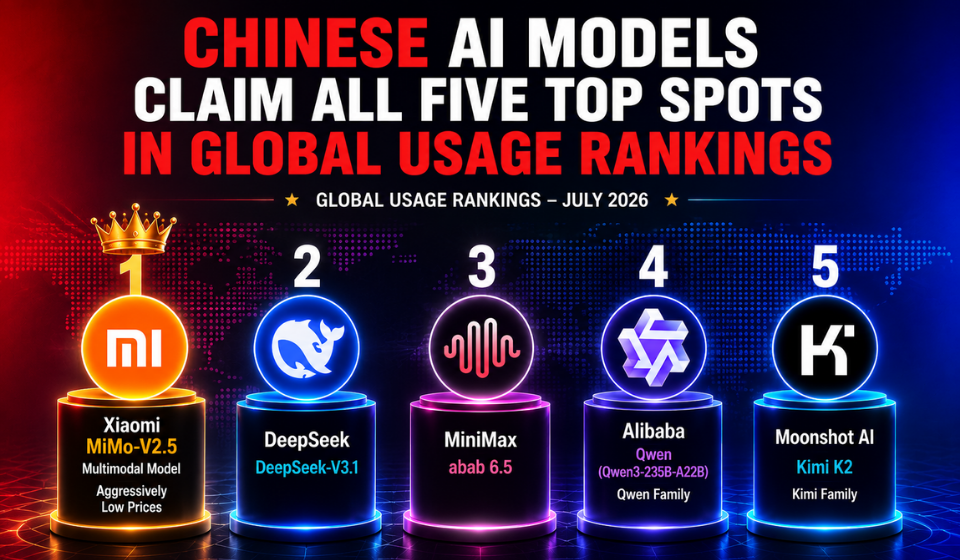
Chinese-developed large language models have reached a historic milestone by claiming all five leading positions on OpenRouter, the world’s largest neutral large language model (LLM) routing platform. The latest rankings mark the first time Chinese AI developers have dominated the platform’s most-used models, highlighting the country’s rapid rise as a global leader in open-weight artificial intelligence.
OpenRouter processes more than 20 trillion tokens every week, making it one of the most reliable indicators of developer adoption across the AI industry. According to its July 2026 rankings, Chinese-origin models now account for more than 60% of all routed traffic, demonstrating their growing popularity among developers worldwide.
Chinese Developers Lead the Top AI Models Rankings
The latest OpenRouter rankings place Xiaomi’s MiMo-V2.5 at the top by token volume. The multimodal model is followed by offerings from DeepSeek, MiniMax, Alibaba’s Qwen family, and Moonshot AI’s Kimi, giving Chinese companies complete control of the platform’s top five positions.
This achievement did not happen overnight. Chinese AI models have steadily climbed the rankings throughout 2026. By April, they occupied six of the top nine positions on OpenRouter. By May, they controlled four of the top five while accounting for approximately 61% of total token consumption. The July rankings now represent the strongest evidence yet of China’s growing influence in the open-weight AI ecosystem.
Why Developers Are Choosing These Top AI Models
The rapid adoption of these Top AI models is largely driven by a combination of strong technical performance and significantly lower operating costs.
CNBC reported that many US companies have increasingly shifted their OpenRouter usage towards Chinese-developed models because they offer competitive performance at substantially lower prices. This trend highlights how developers are prioritising cost efficiency alongside model capability when selecting AI platforms.
Chinese AI companies have also embraced open-weight development, allowing businesses and developers greater flexibility to customise, optimise, and deploy models within their own environments. This approach has made their AI offerings increasingly attractive for commercial applications.
Lower Costs Are Changing the Competitive Landscape
Competitive pricing has become one of the biggest advantages for Chinese AI developers.
For example, DeepSeek’s V4-Pro is listed at roughly one-twelfth the cost of OpenAI’s GPT-5.5 while delivering comparable benchmark performance. Xiaomi further strengthened its position by reducing MiMo API pricing by up to 99% earlier this year, making advanced AI models more affordable for startups, enterprises, and independent developers.
These aggressive pricing strategies have accelerated adoption and contributed to the growing popularity of Top AI models across the global developer community.
Wall Street Sees a Growing Competitive Challenge
The rapid rise of Chinese AI models has also attracted attention from financial analysts and investors.
Christopher Wood, Global Head of Equity Strategy at Jefferies, warned that the increasing popularity of lower-cost Chinese open-source AI models could result in “massive capital destruction” for expensive AI investments in the United States. He has consistently argued that China is well positioned to compete in the long-term AI race due to its expanding energy capacity and rapidly improving computing infrastructure.
These developments suggest that AI competition is increasingly being influenced not only by model performance but also by infrastructure efficiency, deployment flexibility, and operating costs.
Open-Weight AI Continues to Gain Momentum
The growing success of Chinese-developed Top AI models also reflects the increasing popularity of open-weight artificial intelligence.
While Meta’s Llama family helped popularise open-weight AI between 2023 and 2024, its share of OpenRouter traffic has now fallen below 1%, highlighting how quickly the competitive landscape has evolved.
Chinese developers, including Xiaomi, DeepSeek, Alibaba, MiniMax, and Moonshot AI, continue introducing increasingly capable models that are gaining widespread adoption across the developer ecosystem.
Developer Usage and Market Revenue Tell Different Stories
Although OpenRouter rankings demonstrate significant developer adoption, they do not represent the entire AI market.
Companies such as OpenAI and Anthropic continue to generate the majority of industry revenue through premium enterprise subscriptions and commercial AI services. Likewise, consumer-facing platforms such as ChatGPT and Gemini attract substantially larger direct user traffic than AI routing platforms.
However, OpenRouter remains an important leading indicator of developer behaviour because it reflects which models developers choose when evaluating performance, flexibility, and pricing rather than relying solely on brand recognition. By this measure, Chinese-developed open-weight AI models have become the preferred choice for many developers using the platform.
Top Five AI Models on OpenRouter
| Rank | AI Model | Developer |
| 1 | MiMo-V2.5 | Xiaomi |
| 2 | DeepSeek Model Family | DeepSeek |
| 3 | MiniMax Model Family | MiniMax |
| 4 | Qwen Model Family | Alibaba |
| 5 | Kimi Model Family | Moonshot AI |
Key Highlights
| Development | Significance |
| Chinese AI models occupy all top five positions | First time Chinese developers have dominated OpenRouter’s rankings |
| Over 20 trillion tokens processed weekly | Reflects large-scale developer adoption |
| More than 60% of routed traffic | Chinese AI models dominate platform usage |
| DeepSeek V4-Pro costs around one-twelfth of GPT-5.5 | Highlights the growing cost advantage of Chinese AI models |
| Xiaomi reduced MiMo API pricing by up to 99% | Makes advanced AI more accessible to developers |
| Meta Llama now below 1% of routed volume | Demonstrates changing developer preferences |
Why This Matters
The latest rankings show that success in artificial intelligence is increasingly determined by affordability, accessibility, and deployment flexibility as much as raw model performance. Chinese AI companies have successfully combined competitive technology with aggressive pricing strategies, enabling them to gain widespread adoption across the global developer community.
The continued growth of Top AI models also signals that open-weight AI is becoming an increasingly important part of enterprise AI adoption. As organisations look for scalable and cost-effective AI solutions, developers are placing greater emphasis on models that offer flexibility, transparency, and lower operational costs.
Conclusion
The latest OpenRouter rankings represent a landmark achievement for China’s artificial intelligence industry. By securing all five leading positions, Chinese developers have demonstrated their growing influence in the global AI ecosystem through high-performing, cost-effective, and open-weight models. Although companies such as OpenAI and Anthropic continue to lead in overall industry revenue, OpenRouter’s data shows that developer preferences are shifting towards more flexible and affordable alternatives. As innovation accelerates and competition intensifies, these Top AI models are expected to play an increasingly important role in shaping enterprise AI adoption, open-weight model development, and the future direction of the global artificial intelligence market.