


Table of Contents
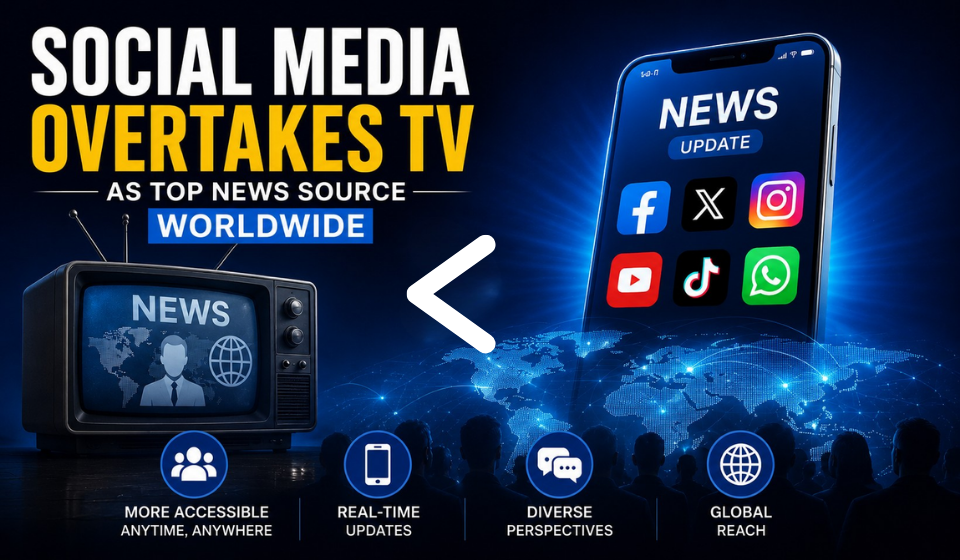
A major shift in global media consumption is underway. According to recent research, social media has overtaken television as the primary source of news worldwide, marking a historic turning point in how people access information.
For decades, television dominated the news landscape, serving as the go-to platform for breaking news, political coverage, and major global events. However, the rapid growth of platforms such as Facebook, X, Instagram, TikTok, YouTube, and LinkedIn has fundamentally changed audience behavior.
Today, millions of users discover news updates through their social feeds before they ever turn on a television or visit a news website.
Why Social Media Is Winning the News Battle
The popularity of social platforms stems from their speed, accessibility, and personalized content experiences.
Key Factors Driving Growth
- Real-time news updates
- Mobile-first accessibility
- Personalized content recommendations
- Video-based storytelling
- Interactive discussions
- Easy content sharing
Unlike traditional television broadcasts that follow fixed schedules, social media delivers information instantly, often as events unfold.
How News Consumption Is Changing
Modern audiences increasingly prefer consuming news through smartphones and social applications rather than traditional broadcast channels.
Emerging User Behaviors
- Following journalists directly
- Watching short-form news videos
- Engaging with live streams
- Consuming news through influencers
- Participating in online discussions
- Receiving algorithm-driven recommendations
These changes are particularly noticeable among younger generations who spend significantly more time on digital platforms.
News Sources Comparison
| News Platform | Key Advantage |
| Social Media | Instant updates and personalization |
| Television | Professional reporting and analysis |
| News Websites | In-depth coverage |
| Podcasts | On-demand consumption |
| Print Media | Detailed long-form journalism |
| Newsletters | Curated information delivery |
The growing dominance of social platforms reflects broader digital transformation trends.
Benefits of Social Media News Consumption
Social media offers several advantages that appeal to modern audiences.
Advantages
- Faster access to breaking news
- Multiple viewpoints and perspectives
- Easy sharing and engagement
- Mobile-friendly experience
- Personalized content feeds
- Global reach
For many users, social platforms have become an all-in-one destination for information, entertainment, and communication.
Challenges and Concerns
While social media offers convenience, experts continue to raise concerns about information quality and credibility.
Key Challenges
- Spread of misinformation
- Deepfake content
- Algorithm bias
- Lack of editorial oversight
- Information overload
- Echo chambers
As social platforms become more influential, balancing accessibility with accuracy remains a major challenge.
Social Media vs Television News
| Factor | Social Media | Television |
| Speed | Instant | Scheduled updates |
| Accessibility | Mobile-first | TV-dependent |
| Personalization | High | Limited |
| User Interaction | Strong | Minimal |
| Content Variety | Extensive | Curated |
| Verification Standards | Variable | Generally higher |
Both mediums continue to play important roles, but audience preferences are clearly shifting toward digital platforms.
Key Findings from the Trend
Major Takeaways
- Social media has surpassed television as the leading news source globally.
- Mobile devices are driving news consumption growth.
- Younger audiences increasingly prefer digital platforms.
- Video content continues to dominate engagement.
- Traditional media organizations are adapting to social-first strategies.
Impact on Media Organizations
News publishers are increasingly investing in social media strategies to reach audiences where they spend the most time.
Industry Responses
- Expanding short-form video content
- Building social-first news teams
- Increasing live-stream coverage
- Leveraging creator partnerships
- Developing platform-specific content
Many broadcasters now prioritize digital distribution alongside traditional television programming.
What This Means for the Future
The rise of social media as the dominant news source signals a broader transformation in the media industry. As platforms continue to integrate artificial intelligence, personalized recommendations, and real-time content delivery, digital news consumption is likely to accelerate further.
However, ensuring trust, transparency, and factual reporting will remain essential as audiences increasingly rely on social networks for information.
Final Thoughts
Social media’s emergence as the world’s leading news source represents one of the most significant shifts in modern media history. The convenience, speed, and personalization offered by digital platforms have reshaped how people discover and consume information.
While television remains an important source of trusted journalism, the future of news is increasingly digital, interactive, and mobile-driven. For publishers, brands, and audiences alike, adapting to this new reality will be crucial in the evolving information landscape.