


Table of Contents
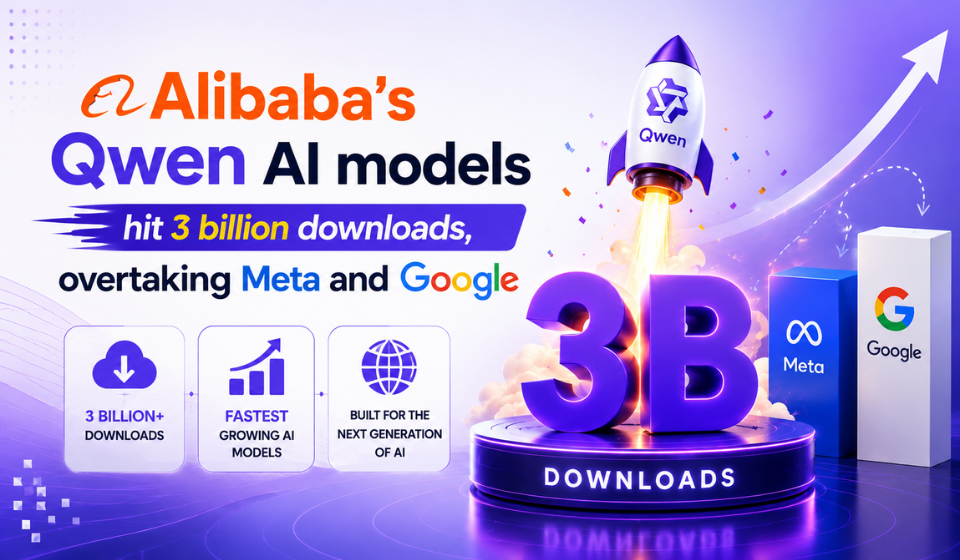
Alibaba has expanded its open-weight AI ecosystem with the release of Qwen3.8, including the flagship Qwen3.8-Max and the smaller Qwen3.8-27B. The release comes as the broader Qwen model family surpasses 3 billion cumulative downloads, highlighting the growing adoption of Alibaba’s models among developers worldwide.
The milestone does not mean 3 billion individual users have downloaded Qwen models. Instead, it represents cumulative model downloads across the ecosystem and reflects repeated developer activity, deployments and experimentation.
Qwen Becomes a Major Foundation for Open Models
The Qwen ecosystem has grown rapidly on Hugging Face, where developers can access and build upon open-weight models.
Hugging Face’s State of Open Models: Summer 2026 report found that Qwen-based models accounted for 151,448 derivative repositories on the platform. That was approximately 2.6 times Meta’s total footprint and significantly ahead of Google’s 82,506 derivatives.
The report also found that Qwen derivatives had been increasing by roughly 180 to 210 repositories per day during the first seven months of 2026. This suggests that Qwen’s influence is not simply the result of individual model launches but also of developers repeatedly using Qwen models as foundations for their own projects.
Alibaba has also released hundreds of models across the wider Qwen family, helping create a large ecosystem of adaptations and specialised versions.
Qwen3.8-Max Brings Alibaba’s Largest Model to Open Weights
Alibaba originally launched Qwen3.8-Max as a commercial model earlier in August before releasing the weights of the underlying Qwen3.8-2.4T-A95B model.
The flagship contains approximately 2.4 trillion total parameters and uses a sparse mixture-of-experts architecture, with around 95 billion parameters activated per token. The open-weight model can be deployed using frameworks including vLLM and SGLang.
The release is particularly significant because it represents the first time Alibaba has made the weights of a Max-class Qwen model available to developers.
The model supports a native context length of 262,144 tokens, with the commercial Qwen3.8-Max version offering extended context capabilities.
Qwen3.8-27B Targets More Accessible Deployment
Alibaba has also released Qwen3.8-27B, a much smaller dense model intended to make the latest Qwen generation more accessible.
Unlike the enormous Qwen3.8-Max, the 27B model is designed for developers who have more limited computing resources. Quantised versions can make local deployment practical on comparatively accessible hardware.
The model has also attracted rapid attention on Hugging Face. Within its first few days, Qwen3.8-27B had accumulated millions of downloads, demonstrating strong early interest from the developer community.
Qwen’s Download Lead Needs Context
The more than 3 billion Qwen downloads are an important indicator of adoption, but they should be interpreted carefully.
The Hugging Face report shows that a relatively small number of model repositories account for a very large share of total downloads. Consequently, download counts do not directly translate into the number of unique developers, companies or end users.
Nevertheless, Qwen’s position is significant. The ecosystem has become one of the largest foundations for developers building, fine-tuning and deploying open models.
Competition With Meta, Google and Other AI Developers
Alibaba’s progress comes as competition around open-weight AI intensifies.
Meta, Google and other major technology companies continue to release models that developers can adapt and deploy. Chinese companies including Alibaba, DeepSeek and Moonshot AI are also becoming increasingly important participants in this market.
The competition is now about more than model size or benchmark scores. Developers are weighing performance, licensing, inference costs, hardware requirements, context length and ecosystem support when selecting models.
Qwen’s large derivative ecosystem gives Alibaba an important advantage because developers can build on existing work rather than starting from scratch.
Open-Weight Does Not Always Mean Unrestricted Use
Another important consideration is licensing.
The term open-weight means that model weights are available to users, but it does not automatically mean that every form of commercial use is unrestricted. Developers should examine the licence attached to the specific Qwen model before deploying it commercially.
This distinction is particularly relevant for Qwen3.8-Max as Alibaba develops ways to combine broad model availability with commercial AI services.
Qwen3.8: Key Facts
| Category | Details |
| AI family | Qwen |
| Flagship | Qwen3.8-Max |
| Total parameters | 2.4 trillion |
| Active parameters | About 95 billion per token |
| Smaller model | Qwen3.8-27B |
| Hugging Face derivatives | 151,448 Qwen-based repositories |
| Qwen downloads | More than 3 billion cumulative |
| Major deployment frameworks | vLLM, SGLang |
| Primary significance | Large-scale open-weight developer ecosystem |
Conclusion
The Qwen3.8 release represents more than another model launch for Alibaba. The combination of Qwen3.8-Max, Qwen3.8-27B and an ecosystem that has surpassed 3 billion cumulative downloads demonstrates how deeply Qwen has become embedded in open-model development.
The milestone also shows that China’s AI industry is competing not only through proprietary models but through developer ecosystems built around accessible weights and community-driven derivatives.
As Alibaba, Meta, Google, DeepSeek and other companies continue competing for developers, Qwen’s growing ecosystem could remain one of the most important forces shaping the future of open-weight AI.