


Table of Contents
OpenAI has officially introduced its latest family of AI models, GPT-5.6, but unlike previous launches, the company is taking a more cautious approach. Instead of making the models immediately available to everyone, OpenAI is rolling out GPT-5.6 to a limited group of trusted partners following a request from the U.S. government to conduct additional evaluations before a broader release.
According to OpenAI, this is intended to be a temporary measure while officials assess potential national security risks associated with increasingly capable AI systems. The company emphasized that it supports broad access to advanced AI and does not view government-controlled access as the ideal long-term model.
What’s New in GPT-5.6?
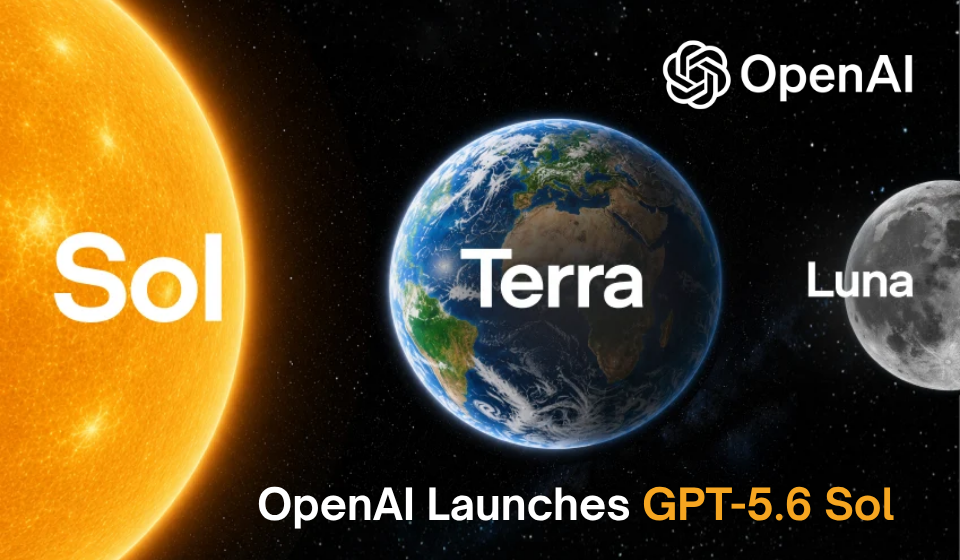
The GPT-5.6 family includes three models designed for different use cases:
- GPT-5.6 Sol – The flagship frontier model for advanced reasoning and complex tasks.
- GPT-5.6 Terra – A balanced model optimized for everyday business and productivity workloads.
- GPT-5.6 Luna – A lightweight, cost-effective model built for high-volume applications and faster responses.
Initially, these models are being tested with a select group of enterprise partners through OpenAI’s API and developer ecosystem before becoming widely available.
GPT-5.6 Model Comparison
| Model | Primary Purpose | Best For |
| GPT-5.6 Sol | Frontier AI model | Advanced reasoning, research, coding |
| GPT-5.6 Terra | Balanced performance | Business workflows and productivity |
| GPT-5.6 Luna | Fast and affordable | High-volume applications and automation |
Why the Limited Rollout Matters
The restricted release reflects a growing shift in how governments and AI companies handle increasingly powerful models.
Some key implications include:
- More rigorous safety and security evaluations before public deployment.
- Greater collaboration between AI developers and government agencies.
- Slower initial access for developers and businesses.
- Ongoing debate over balancing innovation with responsible AI governance.
- A possible framework for future launches of frontier AI models.
While some industry experts welcome additional safety testing, others worry that prolonged restrictions could delay innovation and reduce access for researchers, startups, and developers. OpenAI has indicated that it expects a broader rollout in the coming weeks after the review process is complete.
Key Takeaways
- OpenAI has launched the GPT-5.6 family with three distinct models: Sol, Terra, and Luna.
- Exclusive access is currently reserved for a select group of trusted partners.
- The phased rollout follows a request from the U.S. government for additional security review.
- OpenAI says the restrictions are temporary and broader availability is expected soon.
- The launch highlights the growing importance of AI safety and regulatory oversight.
Final Thoughts
The launch of GPT-5.6 marks another milestone in the rapid evolution of generative AI, but it also signals a new era of collaboration between AI developers and governments. As models become more powerful, questions about security, responsible deployment, and public access are becoming just as important as performance improvements. If the current review process proves successful, GPT-5.6 could set a new benchmark—not only for AI capabilities but also for how advanced AI systems are introduced to the world.