


Table of Contents
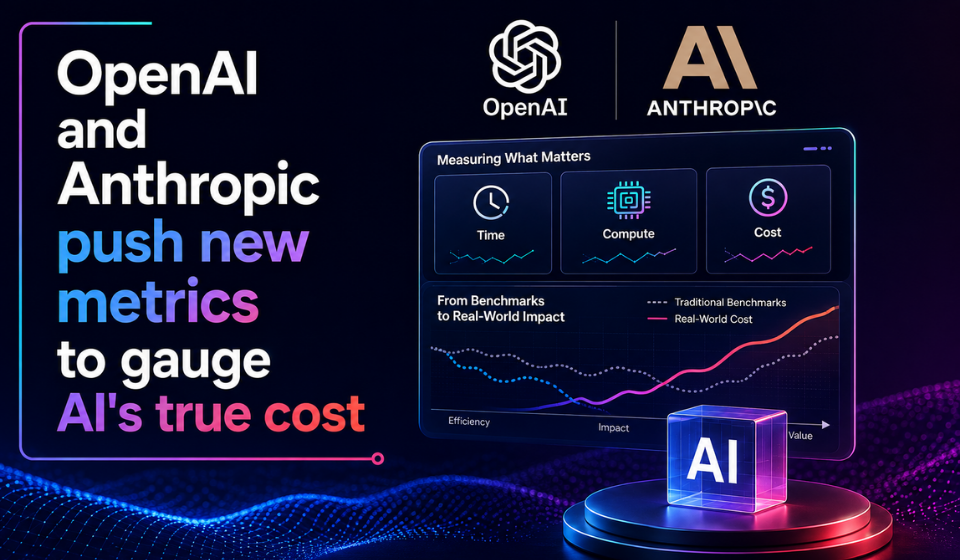
OpenAI and Anthropic are urging enterprise customers to think differently about how they measure the cost and value of artificial intelligence as companies increasingly rely on AI models and agents.
The challenge is becoming more important as AI services are commonly billed according to usage, particularly through tokens. While businesses can see how much they spend on model usage, connecting those costs to measurable business outcomes remains difficult.
This has contributed to growing interest in “tokenomics,” a developing area focused on understanding AI consumption, pricing and the relationship between token usage and business value.
Why Measuring AI Spending Is Difficult
Tokens have become an important unit for measuring AI usage. However, the number of tokens consumed by a model does not automatically indicate how much value an organization receives.
A relatively expensive AI workflow could potentially generate significant productivity gains, while a cheaper workflow might deliver little practical benefit.
This makes traditional technology-spending measurements less effective for some AI deployments.
FinOps researchers have noted that invoices from providers such as OpenAI and Anthropic can show spending by API key or project but may not automatically connect those expenses to individual business units, applications or teams. Companies therefore need additional instrumentation to understand where their AI budgets are going.
The Rise of Enterprise AI Costs
The issue is becoming more urgent as companies expand their use of AI.
AI agents can consume tokens across multiple steps, including planning, reasoning, tool calls and task execution. As deployments become more sophisticated, a simple per-request price may not provide enough information for executives trying to understand the overall economics of an AI workflow.
Recent industry reporting has highlighted companies facing unexpectedly high AI bills as coding agents and other AI tools become more widely deployed.
For OpenAI and Anthropic, this environment creates a need for enterprise customers to understand not only the price of individual model calls but also the productivity and business outcomes generated by those calls.
Linux Foundation Launches Tokenomics Foundation
The measurement challenge has also led to the creation of a dedicated industry initiative.
The Linux Foundation launched the Tokenomics Foundation to develop open standards, benchmarks and best practices for the economics of AI infrastructure.
The initiative aims to bring enterprises, cloud providers and AI technology companies together to improve how organizations measure token consumption and connect AI usage with business value.
The foundation is intended to provide a vendor-neutral framework rather than establish pricing for individual AI providers.
Importantly, OpenAI and Anthropic are not founding members of the Tokenomics Foundation, so the initiative should not be described as a joint project between the two AI companies and the Linux Foundation.
Businesses Are Creating Their Own Metrics
Without universal standards, some companies are developing their own methods for measuring AI’s financial impact.
The supplied report highlights cybersecurity company Elisity, which created a metric called “bionic head count.” The concept compares AI expenditure with employee costs and examines whether combining human workers with AI produces additional business output.
The underlying question is straightforward: does AI generate incremental revenue or productivity, or does it simply increase operating expenses?
Such experiments demonstrate how companies are searching for better ways to evaluate AI investments while standardized measurement practices continue to develop.
AI Could Become a Labour Cost
The economics of AI could eventually change how companies classify these expenses.
Bain & Company analysts have modelled scenarios in which AI-related token costs could become a significant portion of corporate operating expenses.
If AI agents increasingly perform work traditionally handled by employees, companies may begin comparing the cost of AI systems directly with labour costs and productivity.
That does not mean AI spending will automatically replace labour budgets. Instead, it suggests businesses may increasingly evaluate AI as a productive resource rather than simply another software expense.
Why OpenAI and Anthropic Matter
The involvement of OpenAI and Anthropic in the broader enterprise AI cost discussion reflects the growing importance of usage-based AI economics.
Both companies provide AI services that can be consumed through APIs and enterprise products, making token usage an important component of customer costs.
However, token spending alone cannot determine whether an AI deployment is successful. Businesses also need to consider factors such as task completion, employee productivity, revenue impact, quality, reliability and the cost of human oversight.
This broader measurement challenge is helping drive the development of AI-specific FinOps practices and industry standards.
Frequently Asked Questions
Why are OpenAI and Anthropic relevant to AI spending?
OpenAI and Anthropic are major providers of enterprise AI services, including usage-based models where customers need to track and manage AI consumption.
What is tokenomics?
Tokenomics refers to the emerging discipline of measuring and managing the economic aspects of AI token consumption, including usage, pricing, allocation and business value.
What is the Tokenomics Foundation?
It is a Linux Foundation initiative focused on developing standards and best practices for understanding AI infrastructure economics.
Does token usage measure AI ROI?
No. Token consumption measures usage and cost, but it does not by itself show whether an AI system is generating business value.
Conclusion
The growing focus on OpenAI and Anthropic and enterprise AI economics reflects a broader change in how businesses are approaching artificial intelligence.
Companies are moving beyond experimentation and increasingly need to understand whether their AI investments are producing measurable returns. Token-based billing provides a useful measure of consumption, but it does not fully explain productivity, revenue or operational value.
The emergence of the Tokenomics Foundation and other AI cost-management efforts suggests that standardized measurement could become increasingly important.
As AI agents handle more complex tasks and consume more resources, businesses will likely need to measure not only how many tokens they use, but what those tokens actually accomplish.