


Table of Contents
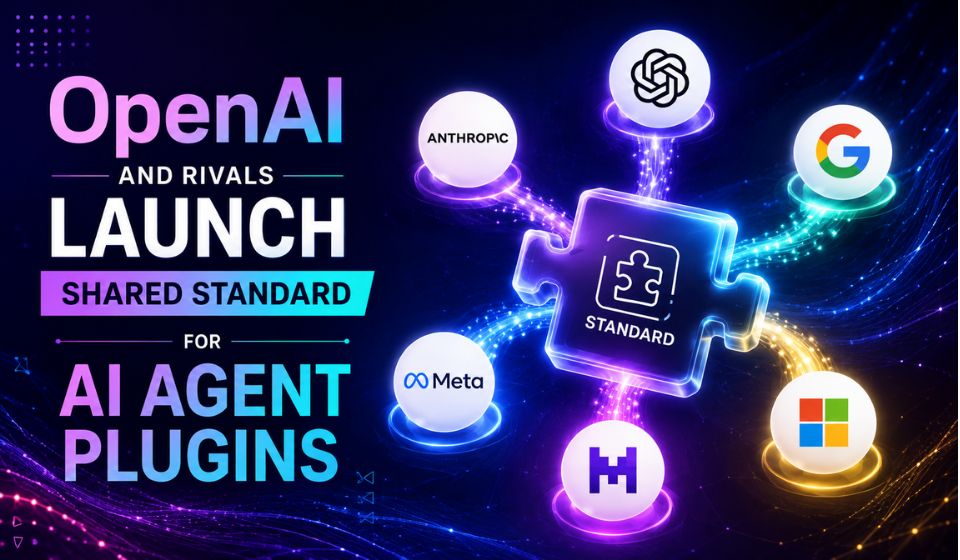
OpenAI, Amazon, Microsoft, Cursor and Vercel have jointly published Agent Plugins, an open standard designed to allow a single AI agent extension to work across competing platforms.
The initiative reflects a growing shift in the AI industry from competing primarily over model capabilities to building the infrastructure that allows AI agents to access tools, data and applications.
Importantly, although OpenAI promoted the launch, the initiative was started by Vercel, rather than OpenAI alone.
A Shared Format for AI Agent Tools
The 1.0.0 specification defines a portable package format that combines two technologies developers already use: Model Context Protocol (MCP) servers and Agent Skills.
MCP servers allow agents to connect with external tools and live data, while Agent Skills provide reusable instructions and resources for specific tasks.
Under the new specification, an Agent Plugin is organized as a directory containing a plugin.json file at its root, a skills folder and an optional MCP configuration.
The format is intended to make agent capabilities easier to package and distribute across compatible clients.
Which Platforms Support Agent Plugins?
Several major AI development and productivity platforms support the standard at launch.
According to the announcement, compatible clients include:
- OpenAI Codex
- ChatGPT
- Cursor
- GitHub Copilot
- Amazon Kiro
- Visual Studio Code
The specification is openly licensed and developed in public. A steering committee consisting of Amazon, Cursor, Microsoft, OpenAI and Vercel will guide the project, while Google is participating as a core maintainer.
This broad industry participation could give the format a stronger chance of adoption across competing AI ecosystems.
A Deliberately Narrow Standard
The Agent Plugins specification is intentionally limited in scope. It establishes how a plugin is packaged and discovered but does not attempt to create universal rules for every aspect of plugin operation.
Installation methods, permission systems, sandboxing and trust decisions remain under the control of individual clients.
That narrow approach could make the standard easier for competing platforms to adopt because they do not need to agree on every security or distribution mechanism.
However, it also means there is no single security framework governing every Agent Plugin.
Plugin Security Remains a Concern
The portability offered by Agent Plugins could benefit developers, but it also raises questions about the security of third-party extensions.
The announcement comes amid concerns about fake Agent Skills that were able to bypass security scanners earlier in the year. A portable plugin ecosystem could make security screening particularly important because the same extension could potentially reach users across several platforms.
The new specification itself does not define universal sandboxing or permission rules. Individual platforms therefore remain responsible for deciding how plugins are reviewed, installed and allowed to interact with users’ systems and data.
Developers See Both Benefits and Limitations
The response to the standard has been mixed.
Developer Dax Raad criticized the specification as a “thin standard,” arguing that some of its useful functionality could eventually be absorbed into extensions specific to individual clients.
Other developers welcomed the interoperability goal. Developer advocate Angie Jones, for example, expressed strong support for the initiative.
The differing reactions highlight the central question surrounding the project: whether a lightweight common format will be enough to create meaningful interoperability across rapidly evolving AI platforms.
What It Means for Developers
One of the biggest potential advantages is portability.
Instead of maintaining separate versions of an AI agent extension for every major platform, smaller developers could potentially create a plugin once and make it available across multiple compatible clients.
This could lower development and maintenance costs while allowing independent developers to reach larger audiences.
However, compatibility with the packaging standard does not guarantee identical functionality everywhere. Individual platforms still control permissions, installation and security policies.
There is also a potential competitive downside. A widely adopted standard could strengthen platforms that already have the largest user bases, because developers naturally benefit most from supporting ecosystems with significant adoption.
AI Competition Moves Beyond Models
The Agent Plugins launch reflects a broader change in the AI market.
Powerful models are increasingly becoming only one part of an AI agent’s capabilities. Agents also need reliable access to software, data, tools and reusable instructions.
OpenAI has continued expanding this software layer alongside its GPT-5 family. GPT-5 launched on August 7, 2025, and the company has since introduced multiple iterations while expanding Codex’s role within ChatGPT.
Against that backdrop, shared infrastructure standards could become increasingly important as companies compete to define how AI agents interact with the wider software ecosystem.
Key Takeaways
- OpenAI Agent Plugins are part of a jointly developed open standard for AI agent extensions.
- Vercel initiated the initiative, while OpenAI, Amazon, Microsoft and Cursor joined the effort.
- The 1.0.0 specification combines MCP servers and Agent Skills.
- Codex, ChatGPT, Cursor, GitHub Copilot, Kiro and VS Code support the standard at launch.
- Google is participating as a core maintainer.
- The specification does not establish universal permissions, sandboxing or trust rules.
- Plugin security remains an important consideration.
- Developers see both interoperability benefits and limitations.
- A common format could help smaller developers reach multiple AI platforms.
- The standard could also benefit already-dominant platforms with large user bases.
FAQs
What are OpenAI Agent Plugins?
Agent Plugins are part of an open specification designed to provide a common packaging format for AI agent extensions across compatible platforms.
Who initiated Agent Plugins?
The initiative was started by Vercel, although OpenAI, Amazon, Microsoft and Cursor are among the companies participating in the project.
Which platforms support the standard?
The launch announcement lists Codex, ChatGPT, Cursor, GitHub Copilot, Amazon Kiro and Visual Studio Code as compatible clients.
Does Agent Plugins provide a universal security system?
No. The specification focuses on packaging and discovery. Installation, permissions, sandboxing and trust decisions remain specific to individual clients.
Conclusion
The OpenAI Agent Plugins initiative represents an effort to make AI agent extensions more portable across competing platforms. By standardizing how MCP servers and Agent Skills can be packaged, the project could reduce duplication for developers and encourage a broader ecosystem of reusable AI tools.
Its limited scope may make adoption easier, but it also leaves critical security and permission decisions to individual platforms. Whether the standard becomes a widely adopted layer of AI infrastructure will depend on how effectively developers and competing AI clients implement it.