


Table of Contents
Microsoft is pushing Copilot beyond traditional question-and-answer interactions as it develops AI systems capable of handling more complex, multi-step work. Project Opal is part of this broader shift, allowing users to delegate structured tasks to an AI agent that can operate asynchronously within a managed computing environment.
Microsoft CEO Satya Nadella has highlighted the company’s broader move toward Copilot experiences capable of taking on increasingly complex work. Recent developments point to Microsoft’s ambition to make AI agents more useful for tasks that can take hours or require multiple steps.
Importantly, Project Opal is not a newly launched September 2026 product. Microsoft introduced the capability in November 2025 and continues to make it available through its Frontier early-access programme.
What Is Project Opal?
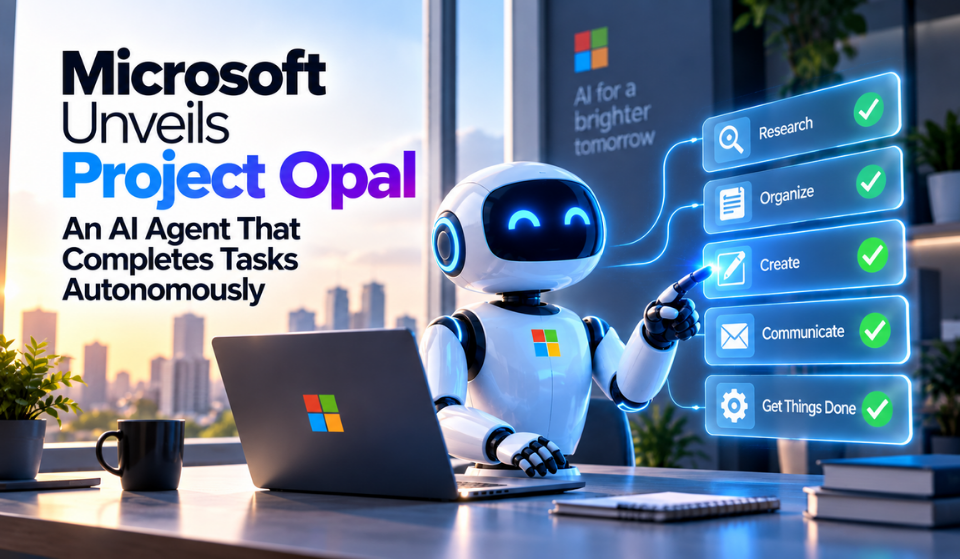
Project Opal is a Microsoft Copilot capability designed to complete task-based work on a user’s behalf.
Instead of asking Copilot to perform one isolated action, users can describe a broader task and allow Opal to work through multiple steps. Microsoft says the system uses computer interaction through a Windows 365 Cloud PC to work with browser-based applications, websites and other digital workflows.
Opal can work asynchronously, meaning users do not necessarily need to remain in front of the computer while a task is running. Users can monitor its activity, provide additional instructions and take control of the Cloud PC when required.
How Project Opal Works
When a task is started, Opal develops a plan and uses a Windows 365 Cloud PC to carry out the required actions.
The system can interact with websites and applications through the virtual computer environment. If it encounters a situation requiring additional information, authentication or human judgement, the task can pause and request user input.
Users can also take direct control of the Cloud PC. This gives employees a way to intervene rather than allowing the AI agent to continue without oversight.
The approach is designed to give AI greater autonomy while maintaining human involvement for situations that require judgement or additional permissions.
What Can Project Opal Do?
Microsoft describes Project Opal as suitable for structured workflows involving multiple steps.
Examples in Microsoft’s documentation include collecting evidence for compliance reviews, handling IT incidents, managing security-group membership requests and compiling spreadsheet information into financial presentations.
| Use Case | Potential Role |
| Compliance reviews | Collect and validate audit evidence |
| IT operations | Handle parts of incident workflows |
| Security administration | Process security-group requests |
| Financial reporting | Compile spreadsheet data into presentations |
| Web-based tasks | Navigate supported websites and applications |
These examples represent workflows Microsoft has identified for the technology. They should not be interpreted as a guarantee that Opal will complete every similar task without human intervention.
Security and Administrative Controls
The use of a dedicated Windows 365 Cloud PC is an important part of the Project Opal design.
Microsoft provides administrative controls that allow organisations to manage access to the feature. Administrators can determine which users or groups receive access and configure the environment through Microsoft’s management tools.
The system can also pause when it encounters actions that require user input. This can help maintain human oversight when a task involves sensitive information or decisions that should not be left entirely to an AI agent.
For businesses, these controls are particularly important as AI systems become capable of taking actions rather than simply generating information.
Project Opal and Autonomous AI
The significance of Project Opal extends beyond one Copilot feature. It reflects the wider industry shift from conversational AI toward agent-based systems.
Traditional AI assistants generally respond to prompts, generate content or provide information. AI agents are being designed to receive an objective and work through a sequence of actions to achieve it.
Microsoft’s Copilot strategy increasingly follows this model. The company is developing AI experiences that can handle more complex workflows while allowing users to remain involved when necessary.
However, autonomous does not mean completely unsupervised. Project Opal provides users with the ability to monitor activity, provide guidance, pause work and take control of the virtual computer.
Project Opal Remains in Early Access
One of the most important points for businesses is that Project Opal is not generally available to all Microsoft 365 users.
Microsoft currently makes the capability available through its Frontier early-access programme for eligible Microsoft Copilot customers. Frontier features are experimental and may change as Microsoft continues development.
This means organisations should view Opal as an evolving technology rather than a fully mature replacement for human-managed business processes.
Why Project Opal Matters
The potential value of Project Opal is its ability to reduce manual work in repetitive, structured processes.
Instead of employees completing every step themselves, an AI agent could potentially handle defined parts of a workflow while people focus on decisions, exceptions and work requiring human judgement.
At the same time, greater AI autonomy introduces new considerations around permissions, monitoring, authentication and security. Businesses will need to determine which tasks can be delegated to AI and which should continue to require human approval.
Microsoft’s Broader Copilot Strategy
Project Opal forms part of Microsoft’s wider effort to turn Copilot into a more capable AI platform.
Microsoft has been expanding Copilot from a conversational assistant into a collection of AI-powered agents and task-oriented experiences. The company’s broader organisational changes also reflect the increasing importance of AI agents and infrastructure to its strategy.
This suggests that Microsoft sees AI not simply as a tool for generating answers, but increasingly as software capable of carrying out defined pieces of work.
Conclusion
Project Opal provides an early look at Microsoft’s vision for more autonomous workplace AI.
By using a Windows 365 Cloud PC, the system can work through structured, multi-step tasks while allowing users to monitor activity, provide guidance or take control when necessary.
However, Project Opal remains an early-access capability rather than a generally available Microsoft 365 feature. Its availability and functionality may continue to evolve as Microsoft develops the technology.
The broader direction is clear: Microsoft wants Copilot to move beyond answering questions and toward completing defined workflows. Project Opal is one example of that shift, combining AI autonomy with administrative controls and human oversight.