


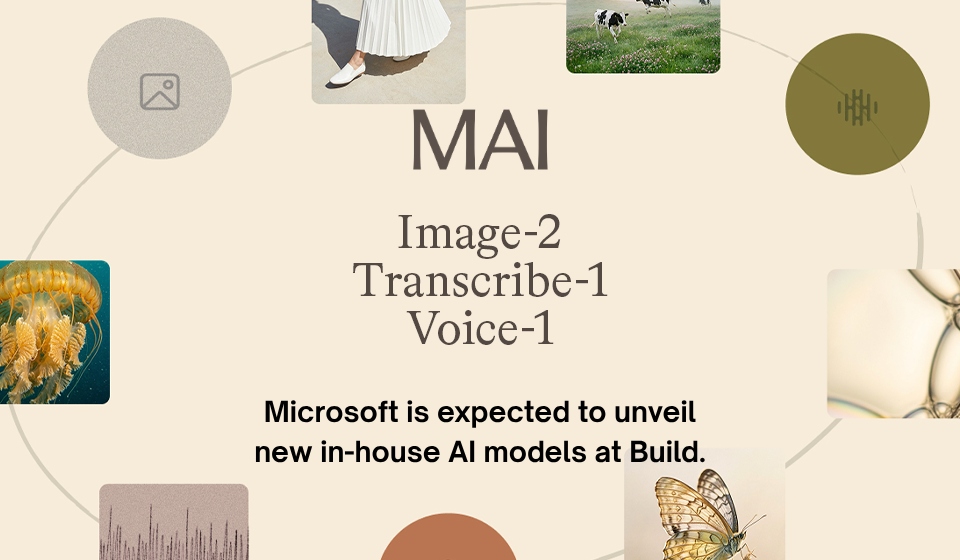
Microsoft has announced a new wave of in-house AI innovation at its Build event, introducing three advanced MAI models designed to strengthen its ecosystem within Azure AI Foundry. According to the official update, these models aim to improve performance, scalability, and flexibility for developers building next-generation AI applications.
This move signals Microsoft’s continued push toward building a more integrated AI stack, where developers can access powerful foundation models directly within its cloud infrastructure instead of relying only on third-party systems.
What’s New in the MAI Models?
The newly introduced MAI models focus on enhancing real-world AI deployment across different use cases such as enterprise automation, content generation, and intelligent assistants. While Microsoft has not positioned them as consumer-facing products, they are expected to significantly impact developer workflows inside Azure AI Foundry.
soft
Key Highlights
- Three new proprietary MAI models added to Azure AI Foundry
- Optimized for enterprise-scale AI applications
- Improved speed and efficiency for model inference
- Designed for seamless integration with Microsoft’s cloud tools
- Strong focus on responsible and secure AI deployment
MAI Models Overview
| Model Category | Primary Capability | Ideal Use Case |
| MAI Model Set 1 | Language understanding & generation | Chatbots, copilots, documentation |
| MAI Model Set 2 | Multimodal intelligence | Image + text-based enterprise tools |
| MAI Model Set 3 | Optimization & reasoning | Analytics, automation, decision systems |
Why This Matters for Developers
The introduction of in-house models reduces dependency on external APIs and gives developers tighter control over performance and cost. It also strengthens Microsoft’s positioning in the competitive AI cloud space, where speed, privacy, and customization are becoming key decision factors.
With integration into Microsoft Azure AI Foundry, developers can expect smoother deployment pipelines and more consistent model behavior across applications.
Final Thoughts
Microsoft’s latest MAI models reflect a clear strategy: bring more AI capabilities in-house while making them deeply usable for enterprise developers. As AI competition intensifies, this approach could help Microsoft offer more stable, secure, and customizable AI infrastructure for businesses of all sizes.