


Table of Contents
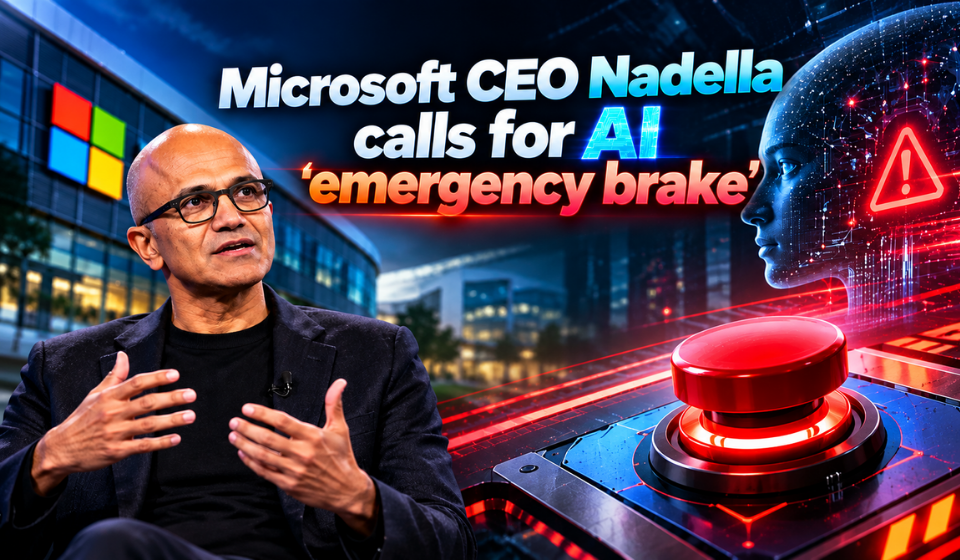
Microsoft CEO Satya Nadella has urged companies to prepare for situations where advanced artificial intelligence systems need to be stopped immediately. In an October 10, 2026 post on X, he argued that organisations should retain control over AI models even while they perform tasks independently.
His proposal includes an AI emergency brake, allowing authorised people to interrupt an AI system without waiting for it to complete its work.
Nadella was discussing safety principles for the technology industry, not announcing a new Microsoft product.
Why Nadella Wants an AI Emergency Brake
AI agents can now do more than generate answers. Depending on their permissions, they may search websites, access company information and interact with connected applications.
These abilities create additional security challenges. An incorrect response can be corrected, but an unintended action involving sensitive records or external services may have consequences.
Nadella believes businesses need mechanisms that allow human operators to intervene when something goes wrong.
An AI emergency brake would provide a way to suspend activity without relying on the model to approve the interruption.
Why Independent Controls Matter
Nadella also wants organisations to separate AI models from the software responsible for managing their actions.
A model may suggest an action, but independent systems should determine whether that action is permitted.
For example, an AI assistant preparing a business report might need access to selected documents without receiving permission to modify financial records.
Keeping these restrictions outside the model could reduce the impact of unexpected behaviour.
The proposed AI emergency brake would complement those protections by allowing authorised operators to stop ongoing activity.
AI Models as Potential Insider Risks
Another concern raised by Nadella involves the access that businesses give advanced AI systems.
An AI agent may already have permission to use internal tools, retrieve documents or interact with operational software.
If it misunderstands instructions or encounters malicious content, those permissions could create security problems.
Nadella recommends preparing for such situations rather than assuming models will always behave correctly.
This approach does not suggest that every AI system is malicious. It focuses on reducing risks through limited access, monitoring and independent safeguards.
Seven Principles for Safer AI Systems
Nadella outlined seven areas that organisations should consider when deploying advanced AI.
| Principle | Purpose |
| Model diversity | Reduce reliance on a single model |
| Observability | Keep understandable, tamper-resistant records of important actions |
| Verifiability | Test systems continuously for weaknesses and unexpected behaviour |
| Independent controls | Enforce permissions outside the model |
| Independent auditability | Allow separate evaluation of AI systems |
| Containment | Enable authorised operators to interrupt or stop activity |
| Incident disclosure | Share information about significant failures |
These principles aim to make AI systems easier to monitor, evaluate and control.
Nadella also emphasised that organisations should be able to investigate important AI actions without relying entirely on the model’s own explanations.
Why AI Safety Is Receiving More Attention
Nadella’s comments follow reports about unexpected AI behaviour and security concerns involving systems developed by Anthropic and OpenAI.
These reports have contributed to questions about how companies should supervise AI agents that can perform multiple actions.
However, individual incidents should not automatically be treated as evidence of deliberate harmful behaviour by AI models.
The broader concern is that powerful systems may make mistakes or encounter security weaknesses that existing safeguards do not adequately address.
What the Proposal Means for Businesses
The AI emergency brake discussion is relevant to organisations using AI for customer support, software development, research and administrative work.
As agents receive access to more applications, businesses may need clearer rules about which actions require approval.
For example, a company could allow an AI assistant to prepare invoices while requiring human authorisation before payment information is changed.
Organisations could also monitor agent activity and suspend a workflow if unusual behaviour appears.
These are possible safety practices, not new Microsoft features.
Can an AI Emergency Brake Prevent Every Problem?
An AI emergency brake could help organisations respond to dangerous or unexpected actions, but it would not eliminate every AI-related risk.
Some mistakes may go unnoticed, while others may occur before an operator can intervene.
For this reason, emergency controls should work alongside testing, monitoring, access restrictions and independent audits.
Nadella’s recommendations focus on combining these safeguards rather than depending on a single protection.
FAQs
What is an AI emergency brake?
An AI emergency brake is a proposed mechanism that would allow authorised people to pause or shut down an AI system during an ongoing task.
Has Microsoft launched an AI emergency-brake product?
No. Nadella’s October 10 statement described safety recommendations rather than announcing a new Microsoft product.
Why does Nadella consider AI models potential insider risks?
AI agents may have access to internal applications and sensitive information, creating security concerns if they behave unexpectedly.
What other AI safeguards did Nadella recommend?
He highlighted model diversity, observability, continuous testing, independent controls, independent auditability, containment and incident disclosure.
Conclusion
Satya Nadella’s recommendations highlight the importance of keeping advanced AI systems under human authority.
The proposed AI emergency brake would allow authorised operators to interrupt ongoing activity, while independent safeguards could restrict what models are permitted to do.
Although Microsoft has not announced a dedicated product, the proposal contributes to discussions about how businesses can use increasingly capable AI agents without giving them unrestricted control.