


Table of Contents
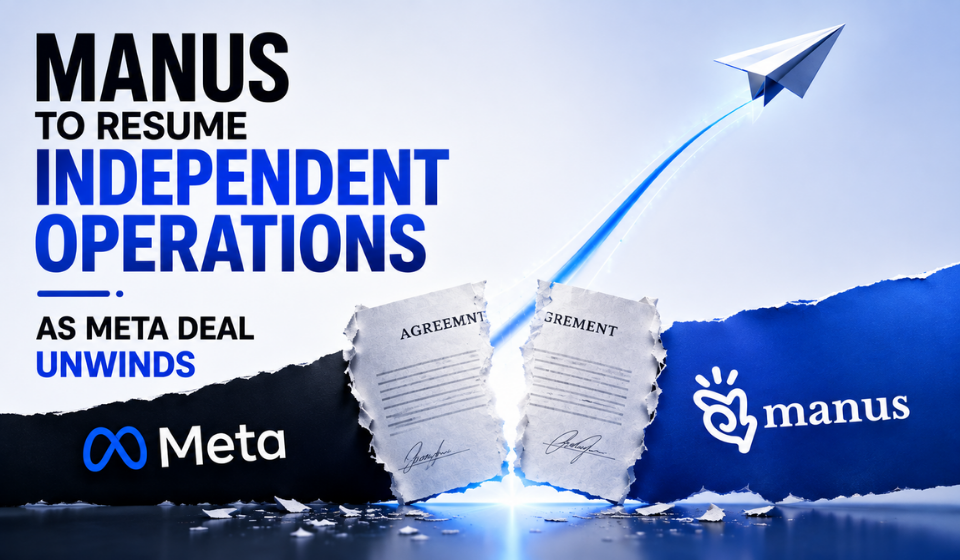
Manus AI is preparing to resume operations as an independent company after its acquisition by Meta was ordered to be unwound by Chinese authorities.
The development reverses a major technology deal announced in December 2025 and creates a new chapter for the Singapore-headquartered AI startup. Manus confirmed that the separation from Meta will also affect some user data generated during the period when the company was owned by Meta.
The company has stressed that the planned data deletion is a regulatory requirement connected to its separation from Meta and is not the result of a security incident.
Some User Data Will Be Deleted
One of the most immediate consequences for users is the planned removal of certain account data.
Manus says data generated by some users on or after December 29, 2025, the date Meta acquired the company, must be deleted to comply with regulatory requirements in specific jurisdictions.
The deletion process is scheduled for August 23 and 24. Affected accounts will temporarily become unavailable while the process takes place.
Users covered by the policy have been given a backup window before the deletion begins. Manus has provided a tool allowing eligible users to save their data before the deadline.
The company says affected customers will receive information through the Manus application and email.
Why Is the Meta Deal Being Reversed?
Meta announced its acquisition of Manus in December 2025 in a transaction reportedly worth around $2 billion.
The deal subsequently came under scrutiny from Chinese authorities amid growing concerns about foreign ownership and control of strategically important artificial intelligence technology.
In April 2026, Chinese authorities ordered the transaction to be unwound, according to reporting on the regulatory review. The decision created a complicated process for separating Manus from Meta and restoring the startup’s independent operations.
The situation represents an unusual example of a major cross-border technology acquisition being reversed after regulatory intervention.
Meta Had Already Begun Separating From Manus
The latest announcement follows earlier signs that the relationship between Meta and Manus was already being dismantled.
Reports indicated that Meta had restricted Manus employees’ access to some internal systems and stopped sharing data between the two companies.
The latest separation process formalises that transition and allows Manus to return to operating independently.
For users, however, the transition creates practical challenges because some information generated during the Meta ownership period must be removed.
Tencent Has Previously Shown Interest
Manus could also receive new investment as it returns to independent ownership.
In July, Reuters reported that Chinese technology giant Tencent was in talks to become Manus’ largest shareholder. The discussions were part of efforts to find an alternative ownership structure after Beijing ordered Meta to unwind the acquisition.
Tencent was already an investor in Manus before Meta’s acquisition, making its reported interest significant.
However, the discussions should not be confused with a completed acquisition or investment. The company’s eventual ownership structure remains subject to further developments.
What Users Need to Know
For affected Manus AI users, the immediate priority is protecting information they want to retain.
Manus has indicated that users within the affected group can back up their data before the deletion period and restore their information after the transition. Accounts are expected to become available again following the two-day deletion process.
The company has also said affected users will not be charged during the relevant transition period and will receive a welcome-back benefit after their accounts are restored.
Manus has not publicly specified how many accounts are affected or provided a complete list of the jurisdictions covered by the policy.
A Significant Test for Cross-Border AI
The return of Manus AI to independent operations is significant beyond the company itself.
The case demonstrates how national-security and technology regulations can influence international AI acquisitions, even after major companies have announced and begun implementing deals.
It also highlights the practical difficulties of separating an AI startup from a large technology company, particularly when customer data, infrastructure and corporate systems have been shared during the acquisition period.
For Manus, the immediate challenge is completing the separation while maintaining service for users and establishing a new ownership structure.
Frequently Asked Questions
Is Manus becoming independent again?
Yes. Manus has announced that it will resume operating independently as its acquisition by Meta is unwound.
Will Manus delete user data?
Some users’ data generated on or after December 29, 2025 is scheduled for deletion as part of the regulatory separation process.
Is the deletion caused by a security breach?
No. Manus specifically says the deletion is related to regulatory requirements and is not the result of a security incident.
Is Tencent buying Manus?
Tencent has reportedly discussed becoming Manus’ largest shareholder, but no completed transaction has been publicly confirmed.
Conclusion
The return of Manus AI to independent operations marks an unusual reversal in the global AI industry. Meta’s reported $2 billion acquisition is being unwound after intervention by Chinese authorities, forcing the startup to separate from its former parent company.
For users, the most important development is the planned deletion of certain data created during the Meta ownership period. Manus has provided affected users with a backup process and information about the temporary account restrictions.
The company’s future ownership remains another important question, particularly following reports of Tencent’s interest. As Manus completes its separation from Meta, the case could become an important example of how regulatory decisions can reshape cross-border AI deals.