


Table of Contents
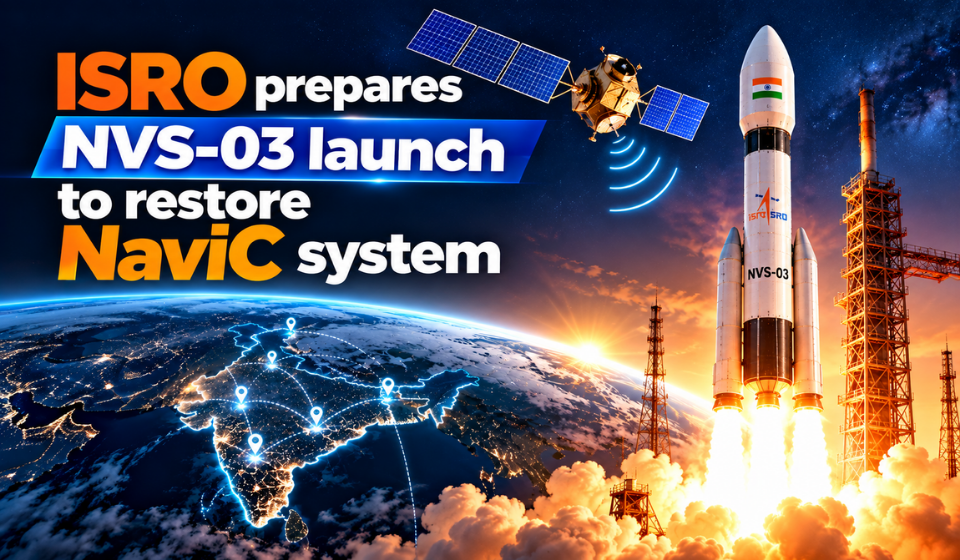
India’s NVS-03 launch is emerging as an important upcoming mission for the country’s navigation infrastructure. The Indian Space Research Organisation (ISRO) is preparing to send the next-generation navigation satellite into orbit in the second half of October or around November 2026.
The urgency comes after NavIC, India’s independent satellite navigation system, dropped to just three operational satellites capable of providing positioning, navigation and timing services. Since at least four satellites are required for basic standalone positioning, the NVS-03 launch is expected to play a key role in restoring the system’s operational capability.
Why the NVS-03 Launch Is Important for NavIC
NavIC, short for Navigation with Indian Constellation, is India’s regional satellite navigation system and serves as an alternative to systems such as GPS. It is designed to provide positioning and timing services across India and areas extending roughly 1,500 kilometres beyond the country’s borders.
The constellation needs a minimum of four operational satellites for basic positioning services, while seven satellites are required for full constellation coverage.
However, satellite failures, problems involving onboard atomic clocks and the recent retirement of IRNSS-1F have reduced the number of functioning satellites to three.
This makes the NVS-03 launch particularly significant. By adding another next-generation satellite, ISRO aims to bring NavIC back above the minimum threshold needed for standalone positioning.
NVS-03 Is Part of NavIC’s Next-Generation Upgrade
NVS-03 belongs to ISRO’s newer NVS series, which is being developed to strengthen and modernise India’s navigation constellation.
The satellite is expected to contribute to the restoration and eventual expansion of NavIC services. The broader objective is not simply to replace ageing spacecraft but to establish a more reliable navigation infrastructure for applications across civilian and strategic sectors.
Key points surrounding NVS-03 include:
- It is the third satellite in the next-generation NVS series.
- The mission is being prepared at Satish Dhawan Space Centre in Sriharikota.
- The launch is targeted for late October or November 2026.
- It is expected to use the GSLV Mark II launch vehicle.
- The satellite is intended to strengthen NavIC’s positioning, navigation and timing services.
- NavIC is designed to cover India and approximately 1,500 km beyond its borders.
The upcoming mission therefore represents an important step in rebuilding the resilience of India’s indigenous navigation network.
Why ISRO Is Turning to GSLV Mark II
The NVS-03 launch is also notable because of the rocket selected for the mission. ISRO is expected to use the GSLV Mark II, rather than the PSLV.
The PSLV is currently on hold following two consecutive mission failures. A failure analysis committee has recommended corrective measures, and the vehicle remains grounded while those measures are addressed.
The GSLV Mark II, meanwhile, recently completed a mission from Sriharikota carrying EOS-05 on September 4, 2026. This recent flight provides relevant operational context as ISRO prepares another important mission using the vehicle.
| Mission Element | Details |
| Satellite | NVS-03 |
| System | NavIC |
| Satellite series | NVS next-generation series |
| Expected launch | Late October or November 2026 |
| Launch vehicle | GSLV Mark II |
| Launch site | Satish Dhawan Space Centre, Sriharikota |
| Current NavIC positioning satellites | 3 |
| Minimum needed for basic positioning | 4 |
| Intended coverage | India and about 1,500 km beyond |
The choice of GSLV Mark II adds importance to the mission because restoring NavIC depends not only on the satellite but also on a reliable launch.
NavIC Restoration Comes Amid Wider ISRO Challenges
The push to restore NavIC comes during a broader discussion about the future structure of India’s space programme.
One recent debate followed comments from IN-SPACe Chairman Pawan Kumar Goenka about ISRO eventually moving away from manufacturing launch vehicles and allowing private companies to take on a larger role.
The remarks faced opposition from nine ISRO employee associations. Former ISRO chairman G. Madhavan Nair has also questioned the idea of following a model in which core space capabilities are increasingly outsourced.
These discussions highlight the changing relationship between ISRO and India’s growing private space sector. However, the immediate operational priority remains clear: strengthening critical systems such as NavIC.
FAQs About the NVS-03 Launch
What is NVS-03?
NVS-03 is the third satellite in ISRO’s next-generation NVS series, developed to strengthen India’s NavIC satellite navigation system.
When will NVS-03 launch?
ISRO is preparing for a launch window in the second half of October or around November 2026.
Why does NavIC need NVS-03?
NavIC currently has three functioning satellites providing positioning, navigation and timing services, while at least four are needed for basic standalone positioning.
Which rocket will launch NVS-03?
The satellite is expected to be launched using ISRO’s GSLV Mark II.
What is NavIC used for?
NavIC provides positioning, navigation and timing services across India and areas extending approximately 1,500 kilometres beyond the country’s borders.
Conclusion
The upcoming NVS-03 launch is more than another satellite deployment for ISRO. It is an important step toward restoring the operational strength of India’s indigenous NavIC navigation system, which has been reduced to three functioning positioning satellites.
With the launch expected in late October or November 2026, the mission will combine a next-generation navigation satellite with the GSLV Mark II launch vehicle. The success of the NVS-03 launch could help restore basic NavIC positioning capability while supporting the longer-term goal of rebuilding and expanding the constellation.
As India continues developing its space ecosystem, maintaining reliable national infrastructure such as NavIC remains an important part of its broader space programme.