


Table of Contents
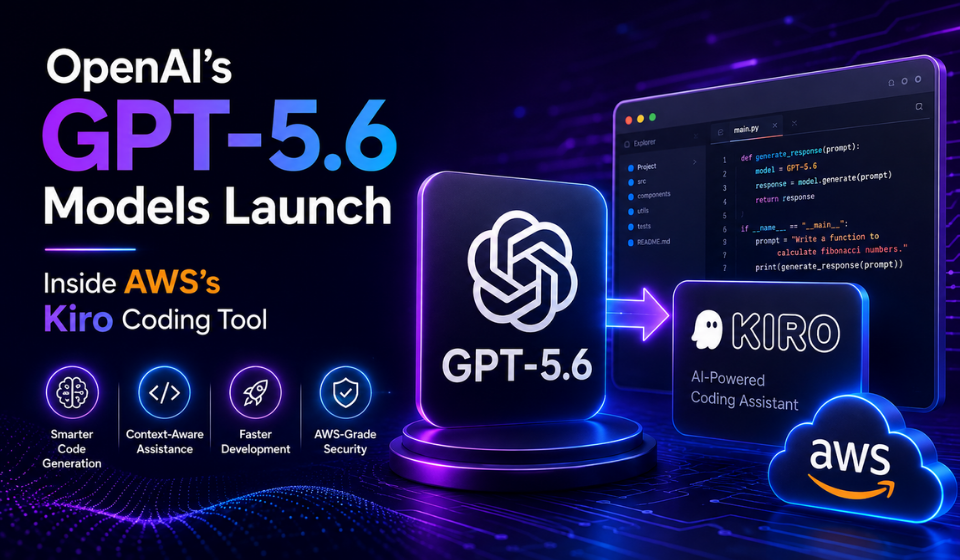
OpenAI has brought its GPT-5.6 model family to Kiro, AWS’s agentic software development environment. The integration gives Kiro users access to three OpenAI models — GPT-5.6 Sol, Terra and Luna — for development workflows involving planning, coding, testing and iteration.
The announcement strengthens the collaboration between OpenAI and AWS while giving developers another option for using OpenAI’s latest models within an AI-native development environment.
How GPT-5.6 Works Inside Kiro
Kiro is designed to move beyond simple AI-assisted code generation. Its workflow can turn high-level prompts into executable specifications, helping developers define requirements and plan implementation before coding begins. Kiro also supports code validation and work across larger codebases.
With the GPT-5.6 Model Kiro integration, developers can select from three model tiers depending on the complexity and cost requirements of their tasks.
According to Kiro’s documentation, GPT-5.6 Sol is positioned for demanding multi-step work, including complex terminal tasks and long-horizon refactoring. Terra and Luna provide additional options that balance capability and cost.
Reported 82% Cost Reduction
One of the most notable claims in the announcement concerns the cost of completing development tasks.
OpenAI and AWS reported that GPT-5.6 Terra completed tasks in Terminal-Bench 2.1 at approximately 82% lower cost when operating within Kiro’s spec-driven harness.
This figure needs important context. The 82% figure refers to cost per successful task, not an 82% increase in accuracy or coding performance. It comes from the stated testing setup involving Kiro and Terminal-Bench 2.1 and should not be interpreted as a universal reduction in the cost of every development workload.
Kiro’s published model information also reports strong Terminal-Bench 2.1 results for GPT-5.6 Sol, with Sol scoring 88.8% in the listed evaluation.
GPT-5.6 Model Options in Kiro
| Model | Positioning | Best suited for |
| GPT-5.6 Sol | Flagship tier | Complex coding and long-horizon tasks |
| GPT-5.6 Terra | Balanced tier | General development workflows |
| GPT-5.6 Luna | More cost-efficient tier | Higher-volume development tasks |
Kiro also allows users to choose models based on the requirements of individual tasks. Its documentation says an Auto option can route work to an appropriate model.
OpenAI Continues to Focus on Price-Performance
The Kiro integration comes as OpenAI continues to emphasize the efficiency and price-performance of the GPT-5.6 family.
In July, OpenAI announced an 80% price reduction for GPT-5.6 Luna and a 20% reduction for GPT-5.6 Terra. The company positioned Luna as its faster, more affordable option for high-volume work.
The company has also continued developing GPT-5.6 Sol for demanding workloads, including coding and agentic tasks. OpenAI describes Sol as its strongest model in the GPT-5.6 family.
What the Kiro Integration Means for Developers
The GPT-5.6 Model Kiro integration gives developers access to OpenAI models directly within a workflow built around structured specifications and agentic software development.
Rather than treating AI as a separate coding assistant, Kiro is designed to connect planning, implementation, validation and other stages of software development. Adding GPT-5.6 models gives developers more choices when deciding how much capability and computational cost a particular task requires.
The reported cost results are encouraging, but actual savings can vary depending on the task, model selected and development workflow.
FAQs
What is GPT-5.6 Model Kiro?
It refers to the availability of OpenAI’s GPT-5.6 family within Kiro, AWS’s agentic software development environment.
Which GPT-5.6 models are available in Kiro?
Kiro provides access to GPT-5.6 Sol, Terra and Luna.
Does GPT-5.6 in Kiro reduce development costs by 82%?
OpenAI and AWS reported an approximately 82% lower cost per successful task for GPT-5.6 Terra in their Terminal-Bench 2.1 testing with Kiro. This should not be interpreted as an 82% reduction for every development project.
Which GPT-5.6 model is designed for complex coding?
Kiro positions GPT-5.6 Sol for demanding multi-step development tasks, including long-horizon refactoring and complex terminal workflows.
What is Kiro?
Kiro is an agentic development environment from AWS that helps developers turn prompts into executable specifications and work through software development tasks with AI agents.
Conclusion
The GPT-5.6 Model Kiro integration brings OpenAI’s Sol, Terra and Luna models into a development environment built around structured, agentic software engineering.
The reported 82% cost-per-successful-task reduction for GPT-5.6 Terra is one of the headline results, although it applies specifically to the stated Kiro and Terminal-Bench 2.1 testing conditions. It should therefore not be presented as a guaranteed saving across all software projects.
With three GPT-5.6 tiers now available, Kiro users have more flexibility to match model capability and cost to different development tasks. The integration also reflects the broader shift toward AI systems that participate in planning, coding and validation rather than simply generating code from individual prompts