


Table of Contents
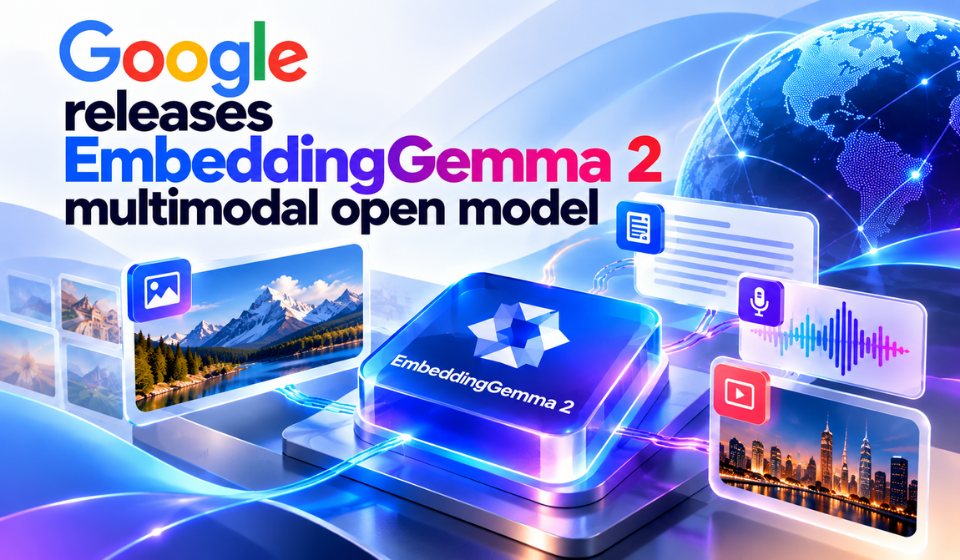
Google DeepMind has rolled out Google’s EmbeddingGemma 2, an open-weight multimodal embedding model built to deliver strong search and retrieval on phones, laptops, and other hardware that runs locally. The model arrived on October 6, 2026, and maps text, code, images, video, and audio into one shared embedding space with 768 dimensions.
Google’s EmbeddingGemma 2 is based on the Gemma 4 architecture, totals 740 million parameters, and ships under the business-friendly Apache 2.0 license. According to Google, it takes the company’s on-device embedding work past plain text and opens the door to multimodal search and retrieval-augmented generation applications.
How Google’s EmbeddingGemma 2 Widens On-Device Search
An embedding turns information into numbers that capture its meaning. Search engines and RAG systems can compare those numbers to find related material, even if the wording or the format is different.
Google’s EmbeddingGemma 2 carries that idea across several kinds of media. Developers might type a text query to find a specific moment in a video, or describe something to search through hours of recorded audio.
It succeeds Google’s first EmbeddingGemma, a text-only model with 308 million parameters that appeared in September 2025. Google reports more than 20 million downloads of that original release, a sign of strong demand for small embedding models.
A Modular Design Adds Flexibility
A standout trait of Google’s EmbeddingGemma 2 is its modular construction. Not every application needs to load all 740 million parameters.
Google’s developer documentation splits the architecture into three main parts:
- Core for text and code: 270 million parameters
- Vision encoder: 170 million parameters
- Audio encoder: 300 million parameters
Every supported input type ends up as vectors in a single embedding space, so a text query can be matched directly against content derived from images, video, or audio.
Google’s EmbeddingGemma 2 also offers a context window of 8,192 tokens, four times the size of the original model’s. One input can hold up to 29 images, 58 video frames, or roughly 5.5 minutes of audio.
Better Benchmarks and Compact Vectors
The new model also adds features that cut down storage needs. With Matryoshka Representation Learning, developers can trim embeddings from the full 768 dimensions down to as few as 128.
Reported benchmark figures show Google’s EmbeddingGemma 2 reaching 78.68 on the code portion of the Massive Text Embedding Benchmark, versus 68.76 for the earlier model, a gain of 9.92 points.
Google states that 256-dimensional vectors keep roughly 95% of the full model’s quality on image, video, and speech retrieval, while at 128 dimensions multimodal retrieval quality drops to about 75%.
Such flexibility may help mobile and edge apps that have limited memory and storage. Developers can pick a vector size that suits their preferred mix of quality, speed, and resource use.
| Feature | Google’s EmbeddingGemma 2 |
| Parameters | 740 million |
| Embedding size | 768 dimensions |
| Context window | 8,192 tokens |
| License | Apache 2.0 |
| Modalities | Text, code, image, video, audio |
| Minimum vector size | 128 dimensions |
Built for Phones, Laptops and Local Apps
Google’s EmbeddingGemma 2 is made with local processing in mind. Google says that once quantised on a Pixel 11 Pro, the text-only weights need around 191MB of active memory, and the full multimodal model takes about 567MB.
Two demos are also expected in Google AI Edge Gallery. Instant Media Search lets people look through local photos and videos using descriptions, and Video Moments Finder can pinpoint scenes without transcribing the audio first.
In addition, Google has launched AI Edge Foresight for Mac, an experimental app that can search transcripts, notes, images, and documents kept on a computer.
Model weights can be downloaded now from Hugging Face and Kaggle. Google intends to add Google’s EmbeddingGemma 2 to ML Kit for Android over the next few weeks, with hardware acceleration on supported devices, and also plans support for the Gemini Enterprise Agent Platform Model Garden.
Google’s EmbeddingGemma 2 FAQs
What is Google’s EmbeddingGemma 2?
It is Google’s open-weight multimodal embedding model covering text, code, images, video, and audio.
What sets Google’s EmbeddingGemma 2 apart?
It places several media types in one shared embedding space, which enables cross-modal search.
Is Google’s EmbeddingGemma 2 able to run on phones?
Yes. Google built it for on-device use, and quantised versions fit within mobile memory limits.
Which license applies to the model?
It is released under Apache 2.0, which allows commercial use.
Has the model had safety tuning?
According to the model card, it received no post-training safety tuning, so developers must add safeguards at the application level.
Conclusion
Google’s EmbeddingGemma 2 marks a major step forward in Google’s compact embedding approach. Linking text, code, images, video, and audio in one vector space could make local search and retrieval systems far more versatile.
Its modular design, adjustable vector sizes, Apache 2.0 license, and modest memory needs appeal to developers working on edge and mobile apps. Still, they should check retrieval quality and build their own safeguards before shipping to production. The release could make multimodal retrieval more practical, private, and affordable, lessening reliance on cloud-based search infrastructure services.