


Table of Contents
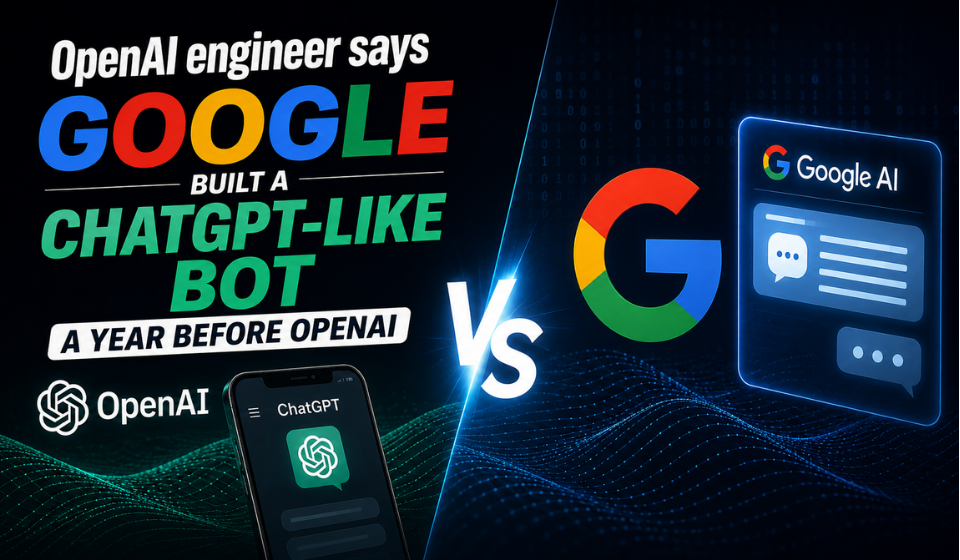
A senior OpenAI executive has claimed that a Google chatbot before ChatGPT existed internally nearly a year before OpenAI launched ChatGPT in November 2022. The comments, made by Thibault “Tibo” Sottiaux, have sparked fresh discussion about Google’s early AI development and whether the company delayed releasing a consumer chatbot despite having similar technology.
Sottiaux previously worked at Google and now serves as Head of Core Products at OpenAI, overseeing products including ChatGPT and Codex. Google has not publicly confirmed his claims, and the statements remain his personal account.
OpenAI Executive Shares Details of an Internal Google Project
The discussion began after AI engineer Cheng Lou referenced remarks from Jeff Dean, Google’s Chief Scientist, who had previously said the company possessed an internal chatbot before ChatGPT but believed it was not more useful than traditional Google Search.
Responding on X, Sottiaux said he was part of the team behind the Google chatbot before ChatGPT. According to him, the project was initially called LMChat before later receiving another internal codename.
He further claimed that Google decided against releasing the chatbot because it was concerned about disrupting its core search business. Sottiaux also alleged that Google DeepMind faced restrictions on launching products that could compete with Google’s existing services.
While these comments have attracted significant attention, Google has not verified the claims or publicly responded to Sottiaux’s statements.
Google’s Early AI Leadership
The conversation has renewed interest in Google’s longstanding contributions to artificial intelligence.
In 2017, Google researchers introduced the Transformer architecture through the landmark paper “Attention Is All You Need.” The breakthrough became the foundation for many modern large language models, including OpenAI’s GPT family.
Before ChatGPT was released, Google had also developed several advanced conversational AI systems, including Meena, LaMDA, and PaLM. However, none of these systems became widely available public chatbots before OpenAI introduced ChatGPT.
Google CEO Sundar Pichai and Chief Scientist Jeff Dean previously acknowledged that the company had similar AI capabilities but said concerns around hallucinations, reliability, and user trust influenced its cautious rollout strategy.
ChatGPT Changed the Competitive Landscape
When OpenAI launched ChatGPT in November 2022, it quickly reshaped the AI industry.
The chatbot reached one million users within five days and surpassed 100 million users in just two months, becoming one of the fastest-growing consumer applications in history.
Google later introduced Bard, which has since evolved into Gemini, its flagship AI assistant.
According to figures reported by India Today, ChatGPT now has approximately one billion monthly active users, while Gemini is reported to be approaching 950 million monthly active users.
Debate Over Google’s Product Strategy
Sottiaux’s comments have reignited debate over whether Google’s cautious approach delayed its entry into the generative AI market.
Although he believes a Google chatbot before ChatGPT existed internally well before OpenAI’s launch, Google has consistently maintained that its AI product decisions were guided by concerns over reliability, responsible deployment, and user trust. The company has not stated that protecting its search business influenced its decision-making, nor has it confirmed the existence of LMChat.
The discussion highlights the broader challenge facing AI companies: balancing rapid innovation with the responsibility of releasing technology that is reliable and ready for widespread public use.
Key Highlights
| Features | Details |
| Main Claim | An OpenAI executive says a Google chatbot before ChatGPT existed internally |
| Executive | Thibault “Tibo” Sottiaux, Head of Core Products at OpenAI |
| Internal Project | LMChat (according to Sottiaux) |
| Google’s Position | No official confirmation of the claims |
| Earlier Google AI Models | Meena, LaMDA, and PaLM |
| Google’s Earlier Explanation | Reliability, hallucinations, and user trust influenced rollout decisions |
| After ChatGPT | Google launched Bard, which later became Gemini |
Conclusion
The claims surrounding a Google chatbot before ChatGPT have reopened discussions about Google’s early AI capabilities and product strategy. While OpenAI executive Thibault Sottiaux believes Google developed an internal chatbot before ChatGPT’s public launch, Google has not confirmed those assertions. Regardless of the debate, Google’s research played a foundational role in modern AI, while ChatGPT’s success accelerated competition and reshaped the global race to build advanced conversational AI systems.