


Table of Contents
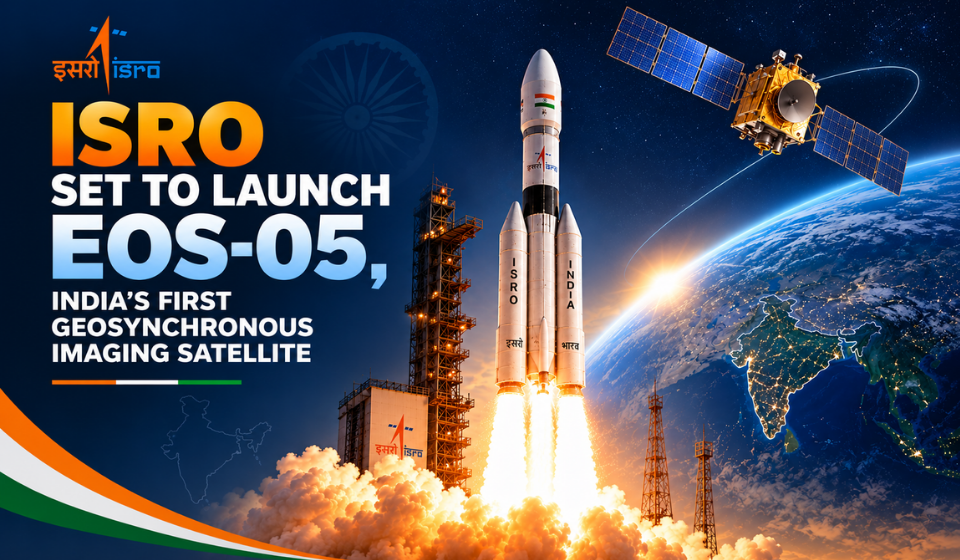
The Indian Space Research Organisation (ISRO) has successfully launched the EOS-05 satellite, also known as GISAT-1A, aboard the GSLV-F17 rocket. The launch took place at 2:55 AM IST on September 4 from the Second Launch Pad at the Satish Dhawan Space Centre in Sriharikota.
The mission marks an important milestone for India’s space programme. According to ISRO, EOS-05 is India’s first-ever imaging satellite intended to operate from geosynchronous orbit. GSLV-F17 successfully placed the spacecraft into its intended Sub-Geosynchronous Transfer Orbit (Sub-GTO), completing the launch vehicle’s primary mission.
EOS-05 Is India’s First Geosynchronous Imaging Satellite
The EOS-05 satellite is an advanced Earth observation spacecraft designed to provide frequent imaging of the Indian landmass from geosynchronous orbit.
A geosynchronous orbit has an orbital period that matches Earth’s rotation, allowing a satellite to repeatedly observe the same broad region. This makes the orbit particularly useful for applications requiring frequent monitoring.
EOS-05 is designed to provide near-real-time Earth observation capabilities. Its imaging systems are expected to support applications including agriculture, environmental monitoring, disaster management and observation of changing weather and surface conditions.
ISRO describes the spacecraft as India’s first imaging satellite from geosynchronous orbit, making the mission an important development in the country’s Earth observation programme.
Key EOS-05 Mission Details
| Features | Details |
| Satellite | EOS-05 / GISAT-1A |
| Launch vehicle | GSLV-F17 |
| Launch date | September 4, 2026 |
| Launch time | 2:55 AM IST |
| Launch site | Satish Dhawan Space Centre, Sriharikota |
| Satellite type | Earth observation |
| Initial orbit | Sub-Geosynchronous Transfer Orbit |
| Operational orbit | Geosynchronous orbit |
| Satellite mass | Approximately 2,367 kg |
| GSLV flight number | 19th GSLV mission |
A Successful Return After Recent Setbacks
The successful launch is particularly significant because it comes after a challenging period for ISRO’s launch programme.
The agency’s previous mission, PSLV-C62, encountered an anomaly on January 12, 2026. ISRO’s official launch records show that GSLV-F17 followed the PSLV-C62 mission, making the EOS-05 launch the agency’s first successful orbital launch of 2026.
The GSLV and PSLV are different launch vehicle families, with different propulsion configurations. Therefore, the PSLV setbacks do not directly indicate a problem with the GSLV platform.
Nevertheless, the successful GSLV-F17 mission provides an important demonstration of the launch vehicle’s ability to deliver a heavy Earth observation spacecraft into a high-energy transfer orbit.
EOS-05 Follows an Earlier Failed Mission
The EOS-05 mission also represents a renewed attempt to establish India’s geosynchronous imaging capability.
In August 2021, the GSLV-F10 mission carrying the earlier GISAT-1/EOS-03 spacecraft failed after an anomaly involving the cryogenic upper stage. The satellite was consequently lost.
The successful GSLV-F17 mission now provides the programme with the outcome that the earlier mission could not achieve. The Times of India described EOS-05 as the second attempt to establish the capability originally targeted by the GISAT programme.
EOS-05 Was Placed Into a Transfer Orbit
Although the launch has been successfully completed, EOS-05 has not simply been placed directly into its final geosynchronous operating position.
ISRO confirms that GSLV-F17 injected the spacecraft into a Sub-Geosynchronous Transfer Orbit. From this initial orbit, the satellite must undergo additional orbital manoeuvres before reaching its intended operational position.
This distinction is important because launch success and final satellite operationalisation are separate stages of a mission.
The successful injection demonstrates that the GSLV-F17 launch vehicle completed its planned deployment. Further orbit-raising activities will determine when EOS-05 reaches its final operating configuration.
What EOS-05 Could Support
The EOS-05 satellite is expected to strengthen India’s Earth observation capabilities by providing frequent views of the same broad geographical region.
Earth observation data can support a variety of civilian and strategic applications. These include agriculture, water-resource monitoring, forestry, environmental studies, urban planning, ocean-resource observation and disaster management.
Frequent observation can be particularly useful during rapidly changing events. Updated satellite imagery can help provide information about conditions during floods, severe weather events and other natural disasters.
India Today also highlighted the broader Earth observation applications associated with the mission, including agriculture, water resources, environmental monitoring and disaster management.
A Major Milestone for India’s Space Programme
The GSLV-F17 mission is the 19th flight of India’s Geosynchronous Satellite Launch Vehicle. The successful deployment of the 2,367-kilogram EOS-05 therefore represents an important demonstration of the country’s heavy-lift launch capability.
The mission also restores momentum to India’s launch programme after the January PSLV-C62 setback.
Following the successful launch, Prime Minister Narendra Modi described the achievement as a reflection of India’s growing space capabilities and highlighted the increasing partnership between ISRO and Indian industry.
Frequently Asked Questions
What is the EOS-05 satellite?
EOS-05, also known as GISAT-1A, is an Earth observation satellite designed to provide imaging capabilities from geosynchronous orbit.
When was EOS-05 launched?
ISRO launched EOS-05 aboard GSLV-F17 at 2:55 AM IST on September 4, 2026, from Sriharikota.
Which rocket launched EOS-05?
EOS-05 was launched using the GSLV-F17, the 19th flight of India’s GSLV.
Did GSLV-F17 place EOS-05 directly into geosynchronous orbit?
No. ISRO confirmed that the rocket placed EOS-05 into a Sub-Geosynchronous Transfer Orbit. The spacecraft must subsequently perform orbital manoeuvres to reach its final operational position.
Why is the mission important?
EOS-05 is India’s first imaging satellite intended to operate from geosynchronous orbit. The mission strengthens India’s Earth observation capabilities and marks an important successful launch for ISRO in 2026.
Conclusion
The successful launch of the EOS-05 satellite marks an important achievement for ISRO and India’s Earth observation programme.
GSLV-F17 lifted off from Sriharikota at 2:55 AM IST and successfully placed the 2,367-kilogram spacecraft into its intended Sub-Geosynchronous Transfer Orbit. EOS-05 is designed to provide frequent observations from geosynchronous orbit, supporting applications such as agriculture, environmental monitoring and disaster management.
The mission is also significant because it follows the January 2026 PSLV-C62 anomaly and the earlier loss of the GISAT-1/EOS-03 spacecraft in 2021. Its successful launch gives ISRO a major boost as it continues expanding India’s space capabilities.
The next important stage will be the spacecraft’s orbit-raising and operationalisation. If those activities proceed as planned, EOS-05 will add a valuable new capability to India’s Earth observation infrastructure.