


Table of Contents
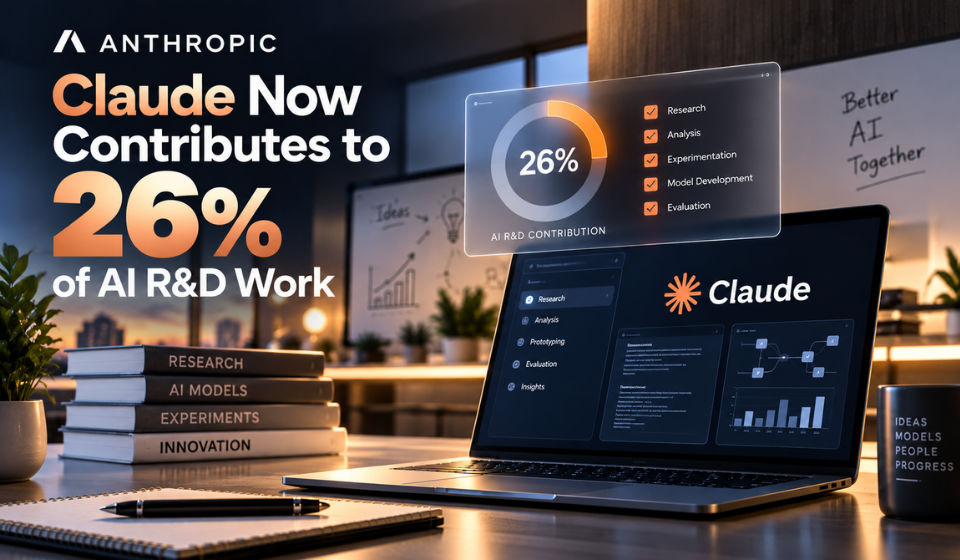
Anthropic says its Claude AI models now lead about 26% of the company’s measured artificial intelligence research and development work focused on building future AI models, up from around 1% in March.
The disclosure provides a rare look at how an AI company is using its own models to help develop more advanced systems. Anthropic says Claude is not operating fully autonomously in any of the areas measured, meaning the 26% figure should not be interpreted as Claude independently carrying out a quarter of the company’s research.
Claude’s Role in AI Research Is Growing
Anthropic reported that AI systems collaborated with humans on more than 90% of its research work in August under the company’s measurement framework.
The distinction between collaboration and leadership is important. The measurement is designed to track how much of a research task AI systems can carry out rather than simply whether an AI tool was used.
Anthropic also said approximately 30,000 software agents were active simultaneously on its main internal platform during August. More than one billion agent decisions were made during the month, with approximately one in 47,000 decisions blocked by the company’s controls.
These figures are Anthropic’s internal measurements and should not be treated as independently audited safety statistics.
| Anthropic Metric | Reported Figure |
| Claude-led AI R&D | 26% |
| Claude-led work in March | About 1% |
| AI-human collaboration | More than 90% |
| Concurrent internal agents | About 30,000 |
| Agent decisions in August | More than 1 billion |
| Blocked decisions | About 1 in 47,000 |
AI Is Helping Develop Future AI Models
The latest figures show that Anthropic is using Claude for increasingly substantial portions of its own model-development process.
Rather than simply assisting with individual coding or research questions, AI systems can increasingly handle larger portions of technical tasks from high-level instructions. Human researchers remain involved, however, and Anthropic says none of the measured areas currently represent fully autonomous work.
This distinction is particularly relevant to discussions about AI systems helping build successor AI models. The data demonstrates increasing AI involvement in model development, but it does not establish that Claude is independently designing and building future models without human researchers.
Anthropic Tracks AI and Human Collaboration
Anthropic’s measurement framework provides a way to distinguish different levels of AI participation in research.
A system may assist a researcher with part of a task, collaborate with researchers throughout a project or take the lead in completing a larger research assignment. The 26% figure relates to the latter category within the work Anthropic measured.
Anthropic’s disclosure therefore provides more information about how AI is being integrated into frontier AI development than a simple measure of how much code or research was generated by Claude.
Safety Research Also Uses AI Compute
Anthropic also disclosed how some of its computing resources were allocated to safety research.
In a snapshot covering July 13 to July 20, approximately 6% of compute used for AI research went toward safety work. For research carried out by AI systems, the figure increased to approximately 12%.
Anthropic described these figures as conservative estimates. Work that contributed equally to safety and AI capabilities was counted as capability work rather than safety work.
The figures therefore represent a specific measurement period rather than a permanent percentage of Anthropic’s computing resources.
Human Oversight Remains Central
Despite the increasing role of AI agents, Anthropic says humans continue to supervise the work.
The company reported that every action taken through its internal agent platform is screened before execution. The relatively small percentage of blocked decisions is an internal safety-control metric and does not by itself establish how safe or reliable the overall system is.
As AI agents gain access to more tools, code and computing resources, the ability to monitor their actions becomes increasingly important.
The Broader Question of AI-Assisted AI Development
Anthropic’s disclosure adds to a growing discussion about whether increasingly capable AI systems could eventually contribute substantially to the development of their successors.
The current data shows that this process is already occurring to an extent: Claude is being used to perform research and engineering work that contributes to the development of future models.
However, AI-assisted model development is not the same as fully autonomous recursive self-improvement. Anthropic’s own figures indicate that human involvement remains part of the measured research process.
Frequently Asked Questions
What percentage of Anthropic’s AI R&D does Claude lead?
Anthropic says Claude leads approximately 26% of its measured AI research and development work, compared with about 1% in March.
Does Claude independently perform 26% of Anthropic’s research?
No. Anthropic says Claude is not fully autonomous in any of the measured areas. The figure represents AI-led work within its measurement framework.
How many AI agents does Anthropic use internally?
Anthropic reported approximately 30,000 software agents active simultaneously on its main internal platform during August.
How much AI research compute went toward safety?
Anthropic’s July 13–20 snapshot found that about 6% of AI research compute was allocated to safety work, compared with approximately 12% for AI-driven AI research.
Is Claude already independently building its successor?
No. The figures show growing AI involvement in developing future AI models, but they do not demonstrate fully autonomous development.
Conclusion
Anthropic’s latest disclosure shows how deeply Claude AI is becoming integrated into the company’s own AI research and development process.
Claude reportedly led 26% of measured AI R&D work in August, compared with about 1% in March, while AI systems collaborated with humans on more than 90% of the research measured.
The numbers highlight the growing role of AI agents in developing future AI systems. At the same time, they should not be interpreted as evidence that Claude is independently building successor models. Anthropic says human oversight remains in place, while its safety and compute figures provide additional context about how the company is managing increasingly capable AI systems.