


Table of Contents
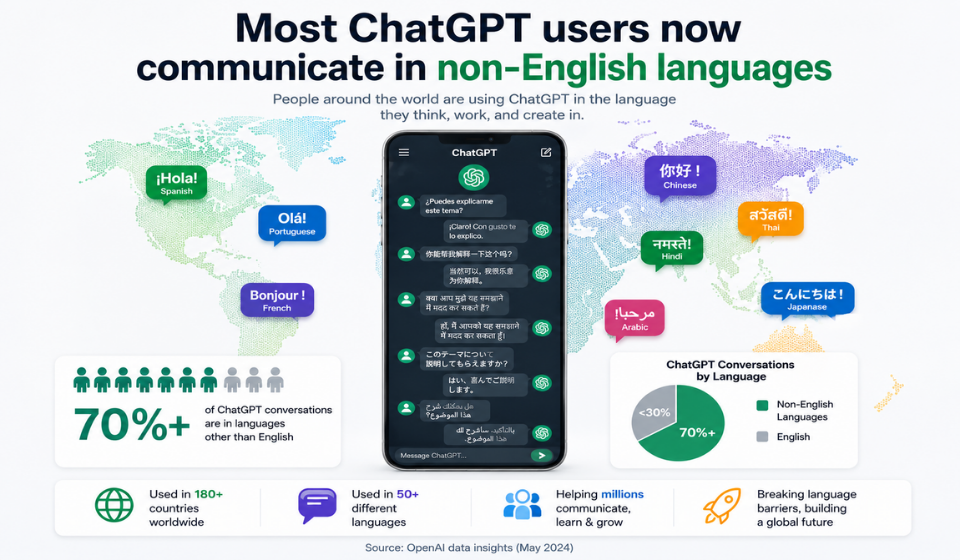
ChatGPT is reaching more people across the globe, and one of the clearest signs of that growth is that most conversations on the platform now happen in languages other than English. This change reflects the rising demand for AI tools that can communicate naturally with users from different regions and language backgrounds.
As access to advanced AI becomes more widespread, people are turning to ChatGPT for a variety of tasks, including studying, writing, coding, translating, brainstorming ideas, and handling customer-related work. Stronger multilingual support has made it easier for users to interact with the platform in the language they know best, helping create a more welcoming and user-friendly experience.
This development shows how generative AI is moving beyond its early English-centered use and becoming a truly global assistant for people in many parts of the world.
Key Highlights
OpenAI’s recent findings reveal several important trends:
- Non-English conversations now exceed English-language interactions.
- ChatGPT adoption is rising quickly in international markets.
- Language models are improving in accuracy across multiple languages.
- Students, professionals, businesses, and developers are using multilingual AI more often.
- OpenAI continues to broaden language support for users in different regions.
ChatGPT’s Progress Across Languages
| Category | Earlier Stage | Current Scenario |
| Dominant Language | English | Non-English languages now account for most usage |
| Global Presence | Mostly concentrated in English-speaking regions | Widely used across international markets |
| Language Capabilities | Limited multilingual support | More fluent and reliable multilingual conversations |
| Primary Applications | Writing, coding, and research | Education, business, translation, creativity, and everyday help |
| Accessibility | Growing gradually | Reaching a much broader global audience |
Why This Shift Matters
The rise in ChatGPT use across multiple languages shows that AI is becoming more inclusive and practical for a wider audience. When users can communicate in their native language, they often find the experience more comfortable, efficient, and useful for learning, work, and collaboration.
For businesses, multilingual AI makes it easier to connect with customers around the world. Students can access learning support in the language they understand best, while professionals can draft content, review information, and solve problems without depending entirely on English. These improvements are helping AI become more relevant across different industries and cultures.
As language capabilities continue to improve, multilingual support is likely to become even more important in future AI tools and applications.
Key Takeaways
- Non-English conversations now make up the majority of ChatGPT usage.
- The trend reflects the platform’s expanding international audience.
- Better multilingual performance is making AI easier to use worldwide.
- People are using ChatGPT for education, business, research, software development, and creative work.
- Ongoing investment in language support is helping OpenAI reach more users across the globe.
Final Thoughts
The rise of non-English conversations on ChatGPT is a major milestone in the growth of artificial intelligence. By allowing users to interact naturally in their preferred language, OpenAI is making AI more accessible, practical, and inclusive for people everywhere. As multilingual capabilities continue to improve, ChatGPT is likely to become an even more valuable tool for learning, communication, and innovation across diverse languages and cultures.