


Table of Contents
OpenAI has brought ChatGPT Ads to India, extending its advertising programme to one of the platform’s largest global markets. The rollout allows sponsored content to appear in certain ChatGPT conversations while opening a new channel for brands and businesses to connect with potential customers.
The advertising feature is available to logged-in adult users on ChatGPT’s Free and Go plans. Users subscribed to Plus, Pro, Business, Enterprise and Education plans will continue to have an ad-free experience.
India’s launch is supported by partnerships with global advertising companies WPP and Omnicom. These are OpenAI’s first agency partners for the country’s advertising rollout, with more than 50 brands expected to begin campaigns during the initial launch period. OpenAI has also confirmed that the agreements are non-exclusive, meaning additional agencies could join the programme over time.
How ChatGPT Ads Work
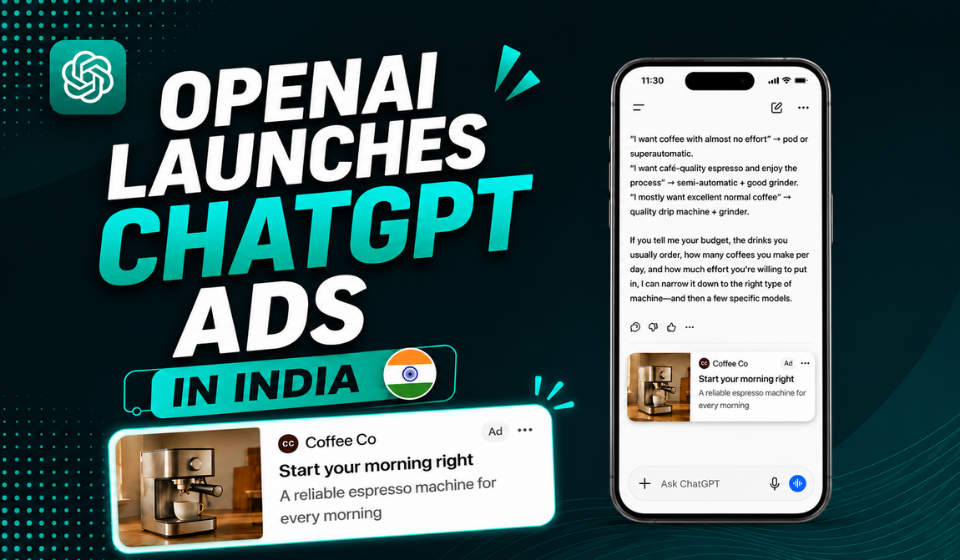
Sponsored content is designed to appear separately from ChatGPT’s AI-generated responses. When an advertisement is considered relevant to a user’s conversation, it may be displayed below the response.
The ads will be clearly marked as sponsored, helping users distinguish paid placements from information generated by the AI. OpenAI has stated that advertising partners cannot influence the responses produced by ChatGPT.
This model could give businesses an opportunity to reach users at moments when they are actively looking for information, researching products or evaluating available services. At the same time, OpenAI will need to ensure that commercial content does not interfere with the usefulness of the platform.
What OpenAI Says About Privacy
Privacy is a major consideration in the introduction of ChatGPT Ads. OpenAI has said that advertisers will not have access to individual conversations, chat history, memories or personal user information.
Advertisers will instead receive aggregated information about campaign performance, such as the number of impressions and clicks generated by their ads. According to OpenAI, user data is not sold to advertisers.
The company has also established restrictions around advertising eligibility and sensitive subjects. Ads will not be shown to users under 18. Sponsored placements are also excluded from conversations involving certain sensitive topics, including mental health and politics.
These safeguards are intended to limit inappropriate advertising situations while maintaining a distinction between private conversations and advertising data.
WPP and Omnicom Become Initial Partners
WPP and Omnicom are working with OpenAI during the early stages of the Indian advertising launch.
Their involvement provides an entry point for brands that want to test the new advertising format, with more than 50 brands expected to run campaigns during the first phase. Because the partnerships are non-exclusive, OpenAI can also establish relationships with other advertising agencies as the platform expands.
The involvement of major agencies could help OpenAI attract established advertisers while it develops the infrastructure and processes required for a larger advertising operation.
Businesses Will Get Direct Access to ChatGPT Ads
OpenAI is not limiting advertising access to companies working through agency partners. Starting September 4, 2026, businesses in India are expected to receive self-serve access through the ChatGPT Ads Manager.
The platform will allow advertisers to launch and manage campaigns directly, with daily budgets starting at ₹725.
Two campaign models will initially be available:
Reach campaigns will use a cost-per-thousand-impressions (CPM) model and are intended for advertisers focused on increasing brand visibility.
Clicks campaigns will use a cost-per-click (CPC) bidding model, allowing advertisers to focus on engagement with their sponsored content.
The self-serve option could make ChatGPT Ads accessible to businesses of different sizes, including companies that do not work with large advertising agencies.
| Features | Details |
| Users eligible to see ads | Logged-in adults on Free and Go plans |
| Ad placement | Below relevant ChatGPT responses |
| Identification | Clearly labelled as sponsored |
| Ad-free plans | Plus, Pro, Business, Enterprise and Education |
| Initial agency partners | WPP and Omnicom |
| Expected initial brand participation | More than 50 brands |
| Self-serve availability | September 4, 2026 |
| Minimum daily budget | ₹725 |
| Campaign models | Reach and Clicks |
India Becomes an Important Advertising Market
India is a significant market for OpenAI because of ChatGPT’s large user base in the country. Reported figures show that the platform had more than 100 million weekly users in India as of February 2026.
This audience provides OpenAI with a major opportunity to test and expand its advertising business. By initially displaying ads to Free and Go users, the company can introduce sponsored placements without changing the experience for users on its higher subscription tiers.
The Indian rollout is part of a broader international expansion. OpenAI initially began testing its advertising programme in the United States before extending it to other countries, including Canada, Australia, New Zealand and the United Kingdom. The programme was subsequently introduced in multiple European markets.
What the Change Means
For eligible ChatGPT users, the most visible change will be the potential appearance of clearly labelled sponsored content below relevant responses. OpenAI says these advertisements will remain separate from the AI’s answers.
For advertisers, the new platform offers another way to reach users who are already engaged in research and decision-making. Major brands can participate through agency relationships, while the upcoming self-serve platform will give businesses more direct control over their campaigns.
The effectiveness of this approach will depend on how well OpenAI manages the relationship between advertising and user experience. Maintaining privacy protections and ensuring that AI responses remain independent from commercial influence will be essential as ChatGPT Ads expand.
Frequently Asked Questions
Who will see ChatGPT Ads?
Logged-in adult users on ChatGPT’s Free and Go plans are eligible to see advertisements.
Which users will remain ad-free?
Plus, Pro, Business, Enterprise and Education subscribers will continue to access ChatGPT without ads.
Where will the advertisements be displayed?
Sponsored content may appear below a relevant ChatGPT response and will be clearly identified.
When will the self-serve Ads Manager launch?
OpenAI plans to open self-serve advertising access in India on September 4, 2026.
What is the minimum campaign budget?
Businesses will be able to start campaigns with daily budgets beginning at ₹725.
What campaign options are being introduced?
The initial options are Reach campaigns using CPM pricing and Clicks campaigns based on CPC bidding.
Can advertisers view private conversations?
No. OpenAI has stated that advertisers receive aggregated campaign metrics rather than access to individual chats, chat histories, memories or personal user details.
Conclusion
The expansion of ChatGPT Ads into India marks another step in OpenAI’s efforts to build new revenue streams around its AI products.
The programme brings sponsored placements to eligible Free and Go users while preserving an ad-free experience for several paid and organisational plans. With WPP and Omnicom participating as initial agency partners, more than 50 brands expected to launch campaigns and a self-serve platform planned for September, OpenAI is establishing a new advertising ecosystem in India.
The programme’s long-term success will depend on whether OpenAI can provide value to advertisers while protecting privacy, maintaining transparency and keeping ChatGPT’s AI-generated responses independent from paid promotions.