


Table of Contents
China is preparing to launch the Chang’e 7 mission, an ambitious robotic lunar exploration mission focused on the Moon’s south polar region.
The spacecraft is mounted on a Long March 5 rocket and was rolled out to the launch pad at the Wenchang Space Launch Site on August 19. According to the information provided, the launch window is scheduled to open at 0000 UTC on August 24, 2026.
The mission will investigate the lunar south pole, with one of its major objectives being the search for water ice in permanently shadowed regions.
A Complex Robotic Mission
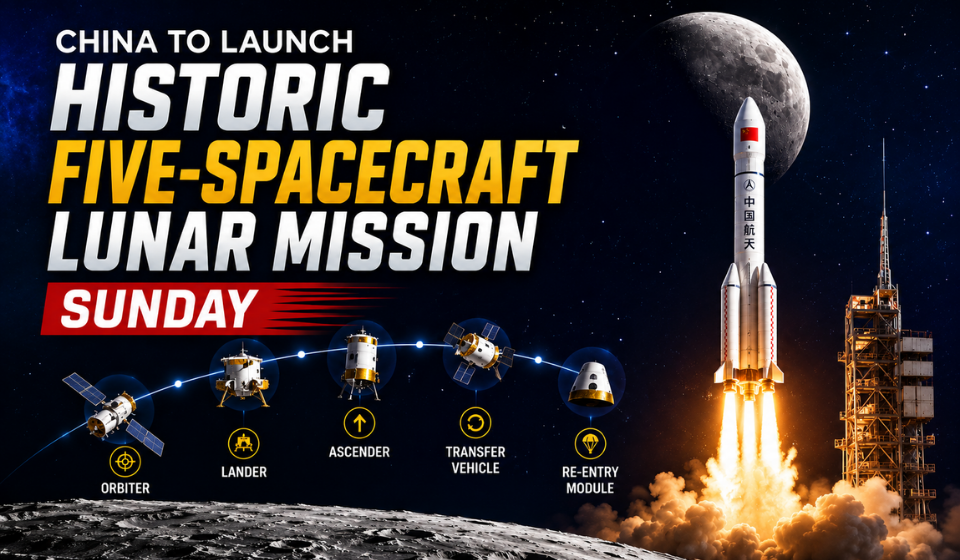
Chang’e 7 combines several spacecraft and exploration systems, including an orbiter, lander, rover and mini-hopping probe.
After reaching lunar orbit, the lander is planned to descend near the illuminated rim of Shackleton Crater close to the Moon’s south pole.
The mission’s different components are designed to examine the region from multiple locations and perspectives.
One of the most unusual elements is the hopping probe. It is intended to move between illuminated areas and permanently shadowed craters, where scientists believe water ice could potentially exist.
The mission will use multiple methods to investigate the lunar surface and subsurface environment rather than relying on a single instrument or exploration technique.
Searching for Water Ice
Water ice is one of the key scientific targets of the Chang’e 7 mission.
Permanently shadowed areas near the lunar poles receive little or no direct sunlight and can remain extremely cold. Scientists have identified these regions as important locations for studying possible deposits of water ice.
Finding and characterizing lunar water could be significant for future exploration because water can potentially provide scientific information about the Moon’s history and, in the longer term, may have applications in supporting human exploration.
Chang’e 7 will therefore provide an opportunity to study one of the most scientifically interesting regions of the Moon in greater detail.
International Contributions
The mission also includes scientific instruments and equipment contributed by several countries and organizations.
The spacecraft carries a Russian dust-detection instrument, an Italian laser retroreflector, a Thai-Chinese cosmic-ray detector and a Swiss Earth-radiation spectrometer.
A camera jointly developed by the space agencies of Bahrain and Egypt is also included.
In addition, a compact wide-field optical telescope developed by the International Lunar Observatory Association and the University of Hong Kong is expected to attempt astronomical observations from the lunar surface.
These contributions make Chang’e 7 an internationally supported scientific mission despite being led by China.
Part of China’s Longer Lunar Programme
Chang’e 7 is planned as the first of two robotic precursor missions supporting China’s proposed International Lunar Research Station.
The next mission, Chang’e 8, is planned for around 2028. Together, the missions are intended to investigate technologies and environments relevant to China’s longer-term lunar exploration plans.
China has also stated its goal of achieving a crewed lunar landing by 2030.
Chang’e 7 is therefore part of a broader sequence of robotic missions rather than an isolated lunar expedition.
Key Details
| Category | Details |
| Mission | Chang’e 7 |
| Country | China |
| Launch site | Wenchang Space Launch Site |
| Rocket | Long March 5 |
| Target region | Moon’s south pole |
| Landing area | Near Shackleton Crater |
| Main objective | Investigate potential water ice |
| Components | Orbiter, lander, rover and mini-hopping probe |
| Reported launch window | August 24, 2026 |
| Follow-up mission | Chang’e 8, planned around 2028 |
FAQs
What is the Chang’e 7 mission?
Chang’e 7 is a Chinese robotic lunar mission designed to investigate the Moon’s south polar region and search for potential water ice.
Why is the Moon’s south pole important?
The lunar south pole contains permanently shadowed regions that can remain extremely cold. These areas are considered important locations for investigating possible water-ice deposits.
What spacecraft are included in Chang’e 7?
The mission includes an orbiter, lander, rover and mini-hopping probe, giving it multiple ways to investigate the lunar environment.
When is Chang’e 7 scheduled to launch?
The launch window is reported to open at 0000 UTC on August 24, 2026.
Is Chang’e 7 part of a larger programme?
Yes. Chang’e 7 and the planned Chang’e 8 mission are intended to serve as robotic precursor missions supporting China’s proposed International Lunar Research Station.
Conclusion
The Chang’e 7 mission represents a major step in China’s continuing lunar exploration programme. Its combination of an orbiter, lander, rover and hopping probe is designed to investigate the Moon’s south pole using multiple approaches, with water ice among the mission’s central scientific targets.
With international scientific contributions and a planned follow-up through Chang’e 8, the mission also forms part of China’s broader plans for lunar exploration. If the August 24 launch proceeds as scheduled, Chang’e 7 will begin a detailed investigation of one of the Moon’s most challenging and scientifically significant regions.