


Table of Contents
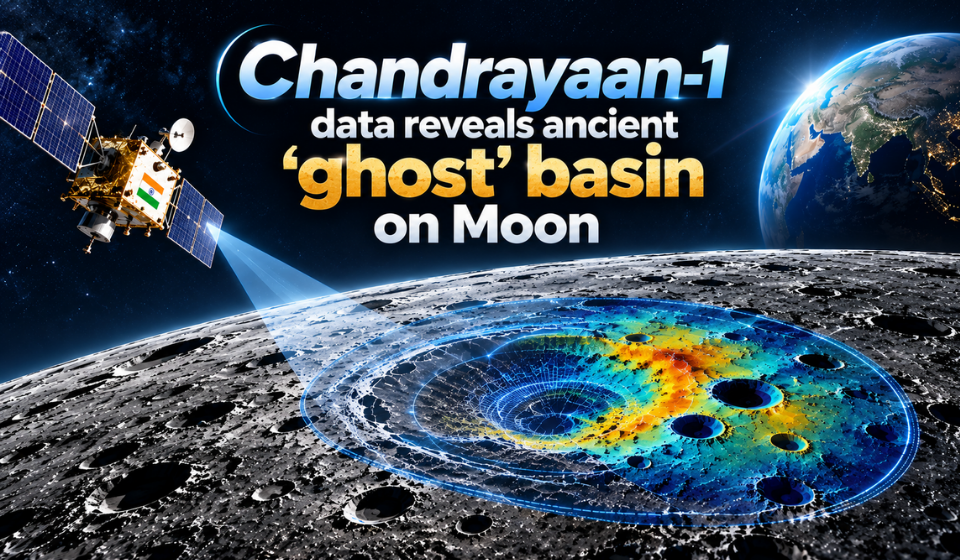
Data from India’s Chandrayaan-1 mission has helped researchers identify mineralogical evidence supporting the presence of a previously obscured impact basin on the Moon.
Scientists from the Physical Research Laboratory (PRL) in Ahmedabad analysed data from NASA’s Moon Mineralogy Mapper (M³) instrument aboard Chandrayaan-1 and identified a distinctive mineralogical pattern around Mare Australe. The findings support the presence of an ancient structure known as the Australe Basin, whose original surface features have been heavily obscured over billions of years.
The study was published in The Planetary Science Journal in August 2026. It suggests that the basin could be extremely ancient and potentially predate the South Pole–Aitken Basin, although its exact age has not been directly established.
Chandrayaan-1 Data Reveal a Hidden Lunar Structure
The Australe Basin is difficult to identify using conventional observations because its original surface expression has been altered by subsequent impacts, volcanic activity and other geological processes.
Instead of relying only on a visible crater rim, the researchers examined the mineral composition of the lunar surface.
A particularly important clue was a circular distribution of orthopyroxene around Mare Australe. The researchers interpret this mineralogical pattern as evidence of material excavated during a large ancient impact.
This approach allowed the team to investigate a basin whose original topographic and gravity signatures are difficult to distinguish today.
| Finding | Significance |
| Chandrayaan-1 M³ data | Provided mineralogical observations |
| Orthopyroxene distribution | Supports the presence of an ancient basin |
| 248 basalt patches | Form a distinctive circular distribution |
| Unusual basalt composition | Adds evidence about the region’s geological history |
| Australe Basin | Ancient, heavily obscured impact structure |
| South Pole–Aitken Basin | Benchmark for comparison of lunar basin ages |
Unusual Basalt Deposits Add More Evidence
The Australe region contains another unusual geological feature: 248 small basalt ponds or patches arranged in a circular pattern.
Rather than forming extensive, continuous mare plains found in some other lunar basins, these volcanic deposits occur as smaller, separated features.
The researchers also found distinctive mineralogical characteristics in the basalts, including relatively low-calcium pyroxenes and higher magnesium characteristics. These differences provide additional information about the geological processes that shaped the region.
Could Australe Be Older Than South Pole–Aitken?
One of the most significant implications of the research is the possibility that the Australe Basin could predate the South Pole–Aitken (SPA) Basin.
The South Pole–Aitken Basin is generally regarded as the Moon’s oldest recognised major impact basin and formed more than four billion years ago.
The PRL researchers suggest that Australe may have formed even earlier. The mineralogical evidence and the lack of widespread pure anorthosite deposits associated with some younger large basins are among the observations considered in this interpretation.
However, the study does not establish a precise numerical age for the Australe Basin. Therefore, it is more accurate to describe it as potentially older than South Pole–Aitken rather than definitively the Moon’s oldest impact basin.
Evidence Points to Multiple Ancient Impacts
The researchers also discuss evidence for another major impact structure in the region.
An approximately 880-kilometre-wide Australe North Basin had previously been identified through lunar observations. The relationship between this structure and the newly investigated Australe Basin could indicate that the region experienced more than one enormous impact.
A later impact may have disrupted and further obscured the earlier basin, making its original structure difficult to recognise.
This possible sequence is one reason mineralogical information is valuable when scientists reconstruct the Moon’s ancient geological history.
How Chandrayaan-1 Made the Research Possible
Chandrayaan-1 was India’s first lunar mission and operated around the Moon from 2008 to 2009.
One of its instruments was NASA’s Moon Mineralogy Mapper, an imaging spectrometer designed to study the mineral composition of the lunar surface.
The new research demonstrates the continuing scientific value of Chandrayaan-1’s archived observations. Nearly two decades after the spacecraft’s mission, researchers are using its datasets to investigate geological questions that cannot be answered through surface imagery alone.
PRL’s planetary remote-sensing researchers continue to study the Moon using data from Chandrayaan-1, Chandrayaan-2, Chandrayaan-3 and international lunar missions.
Why the Australe Basin Matters
The findings provide another piece of evidence about the Moon’s earliest geological history.
Large impacts played an important role in shaping the young Moon, but many ancient impact structures have been modified or obscured by later impacts, volcanic activity and other geological processes.
The Australe Basin demonstrates how mineralogical fingerprints can preserve evidence of ancient geological events even when a basin’s original surface structure is difficult to identify.
The findings could also provide useful geological context for future lunar exploration. However, it would be premature to claim that the study directly determines the landing sites or objectives of specific future missions.
FAQ
What did Chandrayaan-1 help researchers discover?
Chandrayaan-1 data helped researchers identify mineralogical evidence supporting the presence of the ancient Australe Basin on the Moon.
What is the Australe Basin?
The Australe Basin is an ancient, heavily obscured lunar impact structure associated with the Mare Australe region in the Moon’s southeastern hemisphere.
How was the Australe Basin identified?
Researchers analysed mineralogical observations from NASA’s Moon Mineralogy Mapper aboard Chandrayaan-1. A circular distribution of orthopyroxene around Mare Australe provided an important clue supporting the presence of the ancient basin.
Is the Australe Basin the oldest impact basin on the Moon?
It may be older than the South Pole–Aitken Basin, according to the researchers’ interpretation. However, its exact age has not been directly established, so it should not yet be described as definitively the oldest lunar impact basin.
Why is this Chandrayaan-1 finding important?
The research shows how archived Chandrayaan-1 data can reveal evidence of ancient lunar structures that are difficult to identify from surface features alone. It also provides new clues about the Moon’s early geological history.
Conclusion
The latest research shows how Chandrayaan-1 continues to contribute to lunar science nearly two decades after its mission.
Using mineralogical observations from NASA’s Moon Mineralogy Mapper, PRL researchers found evidence supporting the presence of the heavily obscured Australe Basin near Mare Australe. Its unusual mineral signatures and circular distribution of basalt deposits provide clues about an extremely ancient impact event.
The possibility that Australe could predate the South Pole–Aitken Basin makes the finding particularly significant, but its exact age remains uncertain. The study should therefore be viewed as evidence for a previously obscured ancient basin, rather than definitive proof that it is the Moon’s oldest impact structure.
More broadly, the research demonstrates how archived Chandrayaan-1 data can continue to reveal previously hidden aspects of the Moon’s geological history. As lunar exploration expands, mineralogical studies like this could help scientists build a more complete picture of the Moon’s earliest evolution.