


Table of Contents
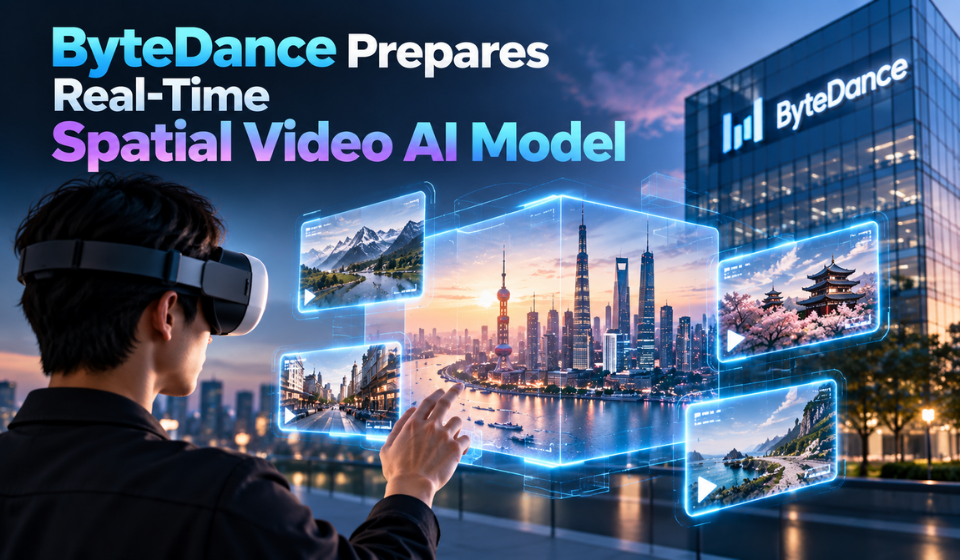
ByteDance is reportedly developing a new artificial intelligence model designed to generate interactive virtual environments in real time, with founder Zhang Yiming personally overseeing the project. Bloomberg reported that the model could launch as early as October, although the timing has not been finalized and the plans could change.
The project would expand ByteDance AI beyond conventional video generation and into the emerging field of world models. According to current reporting, the system is being developed using ByteDance’s Seedance technology and could support applications including games, live streams and short-form dramas.
ByteDance AI Targets Real-Time Virtual Worlds
The reported system is designed to generate environments that can respond to user input rather than simply produce predetermined video clips.
People familiar with the project told Bloomberg that the model is being designed to generate spatial video at roughly 20 frames per second, with latency of around 0.05 seconds. The processing would reportedly take place in the cloud rather than entirely on the user’s device. These figures should be treated as reported development specifications rather than independently verified performance figures.
| Key development | Reported details |
| Project | Real-time spatial video/world model |
| Development lead | Zhang Yiming |
| Technology foundation | Seedance |
| Reported output | About 20 frames per second |
| Reported latency | About 0.05 seconds |
| Processing | Cloud-based |
| Potential uses | Games, live streams and dramas |
| Potential hardware connection | Pico VR headsets |
| Possible launch | As early as October 2026 |
Built on Seedance
The reported world model builds on ByteDance’s existing investment in AI-generated video.
Seedance is ByteDance’s video-generation technology, giving the company an existing foundation for developing more interactive visual experiences. The reported new system would take that technology in a different direction by attempting to create environments that users can interact with dynamically.
Rather than generating a finished video for passive viewing, a world model is designed to maintain an environment that responds to actions and other inputs. This makes the technology potentially relevant to interactive entertainment and spatial computing.
Zhang Yiming Takes a Direct Role
Zhang Yiming’s reported involvement is one of the notable aspects of the project.
According to people familiar with the development cited by Bloomberg, the ByteDance founder has been coordinating work across business units and directing AI resources and computing capacity toward the project. Bloomberg’s report describes the effort as part of ByteDance’s push into world-model technology.
The development also comes as ByteDance expands its broader AI infrastructure. Reuters reported that the company secured a $29.6 billion three-year unsecured loan from nearly 30 banks. The financing is officially for general corporate purposes, while sources told Reuters that much of it is intended for AI-related investments, including AI chips and data-centre infrastructure.
The financing should not be interpreted as funding specifically allocated to the reported world-model project.
Cloud Processing Could Support Pico
The reported model could also have implications for ByteDance’s Pico virtual-reality business.
Instead of requiring the headset to perform all of the computationally intensive work locally, the system would reportedly generate the virtual environment in the cloud. This could potentially reduce the processing requirements of compatible hardware.
However, cloud rendering would also create significant requirements for network speed, reliability and low latency. The reported 0.05-second target therefore represents an important technical challenge rather than a proven commercial capability.
Current reporting suggests the model could generate environments that respond to users’ voices and movements through Pico hardware.
ByteDance Enters the World-Model Competition
The development places ByteDance AI into the growing competition around world models and spatial computing.
Meta and Alphabet are also developing technologies related to AI-generated environments and systems designed to understand or simulate aspects of the physical world. ByteDance’s reported approach is particularly connected to real-time visual generation and its existing entertainment and VR ecosystem.
World models have potential applications beyond entertainment, including robotics, autonomous systems and simulation. However, there is currently no indication that this particular ByteDance project is being developed as a confirmed robotics or autonomous-driving product.
Why Cloud-Rendered AI Matters
Moving AI processing from a device to the cloud could change the economics of spatial computing.
High-performance VR devices need considerable computing power to render complex environments. If some of that work can instead be performed remotely, manufacturers could potentially reduce local hardware requirements.
The trade-off is infrastructure. Real-time interactive environments need fast communication between the user and the cloud. Even small delays can affect the quality of an immersive experience, making latency and network reliability important factors in the technology’s success.
For ByteDance, the approach could also allow its AI models and content ecosystem to become more important than raw headset specifications.
Launch Date Remains Uncertain
The reported model could be launched as early as October 2026, but ByteDance has not publicly confirmed a launch date.
Bloomberg’s sources cautioned that the timing has not been finalized and that plans could change. The reported technical specifications should similarly be viewed as development targets or information from people familiar with the project, rather than confirmed specifications for a finished commercial product.
What It Means for ByteDance AI
The reported project demonstrates how ByteDance AI is moving beyond content-generation tools toward systems designed to create interactive environments.
Its combination of Seedance, cloud computing and Pico hardware could give ByteDance a distinctive route into spatial AI if the technology reaches commercial release. At the same time, the company will need to overcome demanding technical challenges around latency, computing costs, network performance and consistent real-time generation.
Conclusion
ByteDance’s reported world-model project marks an important new direction for the company’s AI strategy. With Zhang Yiming reportedly overseeing development, the company is exploring how Seedance’s video-generation capabilities can be extended into interactive virtual environments.
The possible October launch remains unconfirmed, and the reported performance specifications have yet to be demonstrated publicly. Nevertheless, the project could give ByteDance AI a stronger presence in the emerging market for real-time world models and spatial computing.
As development continues, the key question will be whether ByteDance can turn its reported cloud-based technology into a reliable, low-latency experience that works at commercial scale.