


Table of Contents
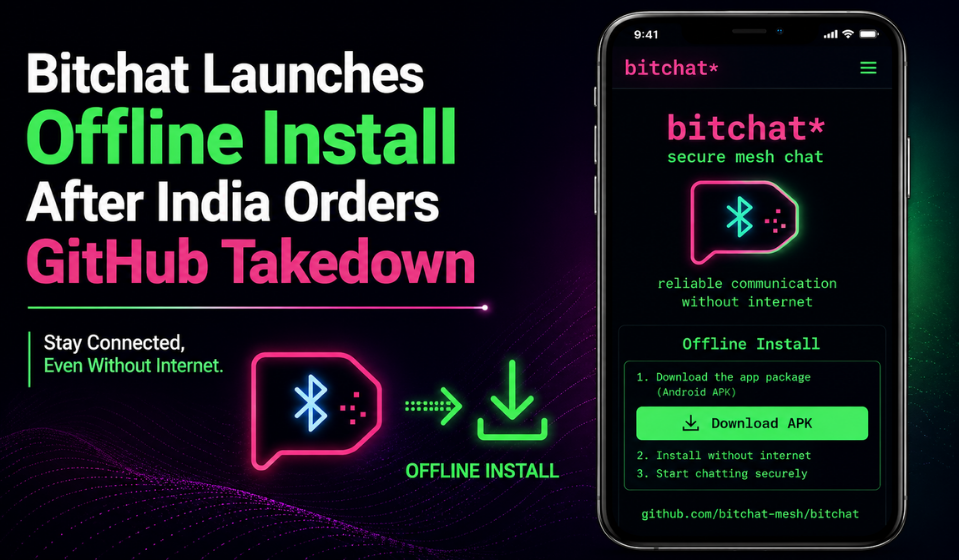
Jack Dorsey’s decentralized messaging application Bitchat has introduced a new feature that allows Android users to share and install the app directly between nearby devices without requiring an internet connection. The latest Bitchat offline update lets users send the app’s APK file directly to nearby Android devices using Bluetooth or local Wi-Fi, enabling installation without relying on the Google Play Store or any other online download source.
The feature was announced shortly after GitHub restricted access in India to repositories hosting Bitchat’s source code following an order from the Indian government’s Cyber Crime Coordination Centre (I4C). By reducing reliance on online distribution platforms, the Bitchat offline update expands how the application can reach new users. The new Bitchat offline capability also reflects the platform’s continued focus on enabling decentralized communication and app distribution without depending on conventional online channels.
From Protest Tool to Wider Public Attention
Bitchat gained wider public attention during student protests in New Delhi, where reports indicated that some demonstrators used the Bluetooth-based messaging app after facing communication disruptions. Bloomberg also reported that the application had previously attracted attention during Nepal’s 2025 Gen Z protests.
Rather than relying on internet connections or centralized servers, Bitchat uses Bluetooth Low Energy (BLE) mesh networking to transmit encrypted messages directly between nearby devices, allowing communication even when mobile data or Wi-Fi is unavailable.
Offline Sharing Makes Distribution Easier
The biggest addition in the latest update is the ability to transfer the Bitchat APK directly from one Android device to another.
A user who already has the application installed can now send the APK file to a nearby Android device using Bluetooth or local Wi-Fi. The recipient can then install the app without downloading it from GitHub, the Google Play Store, or any other online platform.
Previously, users generally obtained the APK from GitHub or another internet-based source. An earlier offline file-sharing capability introduced on 24 July had already begun reducing reliance on online repositories. The feature announced on 30 July further enhances Bitchat offline functionality by making direct device-to-device installation faster and more accessible.
As more users install the application, each Android device can also act as another distribution point, allowing the installation file to be shared with additional nearby users. This approach enables the Bitchat offline ecosystem to grow through its existing user base without depending entirely on online hosting services.
GitHub Repository Restrictions
On 24 July, India’s Cyber Crime Coordination Centre (I4C), operating under the Ministry of Home Affairs, directed GitHub to disable access to three repositories hosting Bitchat’s source code under Section 79(3)(b) of the Information Technology Act.
According to the order, the application’s decentralized architecture could significantly impede lawful interception, attribution, and investigations by law enforcement agencies.
Following the action, Jack Dorsey wrote on X that the Indian government did not support technologies like Bitchat and wanted the project taken down. Reports also noted that the restrictions came during a period of student demonstrations in India, when the application had gained wider public attention.
Ongoing Debate Around Privacy and Regulation
The GitHub restrictions have prompted wider discussion about privacy-focused communication technologies and government oversight.
The Internet Freedom Foundation criticised the blocking order, describing it as unconstitutional and authoritarian. Meanwhile, the I4C stated that decentralized communication platforms could potentially be exploited for coordinating unlawful assemblies, spreading misinformation, criminal conspiracies, radicalisation, and other activities that may affect public order and national security.
These differing perspectives highlight the broader debate over balancing encrypted communication technologies, user privacy, and the requirements of law enforcement agencies.
Key Highlights
| Feature | Details |
|---|---|
| Application | Bitchat |
| Developer | Jack Dorsey |
| Latest Update | Offline APK sharing between Android devices |
| Transfer Methods | Bluetooth and local Wi-Fi |
| Internet Required | No |
| Messaging Technology | Bluetooth Low Energy (BLE) mesh networking |
| User Accounts Required | No |
| Repository Action | GitHub access restricted in India for selected repositories |
| Government Authority | Cyber Crime Coordination Centre (I4C) |
| Purpose of Update | Reduce reliance on online app distribution platforms |
Why This Matters
The Bitchat offline update demonstrates how decentralized applications are evolving beyond traditional app stores and online repositories. By allowing users to exchange installation files directly between nearby devices, the platform improves accessibility in situations where internet connectivity or access to online distribution platforms is limited.
As interest in decentralized messaging grows, Bitchat offline showcases how alternative app distribution methods can improve accessibility while reducing dependence on centralized platforms.
At the same time, the development highlights the continuing discussion around encrypted communication, digital privacy, and the challenges governments face in balancing security requirements with evolving decentralized technologies.
Conclusion
The latest Bitchat offline update significantly expands the application’s decentralized distribution model by allowing Android users to install and share the app without an internet connection. As Bitchat offline capabilities continue to evolve alongside recent GitHub repository restrictions in India, the platform demonstrates how decentralized applications can reduce dependence on traditional online distribution channels while maintaining accessibility. Discussions around encryption, user privacy, accessibility, and regulatory oversight are expected to remain central to the future development of such technologies.