


Table of Contents
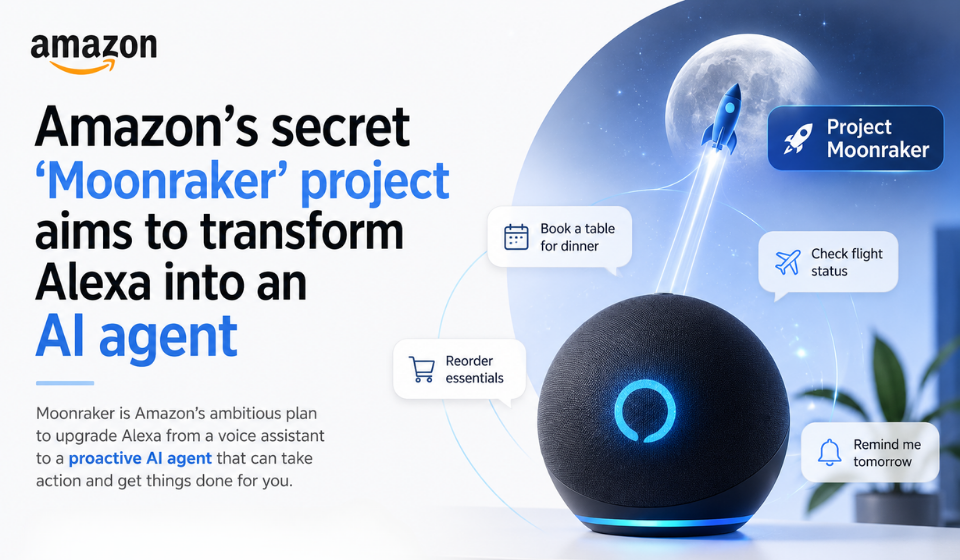
Amazon is reportedly developing an internal project known as Moonraker, an initiative designed to evolve Alexa from a voice assistant into a more capable AI agent. Rather than simply responding to individual questions or commands, the upgraded assistant is expected to understand broader requests and complete multiple connected tasks within a single interaction.
For example, instead of asking Alexa to perform one action at a time, users could issue a single request such as booking a ride, sending a message to a contact, and setting a reminder. The system would then coordinate these actions automatically, reducing the need for repeated commands and creating a more natural conversational experience.
Reports indicate that Moonraker is being developed as part of Amazon’s broader Alexa+ strategy. However, building such advanced AI capabilities comes with significant infrastructure demands, with internal planning documents reportedly projecting substantial investments in computing resources to support the technology.
Key Highlights
The reported Moonraker project could introduce several improvements:
- Enable Alexa to complete multiple related tasks from a single request.
- Expand Alexa’s role from a voice assistant to an AI-powered agent.
- Improve conversational interactions with more natural workflows.
- Automate complex task sequences across supported services.
- Strengthen Amazon’s position in the growing AI assistant market.
Alexa Today vs. Moonraker’s Reported Vision
| Feature | Current Alexa+ | Moonraker (Reported) |
| Task Handling | Primarily individual requests | Multiple connected tasks in one interaction |
| User Interaction | Command-by-command | Goal-oriented conversations |
| Workflow | Limited automation | AI-driven task orchestration |
| Intelligence | Conversational assistance | Agentic decision-making and execution |
| Primary Focus | Responding to requests | Completing end-to-end actions |
Why This Development Matters
The AI industry is rapidly moving toward agentic AI—systems that can plan, reason, and carry out a sequence of actions instead of simply answering questions. Companies such as Amazon, OpenAI, Google, and Anthropic are all investing heavily in assistants capable of handling real-world tasks with minimal user intervention.
If Moonraker becomes part of Alexa’s future, it could significantly expand what smart assistants are able to accomplish in everyday life. From managing schedules and coordinating travel plans to controlling smart home devices and interacting with third-party services, AI assistants may become increasingly proactive rather than reactive.
At the same time, developing these capabilities presents technical and financial challenges. Advanced reasoning models require substantial computing power, and reports suggest that infrastructure costs remain one of the biggest hurdles as Amazon works to enhance Alexa’s intelligence.
Key Takeaways
- Amazon is reportedly developing an AI initiative called Moonraker.
- The project aims to transform Alexa into a more capable AI agent.
- Users may eventually complete multiple tasks through a single voice request.
- Moonraker is expected to build upon Amazon’s existing Alexa+ platform.
- The project reportedly requires significant investment in AI computing infrastructure.
Final Thoughts
Moonraker signals Amazon’s reported ambition to redefine what voice assistants can do. By moving beyond simple command-response interactions toward intelligent task execution, Alexa could become a more capable digital assistant for both personal and professional use. Although Amazon has not officially announced the project, the reports suggest the company is investing heavily in the next generation of AI-powered assistants, where completing tasks—not just answering questions—will be the defining capability.